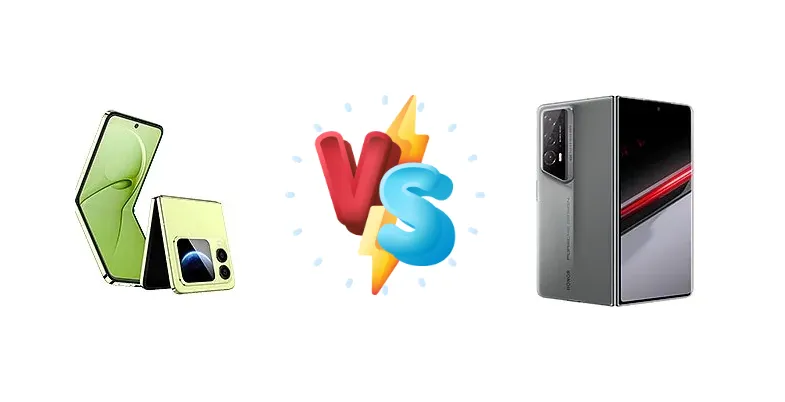
The foldable phone market is heating up, with both Huawei and Honor offering compelling options. The Huawei nova Flip S aims for accessible style, while the Honor Magic V2 RSR Porsche Design represents a no-compromise, luxury foldable experience. This comparison dissects the core differences – from chipset architecture to charging speeds – to determine which device best suits your needs and budget.
🏆 Quick Verdict
For the average user prioritizing raw performance and a premium experience, the Honor Magic V2 RSR Porsche Design is the clear winner. Its Snapdragon 8 Gen 2 chipset delivers significantly more processing power and efficiency. However, the Huawei nova Flip S offers a compelling alternative for those seeking a stylish foldable at a potentially lower price point.
| Network |
|---|
| 2G bands | GSM 850 / 900 / 1800 / 1900 | GSM 850 / 900 / 1800 / 1900 |
| 3G bands | HSDPA 800 / 850 / 900 / 1700(AWS) / 1900 / 2100 | HSDPA 800 / 850 / 900 / 1700(AWS) / 1900 / 2100 |
| 4G bands | LTE | 1, 2, 3, 4, 5, 7, 8, 12, 17, 18, 19, 20, 26, 28, 34, 38, 39, 40, 41, 66 |
| 5G bands | SA/NSA | 1, 3, 5, 8, 28, 38, 41, 77, 78 SA/NSA |
| Speed | HSPA, LTE | HSPA, LTE, 5G |
| Technology | GSM / CDMA / HSPA / CDMA2000 / LTE / 5G | GSM / CDMA / HSPA / CDMA2000 / LTE / 5G |
| Launch |
|---|
| Announced | 2025, October 17 | 2024, January 11 |
| Status | Available. Released 2025, October 25 | Available. Released 2024, January 12 |
| Body |
|---|
| Build | Aluminum alloy frame, glass back or silicone polymer (eco leather) back | Glass front, glass back, magnesium alloy frame, titanium alloy folding mechanism |
| Dimensions | Unfolded: 169.8 x 75.4 x 6.9 mmFolded: 87.8 x 75.4 x 15.1 mm | Unfolded: 156.7 x 145.4 x 4.7 mm or 4.8 mmFolded: 156.7 x 74 x 9.9 mm or 10.1 mm |
| SIM | Nano-SIM + Nano-SIM | · Nano-SIM + eSIM· Nano-SIM + Nano-SIM |
| Weight | 195 g or 199 g (6.88 oz) | 234 g (8.25 oz) |
| Display |
|---|
| Resolution | 1136 x 2690 pixels (~421 ppi density) | 2156 x 2344 pixels (~402 ppi density) |
| Size | 6.94 inches, 111.4 cm2 (~87.0% screen-to-body ratio) | 7.92 inches, 201.6 cm2 (~88.5% screen-to-body ratio) |
| Type | Foldable LTPO OLED, 120Hz, HDR | Foldable LTPO OLED, 1B colors, 120Hz, HDR10+, 1600 nits (peak) |
| Platform |
|---|
| CPU | Octa-core | Octa-core (1x3.36 GHz Cortex-X3 & 2x2.8 GHz Cortex-A715 & 2x2.8 GHz Cortex-A710 & 3x2.0 GHz Cortex-A510) |
| Chipset | Kirin 8030 | Qualcomm SM8550-AC Snapdragon 8 Gen 2 (4 nm) |
| GPU | - | Adreno 740 |
| OS | HarmonyOS 5.1 | Android 13, upgradable to Android 14, MagicOS 8 |
| Memory |
|---|
| Card slot | No | No |
| Internal | 256GB 12GB RAM, 512GB 12GB RAM | 1TB 16GB RAM |
| Main Camera |
|---|
| Dual | 50 MP, f/1.9, 23mm (wide), 1/1.56", PDAF, OIS
8 MP, f/2.2, 112˚ (ultrawide) | - |
| Features | Laser AF, color spectrum sensor, LED flash, HDR, panorama | Multi-zone Laser AF (8x8 dToF), color spectrum sensor, LED flash, HDR, panorama |
| Triple | - | 50 MP, f/1.9, (wide), PDAF, OIS
20 MP, f/2.4, 62mm (telephoto), PDAF, 2.5x optical zoom, OIS
50 MP, f/2.0, 13mm (ultrawide), AF |
| Video | 4K, 1080p, gyro-EIS | 4K@30/60fps (10-bit), 1080p@30/60fps, gyro-EIS, HDR10+, OIS |
| Selfie camera |
|---|
| Features | HDR, panorama | HDR |
| Single | 32 MP, f/2.2, 21mm (ultrawide) | 16 MP, f/2.2, (wide) |
| Video | 4K, 1080p | 4K@30fps, 1080p@30fps, gyro-EIS |
| Sound |
|---|
| 35mm jack | No | No |
| Loudspeaker | Yes, with stereo speakers | Yes, with stereo speakers |
| Comms |
|---|
| Bluetooth | 5.2, A2DP, LE, L2HC | 5.3, A2DP, LE, aptX HD |
| Infrared port | - | Yes |
| NFC | Yes | Yes |
| Positioning | GPS (L1+L5), GLONASS (L1), BDS (B1I+B1c+B2a+B2b), GALILEO (E1+E5a+E5b), QZSS (L1+L5), NavIC | GPS (L1+L5), GLONASS (L1), BDS (B1I+B1c+B2a), GALILEO (E1+E5a), QZSS (L1+L5) |
| Radio | No | No |
| USB | USB Type-C 2.0, OTG | USB Type-C 3.1, OTG, Display Port 1.2 |
| WLAN | Wi-Fi 802.11 a/b/g/n/ac/6, dual-band, Wi-Fi Direct | Wi-Fi 802.11 a/b/g/n/ac/6e/7, dual-band, Wi-Fi Direct |
| Features |
|---|
| Sensors | Fingerprint (side-mounted), accelerometer, gyro, compass | Fingerprint (side-mounted), accelerometer, gyro, proximity, compass |
| Battery |
|---|
| Charging | 66W wired, 100% in 40 min
5W reverse wired | 66W wired
5W reverse wired |
| Type | Li-Po 4400 mAh | Si/C Li-Ion 5000 mAh |
| Misc |
|---|
| Colors | Green, Pink, White, Black, Nova Black, Blue | Agate Gray |
| Models | PSD-AL80 | VER-AN10 |
| Price | About 410 EUR | About 2700 EUR |
Huawei nova Flip S
- Potentially more affordable price point
- Stylish and compact foldable design
- 66W fast charging
- Kirin 8030 chipset offers lower performance than Snapdragon 8 Gen 2
- Likely less advanced camera system
- Potentially less refined display technology
Honor Magic V2 RSR Porsche Design
- Snapdragon 8 Gen 2 delivers flagship-level performance
- Premium Porsche Design aesthetic
- Likely superior camera system and display technology
- Significantly higher price
- Larger and heavier than the nova Flip S
- May not be ideal for users prioritizing portability above all else
Display Comparison
While specific display specs (resolution, refresh rate) are missing, both devices are foldables. The Honor Magic V2 RSR likely benefits from a more advanced panel due to its higher price point, potentially featuring a higher peak brightness and more sophisticated LTPO technology for variable refresh rates, optimizing battery life. The nova Flip S, targeting a more budget-conscious segment, may utilize a slightly less advanced panel, but still aims for a vibrant and immersive viewing experience. Bezels are a key differentiator in foldables, and the Porsche Design model likely minimizes these for a more premium look.
Camera Comparison
Without detailed camera specs, it’s difficult to make a definitive judgment. However, given the price difference, the Honor Magic V2 RSR Porsche Design likely features a more sophisticated camera system with larger sensors and improved image processing. Larger sensors capture more light, resulting in better low-light performance and dynamic range. Optical Image Stabilization (OIS) is also expected on the Honor, further enhancing image quality. The Huawei nova Flip S will likely focus on providing a capable camera for social media and casual photography, but may lack the advanced features and image quality of the Honor.
Performance
The core performance difference lies in the chipsets. The Honor Magic V2 RSR boasts the Qualcomm Snapdragon 8 Gen 2 (4nm), a powerhouse with a Cortex-X3 prime core clocked at 3.36 GHz. This architecture provides a substantial performance advantage over the Huawei nova Flip S’s Kirin 8030. The Snapdragon 8 Gen 2’s 4nm process node translates to superior thermal efficiency, reducing throttling during sustained workloads like gaming. While both are octa-core CPUs, the Snapdragon’s core configuration (1x Cortex-X3, 2x Cortex-A715, 2x Cortex-A710, 3x Cortex-A510) is optimized for both peak performance and power efficiency. The Kirin 8030, while capable, will likely fall behind in demanding tasks. The Honor also benefits from likely faster LPDDR5x RAM.
Battery Life
Both devices offer 66W wired charging, promising a full charge in approximately 40 minutes. The actual battery capacity is unknown for both, but the Snapdragon 8 Gen 2’s superior efficiency in the Honor Magic V2 RSR could translate to longer real-world battery life despite potentially similar battery sizes. Both also offer 5W reverse wired charging, useful for topping up accessories.
Buying Guide
Buy the Huawei nova Flip S if you need a fashionable, compact foldable with decent performance for everyday tasks and social media. It’s ideal for users who value aesthetics and portability over absolute power. Buy the Honor Magic V2 RSR Porsche Design if you prefer a flagship-level foldable with uncompromising performance for demanding applications like gaming, video editing, and multitasking, and are willing to pay a premium for the Porsche Design aesthetic and top-tier specs.
Frequently Asked Questions
❓ Is the Kirin 8030 in the Huawei nova Flip S capable of handling demanding games like Genshin Impact?
While the Kirin 8030 is a capable chipset, it will likely struggle to maintain high frame rates in graphically intensive games like Genshin Impact, especially at higher settings. Expect some frame drops and potential throttling during extended gaming sessions. The Snapdragon 8 Gen 2 in the Honor Magic V2 RSR Porsche Design is far better suited for demanding games.
❓ Does the Honor Magic V2 RSR Porsche Design support high refresh rate gaming, like 120Hz or higher?
Given the Snapdragon 8 Gen 2's capabilities and the phone's premium positioning, it's highly likely the Honor Magic V2 RSR Porsche Design supports high refresh rate gaming, potentially up to 120Hz or even 144Hz, depending on the game and display settings. This results in smoother and more responsive gameplay.
❓ How does the software experience differ between the Huawei nova Flip S and the Honor Magic V2 RSR Porsche Design?
The Huawei nova Flip S runs on EMUI, while the Honor Magic V2 RSR Porsche Design runs on MagicOS. Both are based on Android, but EMUI has historically faced limitations due to US trade restrictions, potentially impacting access to Google Mobile Services. MagicOS, being a separate entity from Huawei, generally offers full Google Mobile Services support and a more streamlined Android experience.
❓ What are the implications of the different chipsets for long-term software support?
Qualcomm typically provides longer chipset support cycles than Huawei's Kirin chips. This means the Honor Magic V2 RSR Porsche Design is likely to receive more frequent software updates and security patches over a longer period, enhancing its longevity.