
Huawei nova 9 vs Samsung Galaxy A52s 5G: A Detailed Comparison
| Phones Images | |||||
|---|---|---|---|---|---|
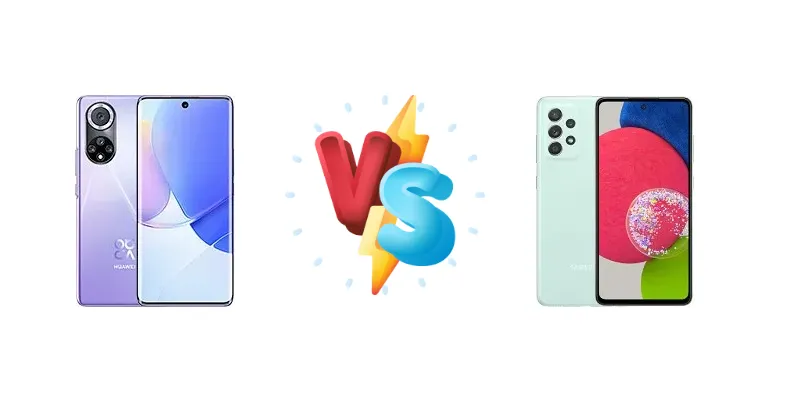
|
🏆 Quick Verdict
For most users, the Samsung Galaxy A52s 5G emerges as the stronger choice. Its superior battery endurance (113h vs 96h) and integrated 5G connectivity provide a more versatile and future-proof experience, despite the nova 9’s faster charging.
| PHONES | ||
|---|---|---|
| Phone Names | Huawei nova 9 | Samsung Galaxy A52s 5G |
| Network | ||
|---|---|---|
| 2G bands | GSM 850 / 900 / 1800 / 1900 | GSM 850 / 900 / 1800 / 1900 |
| 3G bands | HSDPA 800 / 850 / 900 / 1700(AWS) / 1900 / 2100 | HSDPA 850 / 900 / 1700(AWS) / 1900 / 2100 |
| 4G bands | 1, 2, 3, 4, 5, 7, 8, 12, 17, 18, 19, 20, 26, 28, 34, 38, 39, 40, 41, 66 - Europe | 1, 2, 3, 4, 5, 7, 8, 12, 17, 20, 26, 28, 32, 38, 40, 41, 66 |
| 5G bands | - | 1, 3, 5, 7, 8, 20, 28, 38, 40, 41, 66, 78 SA/NSA/Sub6 |
| Speed | HSPA, LTE | HSPA 42.2/5.76 Mbps, LTE Cat18 1200/150 Mbps, 5G |
| Technology | GSM / CDMA / HSPA / LTE | GSM / HSPA / LTE / 5G |
| 1, 2, 3, 4, 5, 8, 18, 19, 26, 34, 38, 39, 40, 41 - China | - | |
| Launch | ||
|---|---|---|
| Announced | 2021, September 23 | 2021, August 17 |
| Status | Available. Released 2021, September 30 | Available. Released 2021, September 01 |
| Body | ||
|---|---|---|
| Build | - | Glass front (Gorilla Glass 5), plastic back |
| Dimensions | 160 x 73.7 x 7.8 mm (6.30 x 2.90 x 0.31 in) | 159.9 x 75.1 x 8.4 mm (6.30 x 2.96 x 0.33 in) |
| SIM | · Nano-SIM· Nano-SIM + Nano-SIM | · Nano-SIM· Nano-SIM + Nano-SIM |
| Weight | 175 g (6.17 oz) | 189 g (6.67 oz) |
| - | IP67 dust/water resistant (up to 1m for 30 min) | |
| Display | ||
|---|---|---|
| Protection | - | Corning Gorilla Glass 5 |
| Resolution | 1080 x 2340 pixels, 19.5:9 ratio (~392 ppi density) | 1080 x 2400 pixels, 20:9 ratio (~405 ppi density) |
| Size | 6.57 inches, 106.0 cm2 (~89.9% screen-to-body ratio) | 6.5 inches, 102.0 cm2 (~84.9% screen-to-body ratio) |
| Type | OLED, 1B colors, 120Hz, HDR10 | Super AMOLED, 120Hz, 800 nits (HBM) |
| Platform | ||
|---|---|---|
| CPU | Octa-core (4x2.4 GHz Kryo 670 & 4x1.8 GHz Kryo 670) | Octa-core (1x2.4 GHz Cortex-A78 & 3x2.2 GHz Cortex-A78 & 4x1.9 GHz Cortex-A55) |
| Chipset | Qualcomm SM7325 Snapdragon 778G 4G (6 nm) | Qualcomm SM7325 Snapdragon 778G 5G (6 nm) |
| GPU | Adreno 642L | Adreno 642L |
| OS | HarmonyOS 2.0 (China), EMUI 12 (Europe), no Google Play Services | Android 11, upgradable to Android 14, One UI 6 |
| Memory | ||
|---|---|---|
| Card slot | No | microSDXC (uses shared SIM slot) |
| Internal | 128GB 8GB RAM, 256GB 8GB RAM | 128GB 4GB RAM, 128GB 6GB RAM, 128GB 8GB RAM, 256GB 6GB RAM, 256GB 8GB RAM |
| UFS | - | |
| Main Camera | ||
|---|---|---|
| Features | LED flash, panorama, HDR | LED flash, panorama, HDR |
| Quad | 50 MP, f/1.9, 23mm (wide), PDAF 8 MP, f/2.2, (ultrawide) 2 MP (macro) Auxiliary lens | 64 MP, f/1.8, 26mm (wide), 1/1.7", 0.8µm, PDAF, OIS 12 MP, f/2.2, 123˚ (ultrawide), 1.12µm 5 MP (macro) Auxiliary lens |
| Single | 32 MP, f/2.0, (wide) | 32 MP, f/2.2, 26mm (wide), 1/2.8", 0.8µm |
| Video | 4K, 1080p, 720p@960fps, gyro-EIS | 4K@30fps, 1080p@30/60fps; gyro-EIS |
| Selfie camera | ||
|---|---|---|
| Features | HDR | HDR |
| Single | 32 MP, f/2.0, (wide) | 32 MP, f/2.2, 26mm (wide), 1/2.8", 0.8µm |
| Video | 4K@30fps, 1080p@30fps, 720p@240fps, gyro-EIS | 4K@30fps, 1080p@30/60fps |
| Sound | ||
|---|---|---|
| 3.5mm jack | No | Yes |
| 35mm jack | No | Yes |
| Loudspeaker | Yes | Yes, with stereo speakers |
| Comms | ||
|---|---|---|
| Bluetooth | 5.2, A2DP, LE | 5.0, A2DP, LE |
| NFC | Yes | Yes (market/region dependent) |
| Positioning | GPS (L1+L5), GLONASS (L1), BDS (B1I+B1c+B2a), GALILEO (E1+E5a), QZSS (L1+L5), NavIC (L5) | GPS, GLONASS, GALILEO, BDS, QZSS |
| Radio | No | No |
| USB | USB Type-C 2.0, OTG | USB Type-C 2.0, OTG |
| WLAN | Wi-Fi 802.11 a/b/g/n/a/6, dual-band, Wi-Fi Direct | Wi-Fi 802.11 a/b/g/n/ac/6, dual-band, Wi-Fi Direct |
| Features | ||
|---|---|---|
| Sensors | Fingerprint (under display, optical), accelerometer, gyro, proximity, compass | Fingerprint (under display, optical), accelerometer, gyro, compass |
| - | Virtual Proximity Sensing | |
| Battery | ||
|---|---|---|
| Charging | 66W wired, 60% in 18 min, 100% in 38 min Reverse wired | 25W wired |
| Type | Li-Po 4300 mAh | Li-Ion 4500 mAh |
| Misc | ||
|---|---|---|
| Colors | Starry Blue, Black, Green, Violet | Awesome Black, Awesome White, Awesome Purple, Awesome Mint |
| Models | NAM-AL00, NAM-LX9 | SM-A528B, SM-A528B/DS, SM-A528N |
| Price | About 120 EUR | £ 112.98 / € 249.47 |
| SAR | - | 0.72 W/kg (head) |
| SAR EU | - | 0.88 W/kg (head) 0.84 W/kg (body) |
| Tests | ||
|---|---|---|
| Battery life | Endurance rating 96h | Endurance rating 113h |
| Camera | Photo / Video | Photo / Video |
| Display | Contrast ratio: Infinite (nominal) | Contrast ratio: Infinite (nominal) |
| Loudspeaker | -27.3 LUFS (Good) | -27.5 LUFS (Good) |
| Performance | AnTuTu: 469798 (v9) GeekBench: 2973 (v5.1) GFXBench: 28fps (ES 3.1 onscreen) | AnTuTu: 429675 (v8), 506432(v9) GeekBench: 11060 (v4.4), 2801 (v5.1) GFXBench: 28fps (ES 3.1 onscreen) |
Huawei nova 9
- Significantly faster 66W charging
- Reverse wired charging capability
- Potentially more streamlined software experience (depending on user preference)
- Lacks 5G connectivity
- Shorter battery life (96h endurance)
- Lower display brightness
Samsung Galaxy A52s 5G
- Integrated 5G connectivity
- Longer battery life (113h endurance)
- Brighter display for outdoor visibility
- Slower 25W charging
- Potentially more software bloat (Samsung One UI)
- Less impressive charging speed
Display Comparison
Both phones feature an 'Infinite' contrast ratio, typical of OLED panels. However, the Samsung Galaxy A52s 5G boasts a significantly brighter display at 800 nits compared to the Huawei nova 9’s 608 nits. This translates to better visibility outdoors under direct sunlight. While both offer vibrant colors, the A52s 5G’s higher peak brightness provides a more comfortable viewing experience in various lighting conditions. The lack of information on refresh rates for both devices means we cannot compare smoothness.
Camera Comparison
Both phones are listed as having Photo/Video capabilities, but detailed camera specifications are absent. Without sensor size, aperture, or image processing details, a direct comparison is difficult. However, given Samsung’s established camera reputation and software optimization, the A52s 5G likely offers a more refined and consistent photography experience. The absence of details suggests neither phone features a standout camera system, focusing instead on all-around competence.
Performance
Both devices utilize the Qualcomm Snapdragon 778G, but with a crucial distinction: the A52s 5G features the 5G variant, while the nova 9 uses the 4G version. This means the A52s 5G has integrated 5G modem capabilities, offering faster data speeds where available. The A52s 5G’s CPU configuration (1x2.4 GHz Cortex-A78 & 3x2.2 GHz Cortex-A78 & 4x1.9 GHz Cortex-A55) also differs from the nova 9’s (4x2.4 GHz Kryo 670 & 4x1.8 GHz Kryo 670), potentially offering slightly better multi-core performance on the Samsung device. While both are 6nm chips, the 5G modem integration in the A52s 5G adds to its overall versatility.
Battery Life
The Samsung Galaxy A52s 5G excels in battery endurance, achieving a measured 113 hours compared to the Huawei nova 9’s 96 hours. While the nova 9 compensates with significantly faster 66W wired charging (60% in 18 minutes, 100% in 38 minutes) versus the A52s 5G’s 25W charging, the longer runtime of the Samsung device is more impactful for users who prioritize all-day battery life. The nova 9’s reverse wired charging is a useful addition, but doesn’t offset the A52s 5G’s superior stamina.
Buying Guide
Buy the Huawei nova 9 if you prioritize incredibly fast charging (66W) and don't rely heavily on 5G connectivity. It's ideal for users who frequently top up their phones and are comfortable with the Huawei ecosystem. Buy the Samsung Galaxy A52s 5G if you value longer battery life, seamless 5G access, and a more established software experience with Samsung's One UI.