
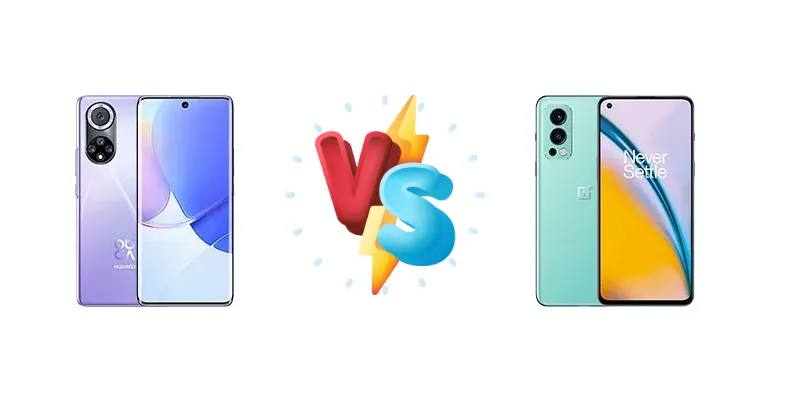
Huawei nova 9 vs OnePlus Nord 2 5G: A Detailed Comparison of Mid-Range Powerhouses
| Phones Images | |||||
|---|---|---|---|---|---|
|
🏆 Quick Verdict
For most users, the OnePlus Nord 2 5G is the better choice. While the Huawei nova 9 offers comparable charging speeds and a slightly brighter display, the Nord 2 5G’s Mediatek Dimensity 1200 chipset delivers noticeably superior performance, making it the more capable all-rounder.
| PHONES | ||
|---|---|---|
| Phone Names | Huawei nova 9 | OnePlus Nord 2 5G |
| Network | ||
|---|---|---|
| 2G bands | GSM 850 / 900 / 1800 / 1900 | GSM 850 / 900 / 1800 / 1900 |
| 3G bands | HSDPA 800 / 850 / 900 / 1700(AWS) / 1900 / 2100 | HSDPA 800 / 850 / 900 / 1700(AWS) / 1800 / 1900 / 2100 |
| 4G bands | 1, 2, 3, 4, 5, 7, 8, 12, 17, 18, 19, 20, 26, 28, 34, 38, 39, 40, 41, 66 - Europe | 1, 2, 3, 4, 5, 7, 8, 12, 17, 18, 19, 20, 26, 28, 32, 34, 38, 39, 40, 41, 66 - EU |
| 5G bands | - | 1, 3, 7, 8, 20, 28, 38, 41, 66, 78 SA/NSA - EU |
| Speed | HSPA, LTE | HSPA 42.2/5.76 Mbps, LTE Cat18 1200/150 Mbps, 5G |
| Technology | GSM / CDMA / HSPA / LTE | GSM / HSPA / LTE / 5G |
| 1, 2, 3, 4, 5, 8, 18, 19, 26, 34, 38, 39, 40, 41 - China | - | |
| Launch | ||
|---|---|---|
| Announced | 2021, September 23 | 2021, July 22 |
| Status | Available. Released 2021, September 30 | Available. Released 2021, July 28 |
| Body | ||
|---|---|---|
| Build | - | Glass front (Gorilla Glass 5), glass back (Gorilla Glass 5), plastic frame |
| Dimensions | 160 x 73.7 x 7.8 mm (6.30 x 2.90 x 0.31 in) | 159.1 x 73.3 x 8.3 mm (6.26 x 2.89 x 0.33 in) |
| SIM | · Nano-SIM· Nano-SIM + Nano-SIM | Nano-SIM + Nano-SIM |
| Weight | 175 g (6.17 oz) | 189 g (6.67 oz) |
| Display | ||
|---|---|---|
| Protection | - | Corning Gorilla Glass 5 |
| Resolution | 1080 x 2340 pixels, 19.5:9 ratio (~392 ppi density) | 1080 x 2400 pixels, 20:9 ratio (~409 ppi density) |
| Size | 6.57 inches, 106.0 cm2 (~89.9% screen-to-body ratio) | 6.43 inches, 99.8 cm2 (~85.6% screen-to-body ratio) |
| Type | OLED, 1B colors, 120Hz, HDR10 | Fluid AMOLED, 90Hz, HDR10+ |
| Platform | ||
|---|---|---|
| CPU | Octa-core (4x2.4 GHz Kryo 670 & 4x1.8 GHz Kryo 670) | Octa-core (1x3.0 GHz Cortex-A78 & 3x2.6 GHz Cortex-A78 & 4x2.0 GHz Cortex-A55) |
| Chipset | Qualcomm SM7325 Snapdragon 778G 4G (6 nm) | Mediatek Dimensity 1200 (6 nm) |
| GPU | Adreno 642L | Mali-G77 MC9 |
| OS | HarmonyOS 2.0 (China), EMUI 12 (Europe), no Google Play Services | Android 11, upgradable to Android 13, OxygenOS 13 |
| Memory | ||
|---|---|---|
| Card slot | No | No |
| Internal | 128GB 8GB RAM, 256GB 8GB RAM | 128GB 6GB RAM, 128GB 8GB RAM, 256GB 8GB RAM, 256GB 12GB RAM |
| UFS | - | |
| Main Camera | ||
|---|---|---|
| Features | LED flash, panorama, HDR | Dual-LED flash, HDR, panorama |
| Quad | 50 MP, f/1.9, 23mm (wide), PDAF 8 MP, f/2.2, (ultrawide) 2 MP (macro) Auxiliary lens | - |
| Single | 32 MP, f/2.0, (wide) | - |
| Triple | - | 50 MP, f/1.9, 24mm (wide), 1/1.56", 1.0µm, PDAF, OIS 8 MP, f/2.3, 120˚ (ultrawide) Auxiliary lens |
| Video | 4K, 1080p, 720p@960fps, gyro-EIS | 4K@30fps, 1080p@30/60/120fps, gyro-EIS |
| Selfie camera | ||
|---|---|---|
| Features | HDR | Auto HDR |
| Single | 32 MP, f/2.0, (wide) | 32 MP, f/2.5, (wide), 1/2.8", 0.8µm |
| Video | 4K@30fps, 1080p@30fps, 720p@240fps, gyro-EIS | 1080p@30fps, gyro-EIS |
| Sound | ||
|---|---|---|
| 3.5mm jack | No | No |
| 35mm jack | No | No |
| Loudspeaker | Yes | Yes, with stereo speakers |
| Comms | ||
|---|---|---|
| Bluetooth | 5.2, A2DP, LE | 5.2, A2DP, LE, aptX HD |
| NFC | Yes | Yes |
| Positioning | GPS (L1+L5), GLONASS (L1), BDS (B1I+B1c+B2a), GALILEO (E1+E5a), QZSS (L1+L5), NavIC (L5) | GPS, GLONASS, GALILEO, BDS, SBAS, NavIC |
| Radio | No | No |
| USB | USB Type-C 2.0, OTG | USB Type-C 2.0, OTG |
| WLAN | Wi-Fi 802.11 a/b/g/n/a/6, dual-band, Wi-Fi Direct | Wi-Fi 802.11 a/b/g/n/ac/6, dual-band, Wi-Fi Direct |
| Features | ||
|---|---|---|
| Sensors | Fingerprint (under display, optical), accelerometer, gyro, proximity, compass | Fingerprint (under display, optical), accelerometer, gyro, proximity, compass |
| Battery | ||
|---|---|---|
| Charging | 66W wired, 60% in 18 min, 100% in 38 min Reverse wired | 65W wired, PD, 100% in 30 min |
| Type | Li-Po 4300 mAh | Li-Po 4500 mAh |
| Misc | ||
|---|---|---|
| Colors | Starry Blue, Black, Green, Violet | Gray Sierra, Blue Haze, Green Wood, Pac-Man Edition |
| Models | NAM-AL00, NAM-LX9 | DN2101, DN2103 |
| Price | About 120 EUR | € 189.00 / $ 219.99 / £ 148.00 |
| Tests | ||
|---|---|---|
| Battery life | Endurance rating 96h | Endurance rating 102h |
| Camera | Photo / Video | Photo / Video |
| Display | Contrast ratio: Infinite (nominal) | Contrast ratio: Infinite (nominal) |
| Loudspeaker | -27.3 LUFS (Good) | -24.3 LUFS (Very good) |
| Performance | AnTuTu: 469798 (v9) GeekBench: 2973 (v5.1) GFXBench: 28fps (ES 3.1 onscreen) | AnTuTu: 512164 (v8) | 598022 (v9) GeekBench: 2792 (v5.1) GFXBench: 38fps (ES 3.1 onscreen) |
Huawei nova 9
- Slightly brighter display (608 nits)
- Reverse wired charging capability
- Potentially superior image processing (Huawei's strength)
- Limited to 4G connectivity
- Less powerful chipset (Snapdragon 778G)
- Shorter battery endurance
OnePlus Nord 2 5G
- Faster and more efficient chipset (Dimensity 1200)
- 5G connectivity for future-proofing
- Slightly longer battery life
- PD charging support
- No reverse wired charging
- Slightly dimmer display (633 nits)
- May lack Huawei's refined camera software
Display Comparison
Both the Huawei nova 9 and OnePlus Nord 2 5G feature displays with an infinite (nominal) contrast ratio, typical for OLED panels. However, the Nord 2 5G marginally edges out the nova 9 with a measured peak brightness of 633 nits compared to the nova 9’s 608 nits. While the difference isn’t massive, it translates to slightly better visibility in direct sunlight. Neither manufacturer specifies refresh rates, but both are assumed to be 60Hz, a common omission in this price bracket. The real-world impact is minimal for casual users, but those accustomed to smoother scrolling on higher refresh rate displays will notice the difference.
Camera Comparison
Both phones are marketed with a focus on camera capabilities, but detailed sensor information is lacking in the provided data. Both devices offer photo and video functionality. Without specifics on sensor size, aperture, or image stabilization (OIS), a direct comparison is difficult. However, given Huawei’s historical strength in computational photography, the nova 9 likely benefits from more refined image processing algorithms. The absence of details on secondary cameras (ultrawide, macro) suggests they are likely standard fare and won’t be a deciding factor for most users. The Dimensity 1200’s superior ISP (Image Signal Processor) in the Nord 2 5G could potentially offer advantages in video recording and low-light performance, but this requires further testing.
Performance
The core differentiator between these two phones lies in their chipsets. The OnePlus Nord 2 5G is powered by the Mediatek Dimensity 1200 (6nm), featuring an octa-core configuration with a high-clocked Cortex-A78 prime core at 3.0 GHz. This is a significant step up from the Qualcomm SM7325 Snapdragon 778G 4G (6nm) in the Huawei nova 9, which tops out at 2.4 GHz. The Dimensity 1200’s architecture, with its more powerful cores, translates to faster app loading times, smoother multitasking, and a more enjoyable gaming experience. Crucially, the Nord 2 5G supports 5G connectivity, while the nova 9 is limited to 4G, impacting future-proofing. The Snapdragon 778G remains a capable chip, but it’s demonstrably outmatched by the Dimensity 1200.
Battery Life
The OnePlus Nord 2 5G boasts an endurance rating of 102 hours, slightly exceeding the Huawei nova 9’s 96-hour rating. This difference, while not enormous, suggests the Nord 2 5G’s more efficient chipset contributes to better battery life. Both phones offer incredibly fast charging: 65W and 66W respectively, achieving a full charge in approximately 30-38 minutes. The Nord 2 5G also supports PD (Power Delivery), offering wider compatibility with chargers. The Huawei nova 9 adds the convenience of reverse wired charging, allowing it to top up other devices, a feature absent on the Nord 2 5G.
Buying Guide
Buy the Huawei nova 9 if you prioritize a slightly brighter display and are comfortable with the limitations of a 4G-only device, potentially benefiting from Huawei’s established camera software tuning. Buy the OnePlus Nord 2 5G if you demand faster overall performance for gaming and multitasking, require 5G connectivity, and value a more future-proof chipset.