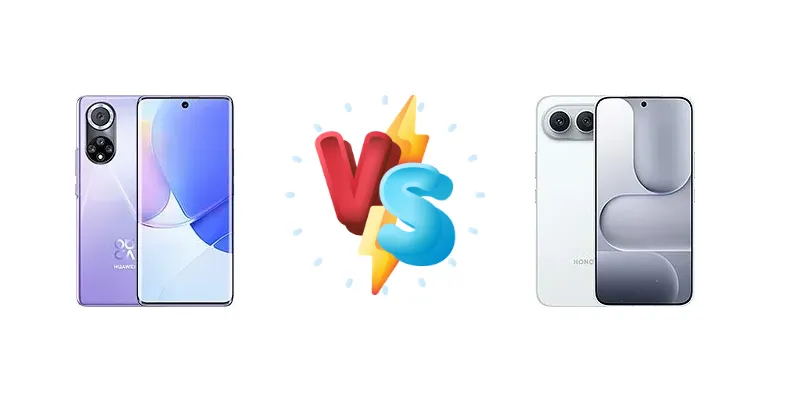
The Huawei nova 9 and Honor 500 represent distinct approaches to the mid-range smartphone market. The nova 9, leveraging the Snapdragon 778G, aims for a balance of features and affordability. The Honor 500, with its newer Snapdragon 8s Gen 4, targets users prioritizing raw performance, but at a potentially higher cost. This comparison dissects the key differences to help you choose the right device.
🏆 Quick Verdict
For the average user, the Honor 500 emerges as the stronger contender. Its Snapdragon 8s Gen 4 chipset delivers significantly improved performance, making it ideal for demanding tasks and gaming. While the nova 9 offers respectable battery endurance and fast charging, the performance gap justifies the price difference for power users.
| Network |
|---|
| 2G bands | GSM 850 / 900 / 1800 / 1900 | GSM 850 / 900 / 1800 / 1900 |
| 3G bands | HSDPA 800 / 850 / 900 / 1700(AWS) / 1900 / 2100 | HSDPA 800 / 850 / 900 / 1700(AWS) / 1900 / 2100 |
| 4G bands | 1, 2, 3, 4, 5, 7, 8, 12, 17, 18, 19, 20, 26, 28, 34, 38, 39, 40, 41, 66 - Europe | LTE |
| 5G bands | - | SA/NSA |
| Speed | HSPA, LTE | HSPA, LTE, 5G |
| Technology | GSM / CDMA / HSPA / LTE | GSM / HSPA / LTE / 5G |
| | 1, 2, 3, 4, 5, 8, 18, 19, 26, 34, 38, 39, 40, 41 - China | - |
| Launch |
|---|
| Announced | 2021, September 23 | 2025, November 24 |
| Status | Available. Released 2021, September 30 | Available. Released 2025, November 27 |
| Body |
|---|
| Build | - | Glass front, aluminum frame |
| Dimensions | 160 x 73.7 x 7.8 mm (6.30 x 2.90 x 0.31 in) | 155.8 x 74.2 x 7.8 mm (6.13 x 2.92 x 0.31 in) |
| SIM | · Nano-SIM· Nano-SIM + Nano-SIM | Nano-SIM + Nano-SIM |
| Weight | 175 g (6.17 oz) | 198 g (6.98 oz) |
| Display |
|---|
| Protection | - | Aluminosilicate glass |
| Resolution | 1080 x 2340 pixels, 19.5:9 ratio (~392 ppi density) | 1264 x 2736 pixels, 19.5:9 ratio (~460 ppi density) |
| Size | 6.57 inches, 106.0 cm2 (~89.9% screen-to-body ratio) | 6.55 inches, 105.4 cm2 (~91.2% screen-to-body ratio) |
| Type | OLED, 1B colors, 120Hz, HDR10 | AMOLED, 1B colors, 120Hz, 3840Hz PWM, HDR Vivid, 6000 nits (peak) |
| Platform |
|---|
| CPU | Octa-core (4x2.4 GHz Kryo 670 & 4x1.8 GHz Kryo 670) | Octa-core (1x3.21 GHz Cortex-X4 & 3x3.0 GHz Cortex-A720 & 2x2.8 GHz Cortex-A720 & 2x2.0 GHz Cortex-A720) |
| Chipset | Qualcomm SM7325 Snapdragon 778G 4G (6 nm) | Qualcomm SM8735 Snapdragon 8s Gen 4 (4 nm) |
| GPU | Adreno 642L | Adreno 825 |
| OS | HarmonyOS 2.0 (China), EMUI 12 (Europe), no Google Play Services | Android 16, MagicOS 10 |
| Memory |
|---|
| Card slot | No | No |
| Internal | 128GB 8GB RAM, 256GB 8GB RAM | 256GB 12GB RAM, 512GB 12GB RAM, 512GB 16GB RAM |
| | UFS | - |
| Main Camera |
|---|
| Dual | - | 200 MP, f/1.9, (wide), 1/1.4", 0.56µm, PDAF, OIS
12 MP, f/2.2, 117˚ (ultrawide), AF |
| Features | LED flash, panorama, HDR | LED flash, HDR, panorama |
| Quad | 50 MP, f/1.9, 23mm (wide), PDAF
8 MP, f/2.2, (ultrawide)
2 MP (macro)
Auxiliary lens | - |
| Single | 32 MP, f/2.0, (wide) | - |
| Video | 4K, 1080p, 720p@960fps, gyro-EIS | 4K, 1080p, gyro-EIS, OIS |
| Selfie camera |
|---|
| Features | HDR | HDR |
| Single | 32 MP, f/2.0, (wide) | 50 MP, f/2.0, (wide) |
| Video | 4K@30fps, 1080p@30fps, 720p@240fps, gyro-EIS | 4K, 1080p, gyro-EIS |
| Sound |
|---|
| 3.5mm jack | No | - |
| 35mm jack | No | No |
| Loudspeaker | Yes | Yes, with stereo speakers |
| Comms |
|---|
| Bluetooth | 5.2, A2DP, LE | 6.0, A2DP, LE, aptX HD, aptX Adaptive, aptX Lossless, LHDC 5, Auracast, ASHA |
| Infrared port | - | Yes |
| NFC | Yes | Yes |
| Positioning | GPS (L1+L5), GLONASS (L1), BDS (B1I+B1c+B2a), GALILEO (E1+E5a), QZSS (L1+L5), NavIC (L5) | GPS (L1+L5), GLONASS (L1), BDS (B1I+B1c+B2a+B2b), GALILEO (E1+E5a+E5b), QZSS (L1+L5), NavIC (L5) |
| Radio | No | No |
| USB | USB Type-C 2.0, OTG | USB Type-C 2.0, OTG |
| WLAN | Wi-Fi 802.11 a/b/g/n/a/6, dual-band, Wi-Fi Direct | Wi-Fi 802.11 a/b/g/n/ac/6/7, dual-band, Wi-Fi Direct |
| Features |
|---|
| Sensors | Fingerprint (under display, optical), accelerometer, gyro, proximity, compass | Fingerprint (under display, optical), accelerometer, gyro, proximity, compass (ultrasound) |
| Battery |
|---|
| Charging | 66W wired, 60% in 18 min, 100% in 38 min
Reverse wired | 80W wired
5W reverse wired |
| Type | Li-Po 4300 mAh | Si/C Li-Ion 8000 mAh |
| Misc |
|---|
| Colors | Starry Blue, Black, Green, Violet | Black, Silver, Blue, Pink |
| Models | NAM-AL00, NAM-LX9 | MEY-AN00 |
| Price | About 120 EUR | About 330 EUR |
| Tests |
|---|
| Battery life |
Endurance rating 96h
| - |
| Camera |
Photo / Video | - |
| Display |
Contrast ratio: Infinite (nominal) | - |
| Loudspeaker |
-27.3 LUFS (Good)
| - |
| Performance |
AnTuTu: 469798 (v9)
GeekBench: 2973 (v5.1)
GFXBench: 28fps (ES 3.1 onscreen) | - |
Huawei nova 9
- Excellent 96-hour battery endurance
- Fast 66W wired charging
- Reverse wired charging capability
- Older Snapdragon 778G chipset
- Limited performance for demanding tasks
Honor 500
- Powerful Snapdragon 8s Gen 4 chipset
- Faster 80W wired charging
- Superior performance for gaming and multitasking
- Battery life potentially lower than nova 9 (unknown capacity)
- Higher price point
Display Comparison
Both devices lack detailed display specifications beyond the Huawei nova 9’s measured 608 nits peak brightness. Given the Honor 500’s positioning, it likely features a comparable or slightly brighter panel. However, without knowing the panel technology (OLED vs. LCD) or refresh rate, a definitive comparison is difficult. The 'Infinite' contrast ratio claim on the nova 9 is a nominal specification common to OLED panels, suggesting it utilizes OLED technology. Bezels and color accuracy remain unknown for both.
Camera Comparison
Both phones are listed with 'Photo / Video' capabilities, offering minimal insight. Without sensor size, aperture, or OIS details, a meaningful comparison is impossible. The absence of specific camera specs suggests a focus on general-purpose photography rather than specialized features. We can assume the Honor 500, being the higher-tier device, likely incorporates a more advanced camera system, but concrete details are needed to confirm this.
Performance
The core difference lies in the chipsets. The Honor 500’s Snapdragon 8s Gen 4 (4nm) represents a significant leap over the Huawei nova 9’s Snapdragon 778G (6nm). The 8s Gen 4 boasts a 1x3.21 GHz Cortex-X4 prime core alongside three 3.0 GHz Cortex-A720 cores and four efficiency cores, compared to the 778G’s Octa-core configuration (4x2.4 GHz Kryo 670 & 4x1.8 GHz Kryo 670). The 4nm process node of the 8s Gen 4 translates to improved power efficiency and reduced thermal throttling under sustained load, crucial for gaming. This means the Honor 500 will handle graphically intensive games and multitasking with considerably more ease.
Battery Life
The Huawei nova 9 boasts an endurance rating of 96 hours, indicating excellent battery life. The Honor 500’s battery capacity is unknown, but its 80W wired charging significantly surpasses the nova 9’s 66W charging. The nova 9 achieves 60% charge in 18 minutes and 100% in 38 minutes. The Honor 500’s 80W charging will likely offer faster top-ups, potentially reducing the 0-100% time. The nova 9 also offers reverse wired charging, a feature also present (at 5W) on the Honor 500, though the lower wattage on the Honor 500 suggests it's primarily for accessories.
Buying Guide
Buy the Huawei nova 9 if you prioritize long battery life (96h endurance rating) and a well-rounded experience without breaking the bank. It’s a solid choice for everyday users who don’t heavily rely on mobile gaming or intensive applications. Buy the Honor 500 if you demand the best possible performance in this price bracket, particularly for gaming and multitasking. The Snapdragon 8s Gen 4 provides a substantial upgrade, making it the preferred option for enthusiasts and power users.
Frequently Asked Questions
❓ Will the Snapdragon 8s Gen 4 in the Honor 500 handle demanding games like Genshin Impact at high settings?
Yes, the Snapdragon 8s Gen 4 is a significant upgrade over the 778G and is well-equipped to handle Genshin Impact and other graphically intensive games at high settings. The 4nm process and improved CPU/GPU architecture will minimize throttling and provide a smoother gaming experience.
❓ How much faster is the 80W charging on the Honor 500 compared to the 66W charging on the Huawei nova 9 in real-world use?
While both offer fast charging, the 80W on the Honor 500 will likely shave off around 10-15 minutes from a full 0-100% charge compared to the nova 9’s 38 minutes. The initial charging curve will be noticeably quicker, providing a substantial top-up in a short amount of time.
❓ Does the Huawei nova 9's reverse wired charging output enough power to meaningfully charge accessories like earbuds?
The Huawei nova 9's reverse wired charging at 66W is sufficient for charging accessories like earbuds or smartwatches. However, it won't rapidly charge larger devices like another smartphone.