
Google Pixel 6a vs. Huawei nova 9: A Detailed Comparison
| Phones Images | |||||
|---|---|---|---|---|---|
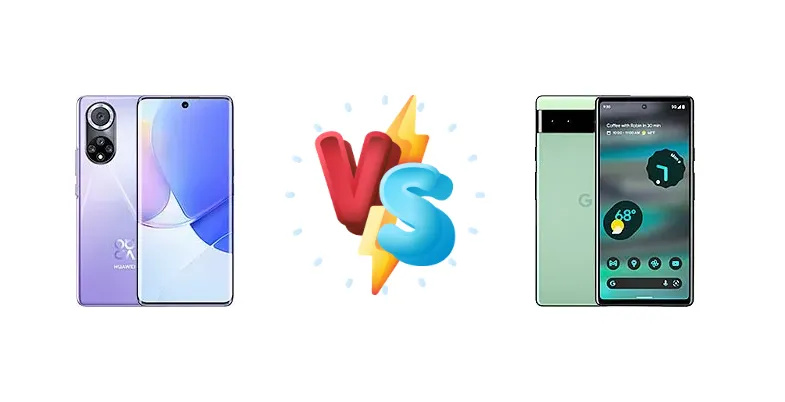
|
🏆 Quick Verdict
For most users, the Google Pixel 6a is the better choice, thanks to its significantly more powerful Google Tensor chipset and superior image processing capabilities. However, the Huawei nova 9 excels in charging speed, reaching 100% in just 38 minutes, making it ideal for users who prioritize minimizing downtime.
| PHONES | ||
|---|---|---|
| Phone Names | Huawei nova 9 | Google Pixel 6a |
| Network | ||
|---|---|---|
| 2G bands | GSM 850 / 900 / 1800 / 1900 | GSM 850 / 900 / 1800 / 1900 |
| 3G bands | HSDPA 800 / 850 / 900 / 1700(AWS) / 1900 / 2100 | HSDPA 800 / 850 / 900 / 1700(AWS) / 1900 / 2100 |
| 4G bands | 1, 2, 3, 4, 5, 7, 8, 12, 17, 18, 19, 20, 26, 28, 34, 38, 39, 40, 41, 66 - Europe | 1, 2, 3, 4, 5, 7, 8, 12, 13, 14, 17, 18, 19, 20, 25, 26, 28, 29, 30, 38, 39, 40, 41, 42, 48, 66, 71 - GX7AS, GB62Z (USA/Canada) |
| 5G bands | - | 1, 2, 3, 5, 7, 8, 12, 20, 25, 28, 30, 38, 40, 41, 48, 66, 71, 77, 78 SA/NSA/Sub6 - GX7AS (USA/Canada) |
| Speed | HSPA, LTE | HSPA, LTE, 5G |
| Technology | GSM / CDMA / HSPA / LTE | GSM / HSPA / LTE / 5G |
| 1, 2, 3, 4, 5, 8, 18, 19, 26, 34, 38, 39, 40, 41 - China | 1, 2, 3, 5, 7, 8, 12, 20, 25, 28, 30, 40, 48, 66, 71, 77, 78 SA/NSA/Sub6 - G1AZG (International) | |
| Launch | ||
|---|---|---|
| Announced | 2021, September 23 | 2022, May 11 |
| Status | Available. Released 2021, September 30 | Available. Released 2022, July 21 |
| Body | ||
|---|---|---|
| Build | - | Glass front (Gorilla Glass 3), aluminum frame, plastic back |
| Dimensions | 160 x 73.7 x 7.8 mm (6.30 x 2.90 x 0.31 in) | 152.2 x 71.8 x 8.9 mm (5.99 x 2.83 x 0.35 in) |
| SIM | · Nano-SIM· Nano-SIM + Nano-SIM | Nano-SIM + eSIM |
| Weight | 175 g (6.17 oz) | 178 g (6.28 oz) |
| - | IP67 dust/water resistant (up to 1m for 30 min) | |
| Display | ||
|---|---|---|
| Protection | - | Corning Gorilla Glass 3 |
| Resolution | 1080 x 2340 pixels, 19.5:9 ratio (~392 ppi density) | 1080 x 2400 pixels, 20:9 ratio (~429 ppi density) |
| Size | 6.57 inches, 106.0 cm2 (~89.9% screen-to-body ratio) | 6.1 inches, 90.7 cm2 (~83.0% screen-to-body ratio) |
| Type | OLED, 1B colors, 120Hz, HDR10 | OLED, HDR |
| - | Always-on display | |
| Platform | ||
|---|---|---|
| CPU | Octa-core (4x2.4 GHz Kryo 670 & 4x1.8 GHz Kryo 670) | Octa-core (2x2.80 GHz Cortex-X1 & 2x2.25 GHz Cortex-A76 & 4x1.80 GHz Cortex-A55) |
| Chipset | Qualcomm SM7325 Snapdragon 778G 4G (6 nm) | Google Tensor (5 nm) |
| GPU | Adreno 642L | Mali-G78 MP20 |
| OS | HarmonyOS 2.0 (China), EMUI 12 (Europe), no Google Play Services | Android 12, upgradable to Android 15, up to 5 major Android upgrades |
| Memory | ||
|---|---|---|
| Card slot | No | No |
| Internal | 128GB 8GB RAM, 256GB 8GB RAM | 128GB 6GB RAM |
| UFS | UFS 3.1 | |
| Main Camera | ||
|---|---|---|
| Dual | - | 12.2 MP, f/1.7, 27mm, (wide), 1/2.55", 1.4µm, dual pixel PDAF, OIS 12 MP, f/2.2, 17mm, 114˚ (ultrawide), 1.25µm |
| Features | LED flash, panorama, HDR | Dual-LED flash, Pixel Shift, Auto-HDR, panorama |
| Quad | 50 MP, f/1.9, 23mm (wide), PDAF 8 MP, f/2.2, (ultrawide) 2 MP (macro) Auxiliary lens | - |
| Single | 32 MP, f/2.0, (wide) | 8 MP, f/2.0, 24mm (wide), 1.12µm |
| Video | 4K, 1080p, 720p@960fps, gyro-EIS | 4K@30/60fps, 1080p@30/60/120/240fps; gyro-EIS, OIS |
| Selfie camera | ||
|---|---|---|
| Features | HDR | HDR, panorama |
| Single | 32 MP, f/2.0, (wide) | 8 MP, f/2.0, 24mm (wide), 1.12µm |
| Video | 4K@30fps, 1080p@30fps, 720p@240fps, gyro-EIS | 1080p@30fps |
| Sound | ||
|---|---|---|
| 3.5mm jack | No | No |
| 35mm jack | No | No |
| Loudspeaker | Yes | Yes, with stereo speakers |
| Comms | ||
|---|---|---|
| Bluetooth | 5.2, A2DP, LE | 5.2, A2DP, LE |
| NFC | Yes | Yes |
| Positioning | GPS (L1+L5), GLONASS (L1), BDS (B1I+B1c+B2a), GALILEO (E1+E5a), QZSS (L1+L5), NavIC (L5) | GPS, GLONASS, GALILEO, QZSS |
| Radio | No | No |
| USB | USB Type-C 2.0, OTG | USB Type-C 3.1 |
| WLAN | Wi-Fi 802.11 a/b/g/n/a/6, dual-band, Wi-Fi Direct | Wi-Fi 802.11 a/b/g/n/ac/6e, dual-band, Wi-Fi Direct |
| Features | ||
|---|---|---|
| Sensors | Fingerprint (under display, optical), accelerometer, gyro, proximity, compass | Fingerprint (under display, optical), accelerometer, gyro, proximity, compass, barometer |
| Battery | ||
|---|---|---|
| Charging | 66W wired, 60% in 18 min, 100% in 38 min Reverse wired | 18W wired, PD3.0 |
| Type | Li-Po 4300 mAh | Li-Po 4410 mAh |
| Misc | ||
|---|---|---|
| Colors | Starry Blue, Black, Green, Violet | Chalk, Charcoal, Sage |
| Models | NAM-AL00, NAM-LX9 | GX7AS, GB62Z, G1AZG, GB17L |
| Price | About 120 EUR | $ 138.99 / C$ 228.74 / ₹ 23,999 |
| Tests | ||
|---|---|---|
| Battery life | Endurance rating 96h | Endurance rating 94h |
| Camera | Photo / Video | - |
| Display | Contrast ratio: Infinite (nominal) | Contrast ratio: Infinite (nominal) |
| Loudspeaker | -27.3 LUFS (Good) | - |
| Performance | AnTuTu: 469798 (v9) GeekBench: 2973 (v5.1) GFXBench: 28fps (ES 3.1 onscreen) | - |
Huawei nova 9
- Superior processing power with Google Tensor
- Exceptional camera performance and image processing
- Guaranteed software updates from Google
- Brighter display for outdoor visibility
- Significantly slower charging speed
- 4G connectivity only
Google Pixel 6a
- Incredibly fast 66W wired charging
- Bright and vibrant display
- Sleek and modern design
- Reverse wired charging capability
- Less powerful Snapdragon 778G chipset
- Reliance on Huawei Mobile Services (HMS) instead of Google Play Services
Display Comparison
The Pixel 6a boasts a significantly brighter display, reaching 876 nits compared to the nova 9’s 608 nits. This translates to better visibility outdoors under direct sunlight. Both displays share an infinite (nominal) contrast ratio, but the Pixel 6a’s higher peak brightness is a clear advantage for users who frequently use their phones in bright environments. While both are OLED panels, the lack of high refresh rate information for the nova 9 suggests a standard 60Hz panel, while the Pixel 6a is likely also 60Hz, focusing instead on color accuracy and brightness.
Camera Comparison
Both phones are marketed with strong camera capabilities, but the Pixel 6a leverages Google’s renowned computational photography expertise. While specific sensor details are missing for the nova 9, the Pixel 6a’s image processing algorithms consistently deliver excellent dynamic range and detail. The Pixel 6a’s Tensor chip plays a crucial role in accelerating these processes. The absence of detailed camera specs for the nova 9 makes a direct sensor comparison difficult, but Google’s software advantage is a significant differentiator. We can assume the nova 9 offers a versatile photo/video experience, but likely won't match the Pixel's consistency.
Performance
The core difference lies in the chipsets. The Google Pixel 6a is powered by Google’s in-house Tensor chip, fabricated on a 5nm process, while the Huawei nova 9 utilizes the Qualcomm Snapdragon 778G 4G (6nm). The Tensor chip’s octa-core configuration, featuring 2x2.80 GHz Cortex-X1 cores, provides a substantial performance uplift over the Snapdragon 778G’s 4x2.4 GHz Kryo 670 cores. This difference is particularly noticeable in demanding tasks like video editing and gaming. The 5nm process of the Tensor also contributes to better thermal efficiency, potentially reducing throttling during sustained workloads. The nova 9's 4G limitation is also a significant drawback for users needing fast mobile data.
Battery Life
Both phones achieve similar endurance ratings – 96 hours for the nova 9 and 94 hours for the Pixel 6a – suggesting comparable battery life in typical usage scenarios. However, the charging speeds are drastically different. The Huawei nova 9’s 66W wired charging is a game-changer, achieving 60% charge in just 18 minutes and a full charge in 38 minutes. The Pixel 6a’s 18W wired charging, while supporting PD3.0, is significantly slower. This makes the nova 9 the clear winner for users who frequently need to top up their battery quickly. The nova 9 also offers reverse wired charging, a feature absent on the Pixel 6a.
Buying Guide
Buy the Huawei nova 9 if you prioritize incredibly fast charging and a bright display for media consumption, and aren't heavily reliant on Google services. Buy the Google Pixel 6a if you value a smoother, more responsive user experience, exceptional camera performance powered by Google’s computational photography, and guaranteed software updates directly from Google.