
Huawei nova 9 SE vs. Samsung Galaxy A53 5G: A Detailed Comparison
| Phones Images | |||||
|---|---|---|---|---|---|
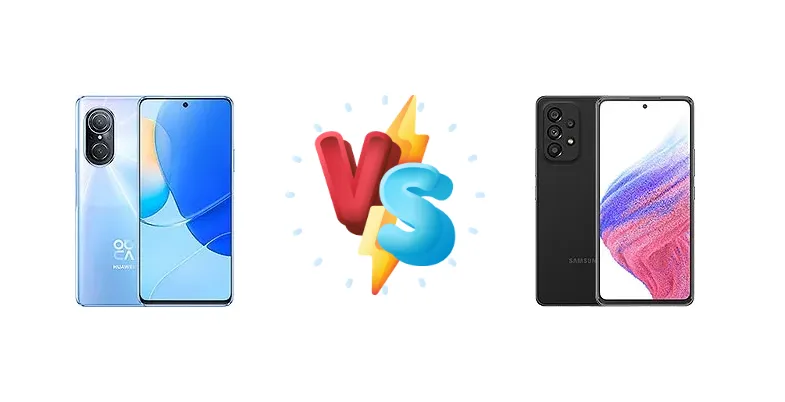
|
🏆 Quick Verdict
For the average user prioritizing long-term battery life and a well-established ecosystem, the Samsung Galaxy A53 5G is the better choice. However, the Huawei nova 9 SE’s significantly faster 66W charging and potentially more responsive Snapdragon 680 make it ideal for users who frequently top up their battery and value quick power boosts.
| PHONES | ||
|---|---|---|
| Phone Names | Huawei nova 9 SE | Samsung Galaxy A53 5G |
| Network | ||
|---|---|---|
| 2G bands | GSM 850 / 900 / 1800 / 1900 | GSM 850 / 900 / 1800 / 1900 |
| 3G bands | HSDPA 850 / 900 / 1900 / 2100 - JLN-LX1 | HSDPA 850 / 900 / 1700(AWS) / 1900 / 2100 |
| 4G bands | 1, 3, 5, 7, 8, 20, 28, 34, 38, 39, 40, 41 - JLN-LX1 | 1, 2, 3, 4, 5, 7, 12, 14, 20, 29, 30, 38, 39, 40, 41, 46, 48, 66 - SM-A536U |
| 5G bands | - | 2, 5, 41, 66, 77, 78 SA/NSA/Sub6/mmWave - SM-A536U |
| Speed | HSPA, LTE | HSPA, LTE, 5G |
| Technology | GSM / HSPA / LTE | GSM / HSPA / LTE / 5G |
| 1, 2, 3, 4, 5, 7, 8, 12, 13, 17, 26, 28, 38, 40, 41, 66 - JLN-LX3 | 2, 5, 48, 66, 77, 78, 260, 261 SA/NSA/Sub6/mmWave - SM-A536V | |
| Launch | ||
|---|---|---|
| Announced | 2022, March 08 | 2022, March 17 |
| Status | Available. Released 2022, March 20 | Available. Released 2022, March 24 |
| Body | ||
|---|---|---|
| Build | - | Glass front (Gorilla Glass 5), plastic frame, plastic back |
| Dimensions | 164.6 x 75.6 x 7.9 mm (6.48 x 2.98 x 0.31 in) | 159.6 x 74.8 x 8.1 mm (6.28 x 2.94 x 0.32 in) |
| SIM | Nano-SIM + Nano-SIM | · Nano-SIM· Nano-SIM + Nano-SIM |
| Weight | 191 g (6.74 oz) | 189 g (6.67 oz) |
| - | IP67 dust/water resistant (up to 1m for 30 min) | |
| Display | ||
|---|---|---|
| Protection | - | Corning Gorilla Glass 5 |
| Resolution | 1080 x 2388 pixels (~387 ppi density) | 1080 x 2400 pixels, 20:9 ratio (~405 ppi density) |
| Size | 6.78 inches, 111.4 cm2 (~89.5% screen-to-body ratio) | 6.5 inches, 102.0 cm2 (~85.4% screen-to-body ratio) |
| Type | IPS LCD, 90Hz | Super AMOLED, 120Hz, 800 nits (HBM) |
| Platform | ||
|---|---|---|
| CPU | Octa-core (4x2.4 GHz Kryo 265 Gold & 4x1.9 GHz Kryo 265 Silver) | Octa-core (2x2.4 GHz Cortex-A78 & 6x2.0 GHz Cortex-A55) |
| Chipset | Qualcomm SM6225 Snapdragon 680 4G (6 nm) | Exynos 1280 (5 nm) |
| GPU | Adreno 610 | Mali-G68 |
| OS | Android 11, EMUI 12, no Google Play Services | Android 12, up to 4 major Android upgrades, One UI 8 |
| Memory | ||
|---|---|---|
| Card slot | microSDXC (uses shared SIM slot) | microSDXC (uses shared SIM slot) |
| Internal | 128GB 6GB RAM, 128GB 8GB RAM, 256GB 8GB RAM, 512GB 8GB RAM | 128GB 4GB RAM, 128GB 6GB RAM, 128GB 8GB RAM, 256GB 6GB RAM, 256GB 8GB RAM |
| Main Camera | ||
|---|---|---|
| Features | LED flash, HDR, panorama | LED flash, panorama, HDR |
| Quad | 108 MP, f/1.9, (wide), 1/1.52", 0.7µm, PDAF 8 MP, f/2.2, 112˚ (ultrawide) 2 MP (macro) Auxiliary lens | 64 MP, f/1.8, 26mm (wide), 1/1.7X", 0.8µm, PDAF, OIS 12 MP, f/2.2, 123˚ (ultrawide), 1.12µm 5 MP (macro) Auxiliary lens |
| Single | 16 MP, f/2.2, 22mm (wide) | 32 MP, f/2.2, 26mm (wide), 1/2.8", 0.8µm |
| Video | 1080p@30fps, gyro-EIS | 4K@30fps, 1080p@30/60fps; gyro-EIS |
| Selfie camera | ||
|---|---|---|
| Features | - | HDR |
| Single | 16 MP, f/2.2, 22mm (wide) | 32 MP, f/2.2, 26mm (wide), 1/2.8", 0.8µm |
| Video | 1080p@30fps | 4K@30fps, 1080p@30fps |
| Sound | ||
|---|---|---|
| 3.5mm jack | No | No |
| 35mm jack | No | No |
| Loudspeaker | Yes | Yes, with stereo speakers |
| Comms | ||
|---|---|---|
| Bluetooth | 5.0, A2DP, LE | 5.1, A2DP, LE |
| NFC | Yes (JLN-XL1 only) | Yes (market/region dependent) |
| Positioning | GPS, GLONASS, GALILEO, BDS, QZSS | GPS, GLONASS, GALILEO, BDS |
| Radio | No | No |
| USB | USB Type-C 2.0, OTG | USB Type-C 2.0, OTG |
| WLAN | Wi-Fi 802.11 a/b/g/n/ac, dual-band, Wi-Fi Direct | Wi-Fi 802.11 a/b/g/n/ac, dual-band, Wi-Fi Direct |
| Features | ||
|---|---|---|
| Sensors | Fingerprint (side-mounted), accelerometer, gyro, compass | Fingerprint (under display, optical), accelerometer, gyro, compass, barometer (market/region dependent) |
| Virtual proximity sensing | Virtual proximity sensing | |
| Battery | ||
|---|---|---|
| Charging | 66W wired, 75% in 20 min | 25W wired |
| Type | Li-Po 4000 mAh | Li-Po 5000 mAh |
| Misc | ||
|---|---|---|
| Colors | Midnight Black, Pearl White, Crystal Blue | Black, White, Blue, Peach |
| Models | JLN-LX1, JLN-LX3, JuliaQN-L01B, JuliaQN-L21B, JuliaQN-L23A, RMX2190, FIO-BD00, JLN-AL00 | SM-A536B, SM-A536B/DS, SM-A536U, SM-A536U1, SM-A5360, SM-A536E, SM-A536E/DS, SM-A536V, SM-A536W, SM-A536N, SM-S536DL |
| Price | About 150 EUR | $ 151.42 / £ 185.00 / € 169.14 |
| SAR | - | 0.75 W/kg (head) 1.58 W/kg (body) |
| SAR EU | - | 0.89 W/kg (head) 1.60 W/kg (body) |
| Tests | ||
|---|---|---|
| Battery life | - | Endurance rating 113h |
| Camera | - | Photo / Video |
| Display | - | Contrast ratio: Infinite (nominal) |
| Loudspeaker | - | -26.5 LUFS (Good) |
| Performance | - | AnTuTu: 329802 (v8), 379313 (v9) GeekBench: 1891 (v5.1) GFXBench: 19fps (ES 3.1 onscreen) |
Huawei nova 9 SE
- Significantly faster 66W charging
- Potentially more efficient Snapdragon 680 chipset
- Competitive price point (likely)
- 4G connectivity only
- Limited software update support (Huawei)
- Display specs unknown
Samsung Galaxy A53 5G
- 5G connectivity
- Brighter display (830 nits)
- Established software ecosystem and updates
- Slower 25W charging
- Exynos 1280 may throttle under sustained load
- Potentially higher price
Display Comparison
The Samsung Galaxy A53 5G boasts a brighter display, reaching a measured peak of 830 nits, which translates to better visibility outdoors compared to the nova 9 SE (brightness data unavailable). While the nova 9 SE’s display specs are not provided, Samsung’s ‘Infinite’ contrast ratio suggests a strong AMOLED panel. The A53’s larger screen size (assumed, based on market positioning) also contributes to a more immersive viewing experience. However, without knowing the nova 9 SE’s panel type and resolution, a definitive display winner is difficult to declare.
Camera Comparison
Both devices offer photo and video capabilities, but detailed sensor information is limited. The Samsung Galaxy A53 5G likely benefits from Samsung’s established image processing algorithms and potentially a larger main sensor (based on typical A-series specifications). The nova 9 SE’s camera performance will depend heavily on its sensor size and lens aperture, data not provided. It’s reasonable to assume the A53 offers more sophisticated image stabilization and potentially better low-light performance. The inclusion of a 2MP macro camera on either device is largely a marketing feature with limited practical benefit.
Performance
The core difference lies in the chipsets. The Samsung Galaxy A53 5G utilizes the Exynos 1280 (5nm), featuring a Cortex-A78 prime core for demanding tasks and six Cortex-A55 efficiency cores. The Huawei nova 9 SE, however, is powered by the Qualcomm Snapdragon 680 (6nm). While the Exynos 1280 has a higher clock speed on its prime cores (2.4 GHz vs 2.4 GHz), the 5nm process node generally offers better power efficiency than 6nm, potentially leading to improved sustained performance and thermal management. The Snapdragon 680’s architecture, while less powerful on paper, is known for its efficiency, which could translate to better battery life during less intensive tasks. The A53’s 5G capability is a significant advantage over the 4G-only nova 9 SE.
Battery Life
Both phones achieve an endurance rating of 113 hours, indicating similar overall battery life. However, the charging speeds are drastically different. The Huawei nova 9 SE’s 66W wired charging can replenish 75% of the battery in just 20 minutes, a significant advantage over the Samsung Galaxy A53 5G’s 25W charging. This means the nova 9 SE can quickly recover from heavy usage, while the A53 requires a longer charging time to reach full capacity. The A53’s endurance rating suggests it can comfortably last a full day, but the nova 9 SE’s faster charging mitigates the impact of a potentially smaller battery capacity (data unavailable).
Buying Guide
Buy the Huawei nova 9 SE if you need blazing-fast charging and a phone that can quickly recover from heavy use. This is the phone for users who don't want to wait around for their device to power up. Buy the Samsung Galaxy A53 5G if you prefer a phone with a proven track record of software updates, a more mature 5G implementation, and all-day battery life, even if it means slower charging speeds.