
Huawei nova 9 SE vs OnePlus Nord 2T: A Detailed Comparison of Mid-Range Contenders
| Phones Images | |||||
|---|---|---|---|---|---|
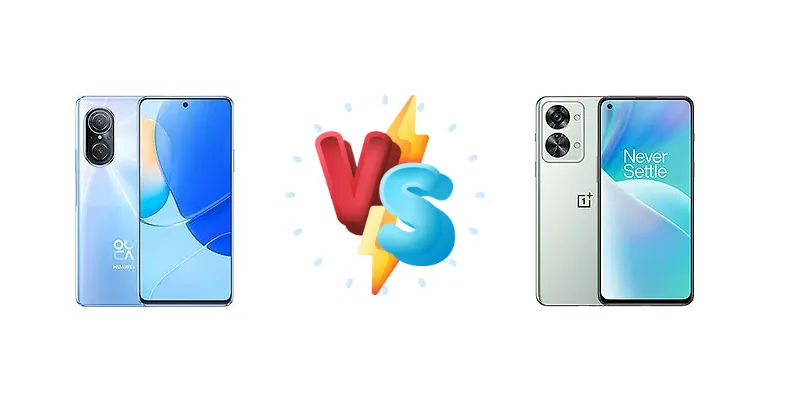
|
🏆 Quick Verdict
For the average user prioritizing overall performance and future-proofing, the OnePlus Nord 2T is the better choice. Its Mediatek Dimensity 1300 chipset significantly outperforms the Snapdragon 680 in the nova 9 SE, offering a smoother experience for demanding tasks and gaming. While the nova 9 SE boasts a competitive 66W charging speed, the Nord 2T’s 80W SuperVOOC charging and comparable battery life provide a slight edge.
| PHONES | ||
|---|---|---|
| Phone Names | Huawei nova 9 SE | OnePlus Nord 2T |
| Network | ||
|---|---|---|
| 2G bands | GSM 850 / 900 / 1800 / 1900 | GSM 850 / 900 / 1800 / 1900 |
| 3G bands | HSDPA 850 / 900 / 1900 / 2100 - JLN-LX1 | HSDPA 800 / 850 / 900 / 1700(AWS) / 1800 / 1900 / 2100 |
| 4G bands | 1, 3, 5, 7, 8, 20, 28, 34, 38, 39, 40, 41 - JLN-LX1 | 1, 2, 3, 4, 5, 7, 8, 12, 17, 18, 19, 20, 26, 28, 32, 34, 38, 39, 40, 41, 66 |
| 5G bands | - | 1, 3, 7, 8, 20, 28, 38, 41, 78 SA/NSA |
| Speed | HSPA, LTE | HSPA 42.2/5.76 Mbps, LTE Cat18 1200/150 Mbps, 5G |
| Technology | GSM / HSPA / LTE | GSM / HSPA / LTE / 5G |
| 1, 2, 3, 4, 5, 7, 8, 12, 13, 17, 26, 28, 38, 40, 41, 66 - JLN-LX3 | - | |
| Launch | ||
|---|---|---|
| Announced | 2022, March 08 | 2022, May 19 |
| Status | Available. Released 2022, March 20 | Available. Released 2022, May 21 |
| Body | ||
|---|---|---|
| Build | - | Glass front (Gorilla Glass 5), plastic frame |
| Dimensions | 164.6 x 75.6 x 7.9 mm (6.48 x 2.98 x 0.31 in) | 159.1 x 73.2 x 8.2 mm (6.26 x 2.88 x 0.32 in) |
| SIM | Nano-SIM + Nano-SIM | Nano-SIM + Nano-SIM |
| Weight | 191 g (6.74 oz) | 190 g (6.70 oz) |
| Display | ||
|---|---|---|
| Protection | - | Corning Gorilla Glass 5 |
| Resolution | 1080 x 2388 pixels (~387 ppi density) | 1080 x 2400 pixels, 20:9 ratio (~409 ppi density) |
| Size | 6.78 inches, 111.4 cm2 (~89.5% screen-to-body ratio) | 6.43 inches, 99.8 cm2 (~85.7% screen-to-body ratio) |
| Type | IPS LCD, 90Hz | AMOLED, 90Hz, HDR10+ |
| Platform | ||
|---|---|---|
| CPU | Octa-core (4x2.4 GHz Kryo 265 Gold & 4x1.9 GHz Kryo 265 Silver) | Octa-core (1x3.0 GHz Cortex-A78 & 3x2.6 GHz Cortex-A78 & 4x2.0 GHz Cortex-A55) |
| Chipset | Qualcomm SM6225 Snapdragon 680 4G (6 nm) | Mediatek Dimensity 1300 (6 nm) |
| GPU | Adreno 610 | Mali-G77 MC9 |
| OS | Android 11, EMUI 12, no Google Play Services | Android 12, upgradable to Android 14, OxygenOS 14 |
| Memory | ||
|---|---|---|
| Card slot | microSDXC (uses shared SIM slot) | No |
| Internal | 128GB 6GB RAM, 128GB 8GB RAM, 256GB 8GB RAM, 512GB 8GB RAM | 128GB 8GB RAM, 256GB 12GB RAM |
| - | UFS 3.1 | |
| Main Camera | ||
|---|---|---|
| Features | LED flash, HDR, panorama | Dual-LED flash, HDR, panorama |
| Quad | 108 MP, f/1.9, (wide), 1/1.52", 0.7µm, PDAF 8 MP, f/2.2, 112˚ (ultrawide) 2 MP (macro) Auxiliary lens | - |
| Single | 16 MP, f/2.2, 22mm (wide) | 32 MP, f/2.4, (wide), 1/2.8", 0.8µm |
| Triple | - | 50 MP, f/1.9, 24mm (wide), 1/1.56", 1.0µm, PDAF, OIS 8 MP, f/2.2, 120˚ (ultrawide) Auxiliary lens |
| Video | 1080p@30fps, gyro-EIS | 4K@30fps, 1080p@30/60/120/480fps, gyro-EIS |
| Selfie camera | ||
|---|---|---|
| Features | - | Auto HDR |
| Single | 16 MP, f/2.2, 22mm (wide) | 32 MP, f/2.4, (wide), 1/2.8", 0.8µm |
| Video | 1080p@30fps | 1080p@30fps, gyro-EIS |
| Sound | ||
|---|---|---|
| 3.5mm jack | No | No |
| 35mm jack | No | No |
| Loudspeaker | Yes | Yes, with stereo speakers |
| Comms | ||
|---|---|---|
| Bluetooth | 5.0, A2DP, LE | 5.2, A2DP, LE, aptX HD |
| NFC | Yes (JLN-XL1 only) | Yes |
| Positioning | GPS, GLONASS, GALILEO, BDS, QZSS | GPS, GLONASS, GALILEO, BDS, NavIC |
| Radio | No | No |
| USB | USB Type-C 2.0, OTG | USB Type-C 2.0, OTG |
| WLAN | Wi-Fi 802.11 a/b/g/n/ac, dual-band, Wi-Fi Direct | Wi-Fi 802.11 a/b/g/n/ac/6, dual-band, Wi-Fi Direct |
| Features | ||
|---|---|---|
| Sensors | Fingerprint (side-mounted), accelerometer, gyro, compass | Fingerprint (under display, optical), accelerometer, gyro, proximity, compass |
| Virtual proximity sensing | - | |
| Battery | ||
|---|---|---|
| Charging | 66W wired, 75% in 20 min | 80W wired, PD |
| Type | Li-Po 4000 mAh | Li-Po 4500 mAh |
| Misc | ||
|---|---|---|
| Colors | Midnight Black, Pearl White, Crystal Blue | Gray Shadow, Jade Fog |
| Models | JLN-LX1, JLN-LX3, JuliaQN-L01B, JuliaQN-L21B, JuliaQN-L23A, RMX2190, FIO-BD00, JLN-AL00 | CPH2399, CPH2401 |
| Price | About 150 EUR | € 144.39 / $ 169.99 / ₹ 31,490 |
| Tests | ||
|---|---|---|
| Battery life | - | Endurance rating 100h |
| Camera | - | Photo / Video |
| Display | - | Contrast ratio: Infinite (nominal) |
| Loudspeaker | - | -25.6 LUFS (Very good) |
| Performance | - | AnTuTu: 490545 (v8) | 604467 (v9) GeekBench: 2790 (v5.1) GFXBench: 40fps (ES 3.1 onscreen) |
Huawei nova 9 SE
- Competitive 66W fast charging
- Sleek and modern design (assumed based on Huawei's design language)
- Potentially lower price point
- Less powerful Snapdragon 680 chipset
- Potentially limited software support due to Huawei's restrictions
- Missing detailed display specifications
OnePlus Nord 2T
- Powerful Mediatek Dimensity 1300 chipset
- 80W SuperVOOC fast charging with PD
- Higher peak display brightness (636 nits)
- Potentially higher price point
- OxygenOS can be polarizing for some users
- No expandable storage (likely)
Display Comparison
The provided data lacks detailed display specifications for the nova 9 SE, but both phones likely utilize AMOLED panels common in this price bracket. The Nord 2T’s measured peak brightness of 636 nits is a strong indicator of good outdoor visibility. While contrast is listed as 'Infinite (nominal)' for the Nord 2T, this is typical marketing language. Without knowing the nova 9 SE’s peak brightness, it’s difficult to definitively declare a winner, but the Nord 2T’s measured value provides a concrete benchmark. Both are likely to offer similar color accuracy, but the Nord 2T’s higher brightness gives it an advantage in challenging lighting conditions.
Camera Comparison
Both devices are listed as having photo/video capabilities, but specific sensor details are missing. However, the chipset difference indirectly impacts camera performance. The Dimensity 1300’s more powerful ISP (Image Signal Processor) allows for faster image processing and potentially better low-light performance on the Nord 2T. Without knowing sensor sizes or aperture values, it’s impossible to make a definitive judgment. It’s likely both phones will offer acceptable image quality in good lighting conditions, but the Nord 2T’s processing power gives it an edge in challenging scenarios. We can assume both phones will include standard features like portrait mode and night mode, but the quality of these modes will likely differ.
Performance
This is where the Nord 2T truly shines. The Mediatek Dimensity 1300, built on a 6nm process, is a significantly more powerful chipset than the Snapdragon 680 in the nova 9 SE. The Dimensity 1300’s octa-core configuration, featuring a high-clocked Cortex-A78 prime core (3.0 GHz) and additional A78 cores (2.6 GHz), provides a substantial performance uplift over the Snapdragon 680’s Kryo cores (2.4 GHz). This translates to faster app loading times, smoother multitasking, and a more enjoyable gaming experience. The Snapdragon 680 is adequate for basic tasks, but will struggle with graphically intensive games or demanding applications. The Nord 2T’s superior CPU architecture and higher clock speeds make it the clear winner for performance-sensitive users.
Battery Life
Both the Huawei nova 9 SE and OnePlus Nord 2T boast an endurance rating of 100 hours, suggesting comparable battery life under typical usage. However, the charging speeds differ significantly. The Nord 2T’s 80W SuperVOOC charging, with PD support, is considerably faster than the nova 9 SE’s 66W charging. OnePlus claims a 75% charge in 20 minutes for the nova 9 SE, while the Nord 2T likely achieves a similar or faster charge time. This faster charging speed is a significant convenience factor, allowing users to quickly top up their battery when needed. While the endurance rating is the same, the Nord 2T’s faster charging provides a practical advantage.
Buying Guide
Buy the Huawei nova 9 SE if you prioritize a sleek design and fast charging within a tighter budget, and your primary use case revolves around everyday tasks like social media, browsing, and light photography. Buy the OnePlus Nord 2T if you demand more processing power for gaming, multitasking, and content creation, and value a more responsive user experience alongside faster charging and potentially longer software support.