
Google Pixel 6a vs. Huawei Nova 9 SE: A Mid-Range Showdown
| Phones Images | |||||
|---|---|---|---|---|---|
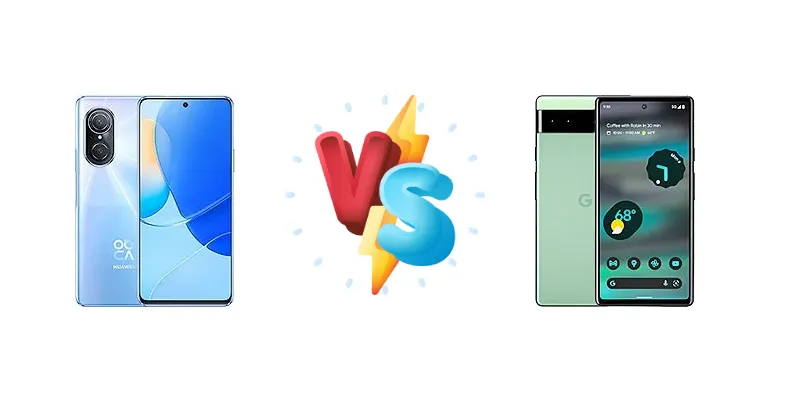
|
🏆 Quick Verdict
For most users, the Google Pixel 6a is the stronger choice, thanks to its significantly more powerful Google Tensor chipset and superior image processing. However, the Huawei nova 9 SE’s blazing-fast 66W charging – capable of reaching 75% charge in just 20 minutes – is a compelling advantage for those who prioritize minimizing downtime.
| PHONES | ||
|---|---|---|
| Phone Names | Huawei nova 9 SE | Google Pixel 6a |
| Network | ||
|---|---|---|
| 2G bands | GSM 850 / 900 / 1800 / 1900 | GSM 850 / 900 / 1800 / 1900 |
| 3G bands | HSDPA 850 / 900 / 1900 / 2100 - JLN-LX1 | HSDPA 800 / 850 / 900 / 1700(AWS) / 1900 / 2100 |
| 4G bands | 1, 3, 5, 7, 8, 20, 28, 34, 38, 39, 40, 41 - JLN-LX1 | 1, 2, 3, 4, 5, 7, 8, 12, 13, 14, 17, 18, 19, 20, 25, 26, 28, 29, 30, 38, 39, 40, 41, 42, 48, 66, 71 - GX7AS, GB62Z (USA/Canada) |
| 5G bands | - | 1, 2, 3, 5, 7, 8, 12, 20, 25, 28, 30, 38, 40, 41, 48, 66, 71, 77, 78 SA/NSA/Sub6 - GX7AS (USA/Canada) |
| Speed | HSPA, LTE | HSPA, LTE, 5G |
| Technology | GSM / HSPA / LTE | GSM / HSPA / LTE / 5G |
| 1, 2, 3, 4, 5, 7, 8, 12, 13, 17, 26, 28, 38, 40, 41, 66 - JLN-LX3 | 1, 2, 3, 5, 7, 8, 12, 20, 25, 28, 30, 40, 48, 66, 71, 77, 78 SA/NSA/Sub6 - G1AZG (International) | |
| Launch | ||
|---|---|---|
| Announced | 2022, March 08 | 2022, May 11 |
| Status | Available. Released 2022, March 20 | Available. Released 2022, July 21 |
| Body | ||
|---|---|---|
| Build | - | Glass front (Gorilla Glass 3), aluminum frame, plastic back |
| Dimensions | 164.6 x 75.6 x 7.9 mm (6.48 x 2.98 x 0.31 in) | 152.2 x 71.8 x 8.9 mm (5.99 x 2.83 x 0.35 in) |
| SIM | Nano-SIM + Nano-SIM | Nano-SIM + eSIM |
| Weight | 191 g (6.74 oz) | 178 g (6.28 oz) |
| - | IP67 dust/water resistant (up to 1m for 30 min) | |
| Display | ||
|---|---|---|
| Protection | - | Corning Gorilla Glass 3 |
| Resolution | 1080 x 2388 pixels (~387 ppi density) | 1080 x 2400 pixels, 20:9 ratio (~429 ppi density) |
| Size | 6.78 inches, 111.4 cm2 (~89.5% screen-to-body ratio) | 6.1 inches, 90.7 cm2 (~83.0% screen-to-body ratio) |
| Type | IPS LCD, 90Hz | OLED, HDR |
| - | Always-on display | |
| Platform | ||
|---|---|---|
| CPU | Octa-core (4x2.4 GHz Kryo 265 Gold & 4x1.9 GHz Kryo 265 Silver) | Octa-core (2x2.80 GHz Cortex-X1 & 2x2.25 GHz Cortex-A76 & 4x1.80 GHz Cortex-A55) |
| Chipset | Qualcomm SM6225 Snapdragon 680 4G (6 nm) | Google Tensor (5 nm) |
| GPU | Adreno 610 | Mali-G78 MP20 |
| OS | Android 11, EMUI 12, no Google Play Services | Android 12, upgradable to Android 15, up to 5 major Android upgrades |
| Memory | ||
|---|---|---|
| Card slot | microSDXC (uses shared SIM slot) | No |
| Internal | 128GB 6GB RAM, 128GB 8GB RAM, 256GB 8GB RAM, 512GB 8GB RAM | 128GB 6GB RAM |
| - | UFS 3.1 | |
| Main Camera | ||
|---|---|---|
| Dual | - | 12.2 MP, f/1.7, 27mm, (wide), 1/2.55", 1.4µm, dual pixel PDAF, OIS 12 MP, f/2.2, 17mm, 114˚ (ultrawide), 1.25µm |
| Features | LED flash, HDR, panorama | Dual-LED flash, Pixel Shift, Auto-HDR, panorama |
| Quad | 108 MP, f/1.9, (wide), 1/1.52", 0.7µm, PDAF 8 MP, f/2.2, 112˚ (ultrawide) 2 MP (macro) Auxiliary lens | - |
| Single | 16 MP, f/2.2, 22mm (wide) | 8 MP, f/2.0, 24mm (wide), 1.12µm |
| Video | 1080p@30fps, gyro-EIS | 4K@30/60fps, 1080p@30/60/120/240fps; gyro-EIS, OIS |
| Selfie camera | ||
|---|---|---|
| Features | - | HDR, panorama |
| Single | 16 MP, f/2.2, 22mm (wide) | 8 MP, f/2.0, 24mm (wide), 1.12µm |
| Video | 1080p@30fps | 1080p@30fps |
| Sound | ||
|---|---|---|
| 3.5mm jack | No | No |
| 35mm jack | No | No |
| Loudspeaker | Yes | Yes, with stereo speakers |
| Comms | ||
|---|---|---|
| Bluetooth | 5.0, A2DP, LE | 5.2, A2DP, LE |
| NFC | Yes (JLN-XL1 only) | Yes |
| Positioning | GPS, GLONASS, GALILEO, BDS, QZSS | GPS, GLONASS, GALILEO, QZSS |
| Radio | No | No |
| USB | USB Type-C 2.0, OTG | USB Type-C 3.1 |
| WLAN | Wi-Fi 802.11 a/b/g/n/ac, dual-band, Wi-Fi Direct | Wi-Fi 802.11 a/b/g/n/ac/6e, dual-band, Wi-Fi Direct |
| Features | ||
|---|---|---|
| Sensors | Fingerprint (side-mounted), accelerometer, gyro, compass | Fingerprint (under display, optical), accelerometer, gyro, proximity, compass, barometer |
| Virtual proximity sensing | - | |
| Battery | ||
|---|---|---|
| Charging | 66W wired, 75% in 20 min | 18W wired, PD3.0 |
| Type | Li-Po 4000 mAh | Li-Po 4410 mAh |
| Misc | ||
|---|---|---|
| Colors | Midnight Black, Pearl White, Crystal Blue | Chalk, Charcoal, Sage |
| Models | JLN-LX1, JLN-LX3, JuliaQN-L01B, JuliaQN-L21B, JuliaQN-L23A, RMX2190, FIO-BD00, JLN-AL00 | GX7AS, GB62Z, G1AZG, GB17L |
| Price | About 150 EUR | $ 138.99 / C$ 228.74 / ₹ 23,999 |
| Tests | ||
|---|---|---|
| Battery life | - | Endurance rating 94h |
| Display | - | Contrast ratio: Infinite (nominal) |
Huawei nova 9 SE
- Significantly more powerful Google Tensor chip
- Superior camera image processing and features
- Guaranteed software updates and security patches
- Slower 18W charging
- May be more expensive than the Nova 9 SE
Google Pixel 6a
- Blazing-fast 66W charging (75% in 20 minutes)
- Sleek and stylish design
- Potentially lower price point
- Less powerful Snapdragon 680 chipset
- Limited software update commitment
Display Comparison
The Pixel 6a boasts a measured peak brightness of 876 nits, offering excellent visibility in bright sunlight. While the nova 9 SE’s display specs aren’t provided, its contrast ratio is listed as 'Infinite (nominal)', suggesting a good quality OLED panel. The Pixel 6a’s higher peak brightness is a tangible benefit for outdoor use, and its display technology likely offers better color accuracy, crucial for photo and video editing. The lack of detailed display specs for the nova 9 SE makes a direct comparison difficult, but the Pixel 6a holds a clear advantage based on measured data.
Camera Comparison
The Pixel 6a’s camera prowess is largely attributed to Google’s computational photography. While sensor details aren’t provided, the Pixel’s image processing algorithms are renowned for their dynamic range and detail. The nova 9 SE’s camera specs are also limited, making a direct sensor comparison impossible. However, the Pixel 6a’s Tensor chip includes dedicated image processing hardware, enabling features like Magic Eraser and Real Tone, which are unavailable on the nova 9 SE. The Pixel 6a’s focus on software optimization gives it a distinct edge in image quality, particularly in challenging lighting conditions.
Performance
The core difference lies in the chipsets. The Google Pixel 6a’s Google Tensor (5nm) is a substantial leap ahead of the Huawei nova 9 SE’s Qualcomm Snapdragon 680 (6nm). Tensor’s octa-core configuration, featuring 2x2.80 GHz Cortex-X1 cores, delivers significantly higher peak performance, especially in computationally intensive tasks like video editing and AI-powered features. The Snapdragon 680, while efficient, is geared towards everyday use. The 5nm fabrication process of the Tensor chip also contributes to better thermal efficiency, potentially reducing throttling during sustained workloads. This translates to a smoother, more responsive experience on the Pixel 6a for power users.
Battery Life
Both phones achieve an endurance rating of 94 hours, indicating similar overall battery life. However, the charging experience is drastically different. The Huawei nova 9 SE’s 66W wired charging is a game-changer, reaching 75% charge in just 20 minutes. The Pixel 6a’s 18W charging, while supporting PD3.0, is considerably slower. This means the nova 9 SE is ideal for users who frequently need to top up their battery quickly, while the Pixel 6a relies on its efficient chipset and software optimization to maintain all-day battery life despite the slower charging speed.
Buying Guide
Buy the Huawei nova 9 SE if you need exceptionally fast charging and a stylish design are paramount, and you primarily use your phone for everyday tasks like social media and light browsing. Buy the Google Pixel 6a if you prioritize processing power for demanding apps, a class-leading camera experience, and guaranteed software updates, even if it means slower charging speeds.