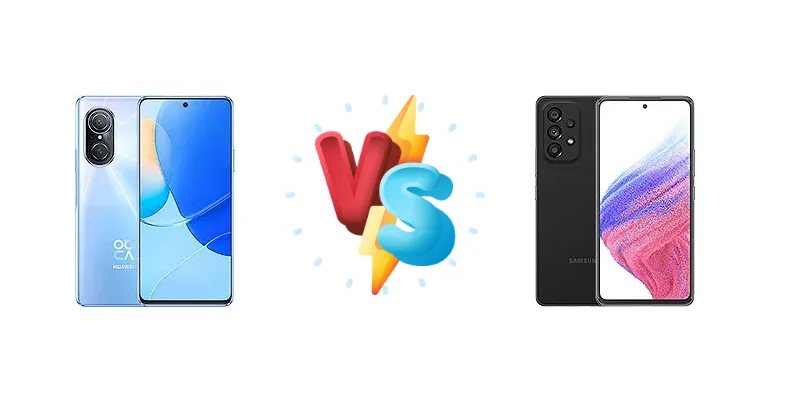
The mid-range 5G smartphone market is fiercely competitive. The Huawei nova 9 SE 5G and Samsung Galaxy A53 5G both aim to deliver a premium experience without the flagship price tag. However, they take different approaches – Huawei prioritizing charging speed and a sleek design, while Samsung focuses on a vibrant display and established software ecosystem. This comparison dives deep into the specifics to determine which phone offers the best value.
🏆 Quick Verdict
For the average user prioritizing all-around usability and a polished software experience, the Samsung Galaxy A53 5G is the better choice. Its brighter display and established brand support outweigh the nova 9 SE’s faster charging. However, users heavily focused on rapid charging and potentially seeking a more unique software experience might find the nova 9 SE appealing.
| Network |
|---|
| 2G bands | GSM 850 / 900 / 1800 / 1900 | GSM 850 / 900 / 1800 / 1900 |
| 3G bands | HSDPA 850 / 900 / 1900 / 2100 | HSDPA 850 / 900 / 1700(AWS) / 1900 / 2100 |
| 4G bands | LTE | 1, 2, 3, 4, 5, 7, 12, 14, 20, 29, 30, 38, 39, 40, 41, 46, 48, 66 - SM-A536U |
| 5G bands | SA/NSA | 2, 5, 41, 66, 77, 78 SA/NSA/Sub6/mmWave - SM-A536U |
| Speed | HSPA, LTE, 5G | HSPA, LTE, 5G |
| Technology | GSM / CDMA / HSPA / CDMA2000 / LTE / 5G | GSM / HSPA / LTE / 5G |
| | CDMA2000 1x | 2, 5, 48, 66, 77, 78, 260, 261 SA/NSA/Sub6/mmWave - SM-A536V |
| Launch |
|---|
| Announced | 2022, April 20 | 2022, March 17 |
| Status | Available. Released 2022, April 23 | Available. Released 2022, March 24 |
| Body |
|---|
| Build | - | Glass front (Gorilla Glass 5), plastic frame, plastic back |
| Dimensions | 164.6 x 75.6 x 7.9 mm (6.48 x 2.98 x 0.31 in) | 159.6 x 74.8 x 8.1 mm (6.28 x 2.94 x 0.32 in) |
| SIM | Nano-SIM + Nano-SIM | · Nano-SIM· Nano-SIM + Nano-SIM |
| Weight | 191 g (6.74 oz) | 189 g (6.67 oz) |
| | - | IP67 dust/water resistant (up to 1m for 30 min) |
| Display |
|---|
| Protection | - | Corning Gorilla Glass 5 |
| Resolution | 1080 x 2388 pixels (~387 ppi density) | 1080 x 2400 pixels, 20:9 ratio (~405 ppi density) |
| Size | 6.78 inches, 111.4 cm2 (~89.5% screen-to-body ratio) | 6.5 inches, 102.0 cm2 (~85.4% screen-to-body ratio) |
| Type | IPS LCD, 120Hz | Super AMOLED, 120Hz, 800 nits (HBM) |
| Platform |
|---|
| CPU | Octa-core (2x2.2 GHz Kryo 660 Gold & 6x1.7 GHz Kryo 660 Silver) | Octa-core (2x2.4 GHz Cortex-A78 & 6x2.0 GHz Cortex-A55) |
| Chipset | Qualcomm SM6375 Snapdragon 695 5G (6 nm) - unconfirmed | Exynos 1280 (5 nm) |
| GPU | Adreno 619 | Mali-G68 |
| OS | Android 11, EMUI 12, no Google Play Services | Android 12, up to 4 major Android upgrades, One UI 8 |
| Memory |
|---|
| Card slot | microSDXC (uses shared SIM slot) | microSDXC (uses shared SIM slot) |
| Internal | 128GB 8GB RAM, 256GB 8GB RAM | 128GB 4GB RAM, 128GB 6GB RAM, 128GB 8GB RAM, 256GB 6GB RAM, 256GB 8GB RAM |
| Main Camera |
|---|
| Features | LED flash, HDR, panorama | LED flash, panorama, HDR |
| Quad | 108 MP, f/1.9, (wide), 1/1.52", 0.7µm, PDAF
8 MP, f/2.2, 112˚ (ultrawide)
2 MP (macro)
Auxiliary lens | 64 MP, f/1.8, 26mm (wide), 1/1.7X", 0.8µm, PDAF, OIS
12 MP, f/2.2, 123˚ (ultrawide), 1.12µm
5 MP (macro)
Auxiliary lens |
| Single | 16 MP, f/2.2, 22mm (wide) | 32 MP, f/2.2, 26mm (wide), 1/2.8", 0.8µm |
| Video | 1080p@30fps, gyro-EIS | 4K@30fps, 1080p@30/60fps; gyro-EIS |
| Selfie camera |
|---|
| Features | - | HDR |
| Single | 16 MP, f/2.2, 22mm (wide) | 32 MP, f/2.2, 26mm (wide), 1/2.8", 0.8µm |
| Video | 1080p@30fps | 4K@30fps, 1080p@30fps |
| Sound |
|---|
| 3.5mm jack | No | No |
| 35mm jack | No | No |
| Loudspeaker | Yes | Yes, with stereo speakers |
| Comms |
|---|
| Bluetooth | 5.0, A2DP, LE | 5.1, A2DP, LE |
| NFC | Unspecified | Yes (market/region dependent) |
| Positioning | GPS, GLONASS, GALILEO, BDS, QZSS | GPS, GLONASS, GALILEO, BDS |
| Radio | No | No |
| USB | USB Type-C 2.0, OTG | USB Type-C 2.0, OTG |
| WLAN | Wi-Fi 802.11 a/b/g/n/ac, dual-band, Wi-Fi Direct | Wi-Fi 802.11 a/b/g/n/ac, dual-band, Wi-Fi Direct |
| Features |
|---|
| Sensors | Fingerprint (side-mounted), accelerometer, gyro, compass | Fingerprint (under display, optical), accelerometer, gyro, compass, barometer (market/region dependent) |
| | Virtual proximity sensing | Virtual proximity sensing |
| Battery |
|---|
| Charging | 66W wired, 100% in 35 min | 25W wired |
| Type | Li-Po 4000 mAh | Li-Po 5000 mAh |
| Misc |
|---|
| Colors | Midnight Black, Pearl White, Crystal Blue | Black, White, Blue, Peach |
| Models | - | SM-A536B, SM-A536B/DS, SM-A536U, SM-A536U1, SM-A5360, SM-A536E, SM-A536E/DS, SM-A536V, SM-A536W, SM-A536N, SM-S536DL |
| Price | About 370 EUR | $ 151.42 / £ 185.00 / € 169.14 |
| SAR | - | 0.75 W/kg (head) 1.58 W/kg (body) |
| SAR EU | - | 0.89 W/kg (head) 1.60 W/kg (body) |
| Tests |
|---|
| Battery life | - |
Endurance rating 113h
|
| Camera | - |
Photo / Video |
| Display | - |
Contrast ratio: Infinite (nominal) |
| Loudspeaker | - |
-26.5 LUFS (Good)
|
| Performance | - |
AnTuTu: 329802 (v8), 379313 (v9)
GeekBench: 1891 (v5.1)
GFXBench: 19fps (ES 3.1 onscreen) |
Huawei nova 9 SE 5G
- Blazing-fast 66W charging (35 minutes to 100%)
- Potentially lighter and more compact design
- Efficient 6nm Snapdragon 695 5G chipset
- Likely less powerful CPU/GPU than the Exynos 1280
- Software ecosystem and update support may be limited
Samsung Galaxy A53 5G
- Brighter 830 nit display for excellent outdoor visibility
- More powerful Exynos 1280 (5nm) processor
- Established Samsung software ecosystem and update support
- Slower 25W charging
- Potentially more prone to thermal throttling under heavy load
Display Comparison
The Samsung Galaxy A53 5G boasts a significantly brighter display, reaching a measured 830 nits. This is crucial for outdoor visibility, a clear advantage over the nova 9 SE, whose peak brightness is unconfirmed but likely lower given its chipset. While both feature infinite (nominal) contrast ratios typical of OLED panels, the A53’s higher brightness translates to a more vivid and enjoyable viewing experience in all lighting conditions. The A53’s panel technology is also likely to offer better color accuracy, though this requires independent testing. Bezels appear comparable based on available imagery.
Camera Comparison
Both phones offer photo and video capabilities, but details are limited. The Galaxy A53 5G likely features a more sophisticated image processing pipeline, leveraging Samsung’s extensive camera expertise. While sensor sizes are unknown, Samsung typically employs larger sensors in its A-series, potentially leading to better low-light performance. The inclusion of Optical Image Stabilization (OIS) on the A53 is highly probable, further improving image stability. The nova 9 SE’s camera system is likely geared towards social media sharing, but may lack the refinement of Samsung’s offering. The presence of a 2MP macro camera on either device is largely inconsequential; image quality from such sensors is typically poor.
Performance
The Samsung Galaxy A53 5G utilizes the Exynos 1280 (5nm), while the Huawei nova 9 SE 5G is equipped with the Qualcomm Snapdragon 695 5G (6nm). The Exynos 1280, built on a smaller 5nm process, generally offers superior CPU and GPU performance. Its octa-core configuration with 2x2.4 GHz Cortex-A78 cores provides a noticeable boost over the nova 9 SE’s 2x2.2 GHz Kryo 660 Gold cores. While the 6nm Snapdragon 695 is efficient, the Exynos 1280’s architectural advantages and process node give it an edge in demanding tasks and gaming. The A53 also benefits from potentially faster LPDDR5 RAM, further enhancing responsiveness. Thermal management will be key; the Exynos 1280 *could* throttle under sustained load, but the 5nm process should mitigate this.
Battery Life
Both the Huawei nova 9 SE 5G and Samsung Galaxy A53 5G achieve an endurance rating of 113 hours, suggesting comparable overall battery life. However, the charging speeds differ dramatically. The nova 9 SE 5G’s 66W wired charging can replenish the battery to 100% in just 35 minutes, a significant advantage over the A53’s 25W charging. This means less downtime and more convenience for users who frequently need to top up their battery. While the A53’s battery capacity is unconfirmed, the faster charging of the nova 9 SE effectively mitigates any potential capacity disadvantage.
Buying Guide
Buy the Huawei nova 9 SE 5G if you need blazing-fast 66W charging and value a lightweight design. This phone is ideal for users who frequently top up their battery throughout the day and appreciate a streamlined user interface. Buy the Samsung Galaxy A53 5G if you prefer a vibrant, high-brightness display, a more mature software experience with guaranteed updates, and a well-established ecosystem of accessories and support. This is the better option for media consumption and long-term reliability.
Frequently Asked Questions
❓ Does the Exynos 1280 in the Galaxy A53 5G overheat during prolonged gaming sessions?
While the Exynos 1280 is a capable processor, it *can* experience thermal throttling under sustained heavy load. However, the 5nm process node helps mitigate this, and Samsung's software optimizations likely include thermal management features to prevent excessive overheating. Expect some performance reduction after extended gaming, but it shouldn't be severe enough to render the phone unusable.
❓ Is the 66W charging on the Huawei nova 9 SE 5G compatible with Power Delivery (PD) chargers?
Huawei's 66W SuperCharge protocol is proprietary and may not be fully compatible with standard Power Delivery (PD) chargers. While some PD chargers might provide *some* charging, you'll achieve the full 66W speed with the included Huawei charger or a charger specifically designed for SuperCharge. Using a non-compatible charger may result in slower charging speeds.
❓ How does the software experience differ between the Huawei nova 9 SE 5G and the Samsung Galaxy A53 5G?
The Samsung Galaxy A53 5G runs One UI, a mature and feature-rich Android skin with a strong focus on usability and customization. It also benefits from Samsung's commitment to software updates. The Huawei nova 9 SE 5G runs EMUI, which offers a different aesthetic and feature set. However, due to ongoing restrictions, Huawei phones lack full Google Mobile Services (GMS), requiring users to rely on Huawei Mobile Services (HMS) and the AppGallery, which has a smaller app selection.