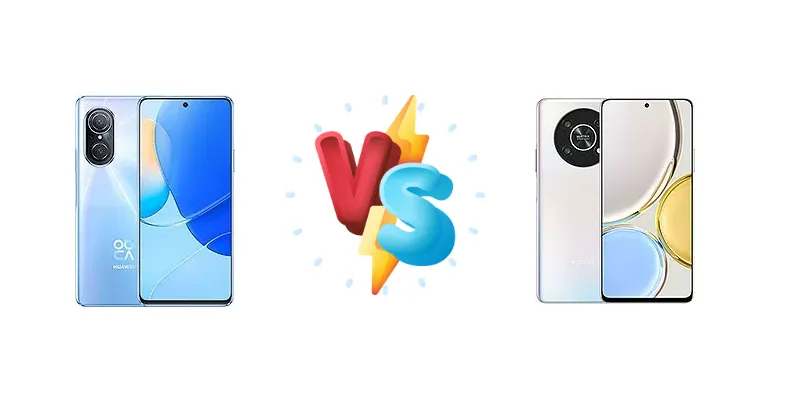
The Huawei nova 9 SE 5G and the Honor X9 5G represent a fascinating intersection of brands and hardware. Both devices leverage the Qualcomm Snapdragon 695 5G chipset, aiming for the competitive mid-range 5G market. However, subtle differences in CPU clock speeds and charging implementation create distinct user experiences, making a direct comparison crucial for informed buyers.
🏆 Quick Verdict
For the average user prioritizing the fastest possible charging, the Honor X9 5G edges out the Huawei nova 9 SE 5G. While both reach 100% with 66W charging, the Honor X9 5G achieves 81% in 30 minutes, suggesting a more efficient charging curve and quicker top-ups during typical use.
| Network |
|---|
| 2G bands | GSM 850 / 900 / 1800 / 1900 | GSM 850 / 900 / 1800 / 1900 |
| 3G bands | HSDPA 850 / 900 / 1900 / 2100 | HSDPA 850 / 900 / 1700(AWS) / 1900 / 2100 |
| 4G bands | LTE | LTE |
| 5G bands | SA/NSA | SA/NSA |
| Speed | HSPA, LTE, 5G | HSPA, LTE, 5G |
| Technology | GSM / CDMA / HSPA / CDMA2000 / LTE / 5G | GSM / HSPA / LTE / 5G |
| | CDMA2000 1x | Virtual proximity sensing |
| Launch |
|---|
| Announced | 2022, April 20 | 2022, March 29 |
| Status | Available. Released 2022, April 23 | Available. Released 2022, March 29 |
| Body |
|---|
| Build | - | Glass front, plastic frame, plastic back |
| Dimensions | 164.6 x 75.6 x 7.9 mm (6.48 x 2.98 x 0.31 in) | 166.1 x 75.8 x 8.1 mm (6.54 x 2.98 x 0.32 in) |
| SIM | Nano-SIM + Nano-SIM | Nano-SIM + Nano-SIM |
| Weight | 191 g (6.74 oz) | 189 g (6.67 oz) |
| Display |
|---|
| Resolution | 1080 x 2388 pixels (~387 ppi density) | 1080 x 2388 pixels (~385 ppi density) |
| Size | 6.78 inches, 111.4 cm2 (~89.5% screen-to-body ratio) | 6.81 inches, 112.3 cm2 (~89.2% screen-to-body ratio) |
| Type | IPS LCD, 120Hz | IPS LCD, 120Hz |
| Platform |
|---|
| CPU | Octa-core (2x2.2 GHz Kryo 660 Gold & 6x1.7 GHz Kryo 660 Silver) | Octa-core (2x2.2 GHz Kryo 660 Gold & 6x1.8 GHz Kryo 660 Silver) |
| Chipset | Qualcomm SM6375 Snapdragon 695 5G (6 nm) - unconfirmed | Qualcomm SM6375 Snapdragon 695 5G (6 nm) |
| GPU | Adreno 619 | Adreno 619 |
| OS | Android 11, EMUI 12, no Google Play Services | Android 11, Magic UI 4.2 |
| Memory |
|---|
| Card slot | microSDXC (uses shared SIM slot) | No |
| Internal | 128GB 8GB RAM, 256GB 8GB RAM | 128GB 8GB RAM, 256GB 8GB RAM |
| Main Camera |
|---|
| Features | LED flash, HDR, panorama | LED flash, panorama, HDR |
| Quad | 108 MP, f/1.9, (wide), 1/1.52", 0.7µm, PDAF
8 MP, f/2.2, 112˚ (ultrawide)
2 MP (macro)
Auxiliary lens | - |
| Single | 16 MP, f/2.2, 22mm (wide) | 16 MP, f/2.5 |
| Triple | - | 48 MP, f/1.8, 26mm (wide), PDAF
2 MP (macro)
Auxiliary lens |
| Video | 1080p@30fps, gyro-EIS | 1080p@30fps |
| Selfie camera |
|---|
| Single | 16 MP, f/2.2, 22mm (wide) | 16 MP, f/2.5 |
| Video | 1080p@30fps | 1080p@30fps |
| Sound |
|---|
| 3.5mm jack | No | No |
| 35mm jack | No | No |
| Loudspeaker | Yes | Yes |
| Comms |
|---|
| Bluetooth | 5.0, A2DP, LE | 5.1, A2DP, LE |
| NFC | Unspecified | Yes |
| Positioning | GPS, GLONASS, GALILEO, BDS, QZSS | GPS, GLONASS, GALILEO, BDS |
| Radio | No | No |
| USB | USB Type-C 2.0, OTG | USB Type-C 2.0, OTG |
| WLAN | Wi-Fi 802.11 a/b/g/n/ac, dual-band, Wi-Fi Direct | Wi-Fi 802.11 a/b/g/n/ac, dual-band, Wi-Fi Direct |
| Features |
|---|
| Sensors | Fingerprint (side-mounted), accelerometer, gyro, compass | Fingerprint (side-mounted), accelerometer, gyro, compass |
| | Virtual proximity sensing | - |
| Battery |
|---|
| Charging | 66W wired, 100% in 35 min | 66W wired, 81% in 30 min |
| Type | Li-Po 4000 mAh | Li-Po 4800 mAh |
| Misc |
|---|
| Colors | Midnight Black, Pearl White, Crystal Blue | Titanium Silver, Ocean Blue, Midnight Black |
| Models | - | ANY-NX1 |
| Price | About 370 EUR | About 240 EUR |
Huawei nova 9 SE 5G
- Potentially optimized Huawei software experience.
- 66W fast charging for quick power-ups.
- Snapdragon 695 5G provides 5G connectivity.
- Slightly slower CPU clock speed compared to Honor X9 5G.
- Charging takes slightly longer to reach 100%.
Honor X9 5G
- Faster charging curve, reaching 81% in 30 minutes.
- Slightly higher CPU clock speed for potentially better performance.
- Potentially cleaner Android experience.
- May lack the software optimizations found on Huawei devices.
- Charging takes slightly longer to reach 100% compared to stated time.
Display Comparison
Neither Huawei nor Honor provide detailed display specifications in the provided data. However, given the price point, we can anticipate both devices utilize LCD panels. The absence of information regarding refresh rates (60Hz vs 90Hz or 120Hz) is a key omission. Color accuracy and peak brightness will likely be similar, targeting a standard mid-range experience. The user experience will depend heavily on software calibration, which differs between Huawei and Honor.
Camera Comparison
Without sensor details, a direct camera comparison is limited. Both phones likely feature a multi-camera setup, but the quality will hinge on the primary sensor's resolution and aperture. The inclusion of a 2MP macro camera on either device is likely a marketing tactic, offering limited practical benefit due to the small sensor size and lack of optical image stabilization (OIS). Image processing algorithms will be a key differentiator, with Huawei historically emphasizing vibrant colors and aggressive sharpening, while Honor tends towards a more natural look.
Performance
Both the Huawei nova 9 SE 5G and Honor X9 5G are powered by the Qualcomm Snapdragon 695 5G (6 nm). The core difference lies in the CPU configuration: the nova 9 SE 5G features 6x1.7 GHz Kryo 660 Silver cores, while the X9 5G boasts 6x1.8 GHz Kryo 660 Silver cores. This 100MHz difference, while seemingly minor, could translate to slightly snappier performance in multi-threaded tasks and sustained workloads. Thermal management will be critical; the 6nm process node is efficient, but prolonged gaming or video encoding could still lead to throttling. The RAM type (LPDDR4x or LPDDR5) is unknown, impacting overall system responsiveness.
Battery Life
Both devices utilize 66W wired charging, a significant advantage in this price segment. However, the Honor X9 5G demonstrates a faster charging curve, reaching 81% charge in 30 minutes compared to the nova 9 SE 5G’s 100% in 35 minutes. This suggests the Honor X9 5G may prioritize faster initial charging, while the Huawei nova 9 SE 5G focuses on completing the full charge cycle. The battery capacity is not specified, but a typical range for this class of device is 4500mAh to 5000mAh. The faster charging of the Honor X9 5G will be more noticeable for users who frequently top up their phones throughout the day.
Buying Guide
Buy the Huawei nova 9 SE 5G if you prioritize brand recognition within the Huawei ecosystem and potentially benefit from software optimizations tailored to Huawei services. Buy the Honor X9 5G if you prefer a slightly faster charging experience and a potentially cleaner Android experience, free from Huawei’s proprietary software layers. Both are excellent choices for users seeking affordable 5G connectivity.
Frequently Asked Questions
❓ Will the Snapdragon 695 5G in either phone struggle with demanding games like PUBG Mobile?
The Snapdragon 695 5G is a capable chipset for mid-range gaming, but demanding titles like PUBG Mobile will likely require reduced graphics settings for a smooth experience. The slightly faster CPU clock speed of the Honor X9 5G might offer a marginal advantage in sustained performance, but thermal throttling could be a limiting factor on both devices.
❓ How does the 66W charging on the Honor X9 5G compare to other fast charging standards?
66W charging is significantly faster than standard 15W or 25W charging. While not as rapid as some 120W or 150W solutions found in higher-end phones, it provides a substantial top-up in a short amount of time. The Honor X9 5G's ability to reach 81% charge in 30 minutes makes it a convenient option for users who need a quick power boost.
❓ Is the difference in CPU clock speed (1.7 GHz vs 1.8 GHz) between the nova 9 SE 5G and X9 5G noticeable in everyday use?
The 100MHz difference in CPU clock speed is unlikely to be dramatically noticeable in typical everyday tasks like browsing, social media, or messaging. However, it *could* result in slightly faster performance during more demanding tasks like video editing or running multiple apps simultaneously. The overall system responsiveness will also depend on RAM speed and software optimization.