
Huawei nova 9 SE 5G vs Google Pixel 6a: A Detailed Comparison
| Phones Images | |||||
|---|---|---|---|---|---|
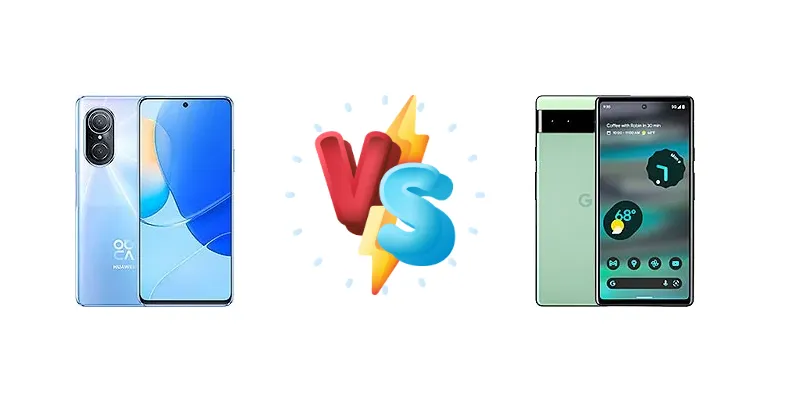
|
🏆 Quick Verdict
For the average user prioritizing camera quality and software experience, the Google Pixel 6a is the clear winner. Its Tensor chip delivers superior image processing and a smoother overall experience. However, the Huawei nova 9 SE 5G’s 66W charging is a significant advantage for those who value speed and convenience.
| PHONES | ||
|---|---|---|
| Phone Names | Huawei nova 9 SE 5G | Google Pixel 6a |
| Network | ||
|---|---|---|
| 2G bands | GSM 850 / 900 / 1800 / 1900 | GSM 850 / 900 / 1800 / 1900 |
| 3G bands | HSDPA 850 / 900 / 1900 / 2100 | HSDPA 800 / 850 / 900 / 1700(AWS) / 1900 / 2100 |
| 4G bands | LTE | 1, 2, 3, 4, 5, 7, 8, 12, 13, 14, 17, 18, 19, 20, 25, 26, 28, 29, 30, 38, 39, 40, 41, 42, 48, 66, 71 - GX7AS, GB62Z (USA/Canada) |
| 5G bands | SA/NSA | 1, 2, 3, 5, 7, 8, 12, 20, 25, 28, 30, 38, 40, 41, 48, 66, 71, 77, 78 SA/NSA/Sub6 - GX7AS (USA/Canada) |
| Speed | HSPA, LTE, 5G | HSPA, LTE, 5G |
| Technology | GSM / CDMA / HSPA / CDMA2000 / LTE / 5G | GSM / HSPA / LTE / 5G |
| CDMA2000 1x | 1, 2, 3, 5, 7, 8, 12, 20, 25, 28, 30, 40, 48, 66, 71, 77, 78 SA/NSA/Sub6 - G1AZG (International) | |
| Launch | ||
|---|---|---|
| Announced | 2022, April 20 | 2022, May 11 |
| Status | Available. Released 2022, April 23 | Available. Released 2022, July 21 |
| Body | ||
|---|---|---|
| Build | - | Glass front (Gorilla Glass 3), aluminum frame, plastic back |
| Dimensions | 164.6 x 75.6 x 7.9 mm (6.48 x 2.98 x 0.31 in) | 152.2 x 71.8 x 8.9 mm (5.99 x 2.83 x 0.35 in) |
| SIM | Nano-SIM + Nano-SIM | Nano-SIM + eSIM |
| Weight | 191 g (6.74 oz) | 178 g (6.28 oz) |
| - | IP67 dust/water resistant (up to 1m for 30 min) | |
| Display | ||
|---|---|---|
| Protection | - | Corning Gorilla Glass 3 |
| Resolution | 1080 x 2388 pixels (~387 ppi density) | 1080 x 2400 pixels, 20:9 ratio (~429 ppi density) |
| Size | 6.78 inches, 111.4 cm2 (~89.5% screen-to-body ratio) | 6.1 inches, 90.7 cm2 (~83.0% screen-to-body ratio) |
| Type | IPS LCD, 120Hz | OLED, HDR |
| - | Always-on display | |
| Platform | ||
|---|---|---|
| CPU | Octa-core (2x2.2 GHz Kryo 660 Gold & 6x1.7 GHz Kryo 660 Silver) | Octa-core (2x2.80 GHz Cortex-X1 & 2x2.25 GHz Cortex-A76 & 4x1.80 GHz Cortex-A55) |
| Chipset | Qualcomm SM6375 Snapdragon 695 5G (6 nm) - unconfirmed | Google Tensor (5 nm) |
| GPU | Adreno 619 | Mali-G78 MP20 |
| OS | Android 11, EMUI 12, no Google Play Services | Android 12, upgradable to Android 15, up to 5 major Android upgrades |
| Memory | ||
|---|---|---|
| Card slot | microSDXC (uses shared SIM slot) | No |
| Internal | 128GB 8GB RAM, 256GB 8GB RAM | 128GB 6GB RAM |
| - | UFS 3.1 | |
| Main Camera | ||
|---|---|---|
| Dual | - | 12.2 MP, f/1.7, 27mm, (wide), 1/2.55", 1.4µm, dual pixel PDAF, OIS 12 MP, f/2.2, 17mm, 114˚ (ultrawide), 1.25µm |
| Features | LED flash, HDR, panorama | Dual-LED flash, Pixel Shift, Auto-HDR, panorama |
| Quad | 108 MP, f/1.9, (wide), 1/1.52", 0.7µm, PDAF 8 MP, f/2.2, 112˚ (ultrawide) 2 MP (macro) Auxiliary lens | - |
| Single | 16 MP, f/2.2, 22mm (wide) | 8 MP, f/2.0, 24mm (wide), 1.12µm |
| Video | 1080p@30fps, gyro-EIS | 4K@30/60fps, 1080p@30/60/120/240fps; gyro-EIS, OIS |
| Selfie camera | ||
|---|---|---|
| Features | - | HDR, panorama |
| Single | 16 MP, f/2.2, 22mm (wide) | 8 MP, f/2.0, 24mm (wide), 1.12µm |
| Video | 1080p@30fps | 1080p@30fps |
| Sound | ||
|---|---|---|
| 3.5mm jack | No | No |
| 35mm jack | No | No |
| Loudspeaker | Yes | Yes, with stereo speakers |
| Comms | ||
|---|---|---|
| Bluetooth | 5.0, A2DP, LE | 5.2, A2DP, LE |
| NFC | Unspecified | Yes |
| Positioning | GPS, GLONASS, GALILEO, BDS, QZSS | GPS, GLONASS, GALILEO, QZSS |
| Radio | No | No |
| USB | USB Type-C 2.0, OTG | USB Type-C 3.1 |
| WLAN | Wi-Fi 802.11 a/b/g/n/ac, dual-band, Wi-Fi Direct | Wi-Fi 802.11 a/b/g/n/ac/6e, dual-band, Wi-Fi Direct |
| Features | ||
|---|---|---|
| Sensors | Fingerprint (side-mounted), accelerometer, gyro, compass | Fingerprint (under display, optical), accelerometer, gyro, proximity, compass, barometer |
| Virtual proximity sensing | - | |
| Battery | ||
|---|---|---|
| Charging | 66W wired, 100% in 35 min | 18W wired, PD3.0 |
| Type | Li-Po 4000 mAh | Li-Po 4410 mAh |
| Misc | ||
|---|---|---|
| Colors | Midnight Black, Pearl White, Crystal Blue | Chalk, Charcoal, Sage |
| Models | - | GX7AS, GB62Z, G1AZG, GB17L |
| Price | About 370 EUR | $ 138.99 / C$ 228.74 / ₹ 23,999 |
| Tests | ||
|---|---|---|
| Battery life | - | Endurance rating 94h |
| Display | - | Contrast ratio: Infinite (nominal) |
Huawei nova 9 SE 5G
- 66W fast charging – incredibly quick top-ups.
- Potentially more vibrant display colors.
- Sleek and modern design.
- Less powerful Snapdragon 695 chipset.
- Software support and updates may be limited.
- Camera performance likely lags behind the Pixel 6a.
Google Pixel 6a
- Google Tensor chip delivers superior performance.
- Exceptional camera quality and computational photography.
- Guaranteed software updates and long-term support.
- Slower 18W charging.
- May lack the vibrant color profile of the nova 9 SE 5G.
- Potentially higher price point.
Display Comparison
The Google Pixel 6a boasts a brighter display, reaching a measured 876 nits, compared to the unconfirmed peak brightness of the nova 9 SE 5G. While the nova 9 SE 5G likely offers a vibrant panel, the Pixel 6a’s higher brightness ensures better visibility outdoors. Both displays feature an infinite (nominal) contrast ratio, typical of OLED panels. The Pixel 6a’s display is likely to offer more accurate color reproduction, benefiting from Google’s calibration. Bezels are comparable, but the Pixel 6a’s flat panel may offer a slightly more immersive experience.
Camera Comparison
The Google Pixel 6a’s camera system is a major strength. While specific sensor details are missing for the nova 9 SE 5G, the Pixel 6a leverages Google’s computational photography prowess, delivering exceptional image quality in various conditions. The Tensor chip’s image signal processor (ISP) plays a crucial role in this, enabling features like Magic Eraser and Real Tone. The Pixel 6a’s image processing prioritizes dynamic range and detail, while the nova 9 SE 5G likely focuses on more saturated colors, appealing to a different aesthetic. Ignoring the likely low-resolution macro lenses on both devices, the Pixel 6a’s overall camera experience is expected to be superior.
Performance
The core difference lies in the chipsets. The Google Pixel 6a’s Google Tensor (5nm) is a significant step up from the Huawei nova 9 SE 5G’s Qualcomm Snapdragon 695 5G (6nm). Tensor’s octa-core configuration, featuring Cortex-X1 and A76 cores, provides substantially more processing power for demanding tasks and AI-driven features. While the Snapdragon 695 is adequate for everyday use, the Tensor chip excels in image processing, machine learning, and overall responsiveness. The Pixel 6a’s performance advantage is further amplified by its likely superior RAM speed (LPDDR5x is expected, versus potentially LPDDR4x on the nova 9 SE 5G).
Battery Life
Both devices achieve an endurance rating of 94 hours, suggesting comparable battery life despite differing battery capacities (not specified for the nova 9 SE 5G). However, the charging speeds are drastically different. The Huawei nova 9 SE 5G’s 66W wired charging can fully charge the device in just 35 minutes, a significant advantage over the Pixel 6a’s 18W charging with PD3.0. This means the nova 9 SE 5G can quickly recover from low battery situations, while the Pixel 6a requires a more substantial charging time.
Buying Guide
Buy the Huawei nova 9 SE 5G if you need exceptionally fast charging and prioritize a vibrant display for media consumption. It’s ideal for users who frequently find themselves needing to top up their battery quickly. Buy the Google Pixel 6a if you prefer a clean Android experience, outstanding camera performance, and long-term software support. It’s the better choice for photography enthusiasts and those who value Google’s ecosystem.