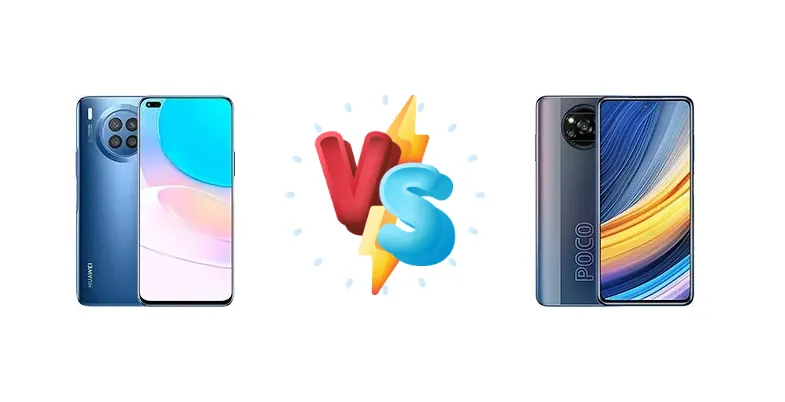
The Huawei nova 8i and Xiaomi Poco X3 Pro represent compelling options in the competitive mid-range smartphone market. While both aim to deliver a solid experience without breaking the bank, they take distinctly different approaches. The nova 8i prioritizes aesthetics and charging speed, while the Poco X3 Pro focuses on raw processing power. This comparison dissects their key differences to help you choose the right device.
🏆 Quick Verdict
For most users, the Xiaomi Poco X3 Pro emerges as the stronger contender. Its Snapdragon 860 chipset provides a significantly more powerful experience for gaming and demanding tasks, outweighing the nova 8i’s faster charging. However, users prioritizing a sleeker design and extremely rapid top-ups may find the nova 8i appealing.
| Network |
|---|
| 2G bands | GSM 850 / 900 / 1800 / 1900 | GSM 850 / 900 / 1800 / 1900 |
| 3G bands | HSDPA 850 / 900 / 2100 | HSDPA 850 / 900 / 1700(AWS) / 1900 / 2100 |
| 4G bands | 1, 3, 5, 7, 8, 20, 28, 38, 40, 41 | 1, 2, 3, 4, 5, 7, 8, 20, 28, 38, 40, 41 - International |
| Speed | HSPA, LTE | HSPA, LTE |
| Technology | GSM / HSPA / LTE | GSM / HSPA / LTE |
| | - | 1, 2, 3, 5, 8, 38, 40, 41 - India |
| Launch |
|---|
| Announced | 2021, July 07 | 2021, March 22 |
| Status | Available. Released 2021, July 22 | Available. Released 2021, March 24 |
| Body |
|---|
| Build | - | Glass front (Gorilla Glass 6), plastic back |
| Dimensions | 161.9 x 74.7 x 8.6 mm (6.37 x 2.94 x 0.34 in) | 165.3 x 76.8 x 9.4 mm (6.51 x 3.02 x 0.37 in) |
| SIM | Nano-SIM + Nano-SIM | Nano-SIM + Nano-SIM |
| Weight | 190 g (6.70 oz) | 215 g (7.58 oz) |
| | - | IP53, dust and splash resistant |
| Display |
|---|
| Protection | - | Corning Gorilla Glass 6 |
| Resolution | 1080 x 2376 pixels (~391 ppi density) | 1080 x 2400 pixels, 20:9 ratio (~395 ppi density) |
| Size | 6.67 inches, 108.1 cm2 (~89.4% screen-to-body ratio) | 6.67 inches, 107.4 cm2 (~84.6% screen-to-body ratio) |
| Type | IPS LCD | IPS LCD, 120Hz, 2404Hz PWM, HDR10, 450 nits (typ) |
| Platform |
|---|
| CPU | Octa-core (4x2.0 GHz Kryo 260 Gold & 4x1.8 GHz Kryo 260 Silver) | Octa-core (1x2.96 GHz Kryo 485 Gold & 3x2.42 GHz Kryo 485 Gold & 4x1.78 GHz Kryo 485 Silver) |
| Chipset | Qualcomm SM6115 Snapdragon 662 (11 nm) | Qualcomm Snapdragon 860 (7 nm) |
| GPU | Adreno 610 | Adreno 640 |
| OS | Android 10, EMUI 11, no Google Play Services | Android 11, upgradable to Android 12, MIUI 13 for POCO |
| Memory |
|---|
| Card slot | No | microSDXC (uses shared SIM slot) |
| Internal | 128GB 6GB RAM, 128GB 8GB RAM | 128GB 6GB RAM, 128GB 8GB RAM, 256GB 6GB RAM, 256GB 8GB RAM |
| | - | UFS 3.1 |
| Main Camera |
|---|
| Features | LED flash, Panorama, HDR | Dual-LED flash, HDR, panorama |
| Quad | 64 MP, f/1.9, 26mm (wide), PDAF
8 MP, f/2.4, 120˚, 17mm (ultrawide)
2 MP (macro)
Auxiliary lens | 48 MP, f/1.8, (wide), 1/2.0", 0.8µm, PDAF
8 MP, f/2.2, 119˚ (ultrawide), 1.0µm
2 MP (macro)
Auxiliary lens |
| Single | 16 MP, f/2.0, (wide) | 20 MP, f/2.2, (wide), 1/3.4", 0.8µm |
| Video | 1080p@30fps | 4K@30fps, 1080p@30/60/120/240fps, 1080p@960fps, gyro-EIS |
| Selfie camera |
|---|
| Features | HDR | HDR, panorama |
| Single | 16 MP, f/2.0, (wide) | 20 MP, f/2.2, (wide), 1/3.4", 0.8µm |
| Video | 1080p@30fps | 1080p@30fps |
| Sound |
|---|
| 3.5mm jack | Yes | Yes |
| 35mm jack | Yes | Yes |
| Loudspeaker | Yes | Yes, with stereo speakers |
| | - | 24-bit/192kHz audio |
| Comms |
|---|
| Bluetooth | 5.0, A2DP, LE | 5.0, A2DP, LE |
| Infrared port | - | Yes |
| NFC | No | Yes (market/region dependent) |
| Positioning | GPS, GLONASS, GALILEO, BDS | GPS, GLONASS, GALILEO, BDS |
| Radio | No | FM radio, recording |
| USB | USB Type-C 2.0 | USB Type-C 2.0, OTG |
| WLAN | Wi-Fi 802.11 a/b/g/n/ac, dual-band, Wi-Fi Direct | Wi-Fi 802.11 a/b/g/n/ac, dual-band, Wi-Fi Direct |
| Features |
|---|
| Sensors | Fingerprint (side-mounted), accelerometer, gyro, proximity, compass | Fingerprint (side-mounted), accelerometer, gyro, proximity, compass |
| Battery |
|---|
| Charging | 66W wired, 60% in 17 min, 100% in 38 min | 33W wired, 59% in 30 min, 100% in 59 min |
| Type | Li-Po 4300 mAh | Li-Po 5160 mAh |
| Misc |
|---|
| Colors | Moonlight Silver, Interstellar Blue, Starry Black | Phantom Black, Frost Blue, Metal Bronze |
| Models | NEN-L22, NEN-LX1, NEN-LX3 | M2102J20SG, M2102J20SI |
| Price | About 200 EUR | $ 128.04 / £ 249.99 |
| SAR | - | 0.99 W/kg (head) 0.67 W/kg (body) |
| SAR EU | - | 0.57 W/kg (head) 0.90 W/kg (body) |
| Tests |
|---|
| Battery life | - |
Endurance rating 112h
|
| Camera | - |
Photo / Video |
| Display | - |
Contrast ratio: 1401:1 (nominal) |
| Loudspeaker | - |
-26.1 LUFS (Good)
|
| Performance | - |
AnTuTu: 453223 (v8)
GeekBench: 2574 (v5.1)
GFXBench: 38fps (ES 3.1 onscreen) |
Huawei nova 8i
- Extremely fast 66W charging
- Sleek and modern design (assumed based on Huawei's aesthetic)
- Potentially strong image processing (based on Huawei's reputation)
- Less powerful Snapdragon 662 chipset
- Limited performance for demanding games
- Missing detailed display specifications
Xiaomi Poco X3 Pro
- Powerful Snapdragon 860 processor
- Excellent performance for gaming and multitasking
- Competitive battery life
- Slower 33W charging
- Less emphasis on design aesthetics
- Limited display information beyond contrast ratio
Display Comparison
Both devices share a nominal contrast ratio of 1401:1, suggesting similar visual pop. However, detailed display specs like peak brightness, color gamut coverage, and panel type are missing for the nova 8i. The Poco X3 Pro, while lacking detailed display data beyond contrast, benefits from Xiaomi’s generally strong display calibration. Without further information on the nova 8i’s panel, the Poco X3 Pro likely offers a more consistently accurate and vibrant viewing experience.
Camera Comparison
Both phones are listed as having Photo/Video capabilities, but lack specific details regarding sensor size, aperture, or image processing algorithms. Given Huawei’s historical strength in computational photography, the nova 8i may offer more refined image processing, particularly in challenging lighting conditions. However, without concrete sensor specifications, it’s difficult to definitively assess camera quality. The absence of information suggests neither phone is likely to compete with flagship camera systems.
Performance
The performance gap is the most significant differentiator. The Poco X3 Pro’s Qualcomm Snapdragon 860 (7nm) is a substantial upgrade over the nova 8i’s Snapdragon 662 (11nm). The 860 features a 1x2.96 GHz Kryo 485 Gold core, alongside three additional Gold cores clocked at 2.42 GHz, and four Silver cores at 1.78 GHz, compared to the nova 8i’s 4x2.0 GHz Kryo 260 Gold and 4x1.8 GHz Kryo 260 Silver. This translates to a noticeable advantage in CPU and GPU performance, making the Poco X3 Pro far better suited for demanding games and applications. The 7nm process node also contributes to better thermal efficiency, reducing the likelihood of throttling during extended use.
Battery Life
Both devices boast an endurance rating of 112 hours, indicating comparable battery life under typical usage. However, the charging speeds differ dramatically. The nova 8i’s 66W wired charging is significantly faster, reaching 60% in 17 minutes and 100% in 38 minutes. The Poco X3 Pro’s 33W charging takes 30 minutes to reach 59% and 59 minutes for a full charge. While the Poco X3 Pro’s battery life is comparable, the nova 8i’s faster charging is a clear convenience advantage for users who frequently need to top up their device quickly.
Buying Guide
Buy the Huawei nova 8i if you need a phone with a focus on stylish design and exceptionally fast 66W charging, and your primary use cases are social media, casual gaming, and everyday tasks. Buy the Xiaomi Poco X3 Pro if you prioritize performance for gaming, video editing, or multitasking, and are willing to trade some charging speed for a more capable processor.
Frequently Asked Questions
❓ Is the Snapdragon 662 in the nova 8i sufficient for playing PUBG Mobile?
While the Snapdragon 662 can run PUBG Mobile, it will likely require lower graphics settings and may experience occasional frame drops, especially during intense firefights. The Poco X3 Pro’s Snapdragon 860 offers a much smoother and more consistent gaming experience with higher graphics settings.
❓ How does the charging speed of the nova 8i compare to other phones with 66W charging?
The nova 8i’s 66W charging is competitive with other phones utilizing the same standard. It delivers a full charge in approximately 38 minutes, which is typical for 66W implementations. However, it's important to note that charging speed can vary based on factors like battery temperature and cable quality.
❓ Does the Poco X3 Pro get excessively hot during prolonged gaming sessions?
The Snapdragon 860 is generally efficient, and the Poco X3 Pro incorporates thermal management features. While it may get warm during extended gaming, it’s unlikely to experience significant throttling due to overheating, unlike some other phones with less efficient chipsets.
❓ Are there any significant software differences between Huawei's EMUI and Xiaomi's MIUI?
Yes. Huawei's EMUI (now HarmonyOS in some regions) and Xiaomi's MIUI offer distinct user experiences. EMUI is often praised for its clean interface and focus on efficiency, while MIUI is known for its extensive customization options and feature set. The choice depends on personal preference.