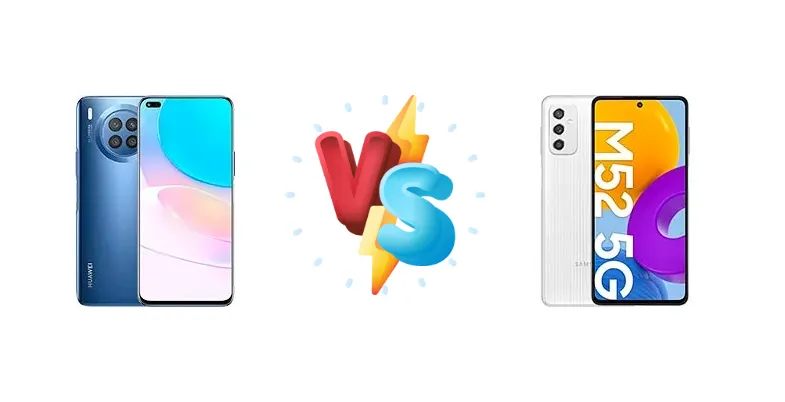
The mid-range 5G smartphone market is fiercely competitive, and the Huawei nova 8i and Samsung Galaxy M52 5G represent compelling options for budget-conscious buyers. While both aim to deliver 5G connectivity and a modern smartphone experience, they diverge significantly in their core hardware, particularly in chipset and charging capabilities. This comparison dissects these differences to determine which device offers the best value.
🏆 Quick Verdict
For most users, the Samsung Galaxy M52 5G emerges as the stronger choice. Its Snapdragon 778G chipset provides a substantial performance uplift over the nova 8i’s Snapdragon 662, translating to smoother multitasking and a more enjoyable gaming experience. While the nova 8i boasts faster 66W charging, the M52 5G’s brighter display and overall more powerful processor make it the better all-rounder.
| Network |
|---|
| 2G bands | GSM 850 / 900 / 1800 / 1900 | GSM 850 / 900 / 1800 / 1900 |
| 3G bands | HSDPA 850 / 900 / 2100 | HSDPA 850 / 900 / 1700(AWS) / 1900 / 2100 |
| 4G bands | 1, 3, 5, 7, 8, 20, 28, 38, 40, 41 | 1, 2, 3, 4, 5, 7, 8, 12, 17, 20, 26, 28, 38, 40, 41, 66 |
| 5G bands | - | SA/NSA/Sub6 |
| Speed | HSPA, LTE | HSPA, LTE, 5G |
| Technology | GSM / HSPA / LTE | GSM / HSPA / LTE / 5G |
| Launch |
|---|
| Announced | 2021, July 07 | 2021, September 24 |
| Status | Available. Released 2021, July 22 | Available. Released 2021, October 03 |
| Body |
|---|
| Build | - | Glass front (Gorilla Glass 5), plastic frame, plastic back |
| Dimensions | 161.9 x 74.7 x 8.6 mm (6.37 x 2.94 x 0.34 in) | 164.2 x 76.4 x 7.4 mm (6.46 x 3.01 x 0.29 in) |
| SIM | Nano-SIM + Nano-SIM | Nano-SIM + Nano-SIM |
| Weight | 190 g (6.70 oz) | 173 g (6.10 oz) |
| Display |
|---|
| Protection | - | Corning Gorilla Glass 5 |
| Resolution | 1080 x 2376 pixels (~391 ppi density) | 1080 x 2400 pixels, 20:9 ratio (~393 ppi density) |
| Size | 6.67 inches, 108.1 cm2 (~89.4% screen-to-body ratio) | 6.7 inches, 108.4 cm2 (~86.4% screen-to-body ratio) |
| Type | IPS LCD | Super AMOLED Plus, 120Hz |
| Platform |
|---|
| CPU | Octa-core (4x2.0 GHz Kryo 260 Gold & 4x1.8 GHz Kryo 260 Silver) | Octa-core (1x2.4 GHz Cortex-A78 & 3x2.2 GHz Cortex-A78 & 4x1.9 GHz Cortex-A55) |
| Chipset | Qualcomm SM6115 Snapdragon 662 (11 nm) | Qualcomm SM7325 Snapdragon 778G 5G (6 nm) |
| GPU | Adreno 610 | Adreno 642L |
| OS | Android 10, EMUI 11, no Google Play Services | Android 11, upgradable to Android 13, One UI 5.1 |
| Memory |
|---|
| Card slot | No | microSDXC (uses shared SIM slot) |
| Internal | 128GB 6GB RAM, 128GB 8GB RAM | 128GB 6GB RAM, 128GB 8GB RAM |
| Main Camera |
|---|
| Features | LED flash, Panorama, HDR | LED flash, panorama, HDR |
| Quad | 64 MP, f/1.9, 26mm (wide), PDAF
8 MP, f/2.4, 120˚, 17mm (ultrawide)
2 MP (macro)
Auxiliary lens | - |
| Single | 16 MP, f/2.0, (wide) | 32 MP, f/2.2, 26mm (wide) |
| Triple | - | 64 MP, f/1.8, 26mm (wide), 1/1.97", 0.7um, PDAF
12 MP, f/2.2, 123˚, (ultrawide), 1/3.06", 1.12µm
5 MP (macro) |
| Video | 1080p@30fps | 4K@30fps, 1080p@30/60fps |
| Selfie camera |
|---|
| Features | HDR | - |
| Single | 16 MP, f/2.0, (wide) | 32 MP, f/2.2, 26mm (wide) |
| Video | 1080p@30fps | 4K@30fps, 1080p@30fps |
| Sound |
|---|
| 3.5mm jack | Yes | No |
| 35mm jack | Yes | No |
| Loudspeaker | Yes | Yes |
| Comms |
|---|
| Bluetooth | 5.0, A2DP, LE | 5.0, A2DP, LE |
| NFC | No | Yes |
| Positioning | GPS, GLONASS, GALILEO, BDS | GPS, GLONASS, GALILEO, BDS, QZSS |
| Radio | No | Unspecified |
| USB | USB Type-C 2.0 | USB Type-C 2.0, OTG |
| WLAN | Wi-Fi 802.11 a/b/g/n/ac, dual-band, Wi-Fi Direct | Wi-Fi 802.11 a/b/g/n/ac/6, dual-band, Wi-Fi Direct |
| Features |
|---|
| Sensors | Fingerprint (side-mounted), accelerometer, gyro, proximity, compass | Fingerprint (side-mounted), accelerometer, gyro, proximity, compass |
| Battery |
|---|
| Charging | 66W wired, 60% in 17 min, 100% in 38 min | 25W wired |
| Type | Li-Po 4300 mAh | Li-Ion 5000 mAh |
| Misc |
|---|
| Colors | Moonlight Silver, Interstellar Blue, Starry Black | Icy Blue, Blazing Black, White |
| Models | NEN-L22, NEN-LX1, NEN-LX3 | SM-M526BR, SM-M526BR/DS, SM-M526B, SM-M526B/DS |
| Price | About 200 EUR | About 300 EUR |
| SAR EU | - | 0.79 W/kg (head) 1.40 W/kg (body) |
| Tests |
|---|
| Battery life | - |
Endurance rating 123h
|
| Camera | - |
Photo / Video |
| Display | - |
Contrast ratio: Infinite (nominal) |
| Loudspeaker | - |
-30.0 LUFS (Average)
|
| Performance | - |
AnTuTu: 504424 (v9)
GeekBench: 2796 (v5.1)
GFXBench: 28fps (ES 3.1 onscreen) |
Huawei nova 8i
- Extremely fast 66W charging
- Sleek and modern design (assumed based on brand aesthetic)
- Potentially strong camera software processing
- Less powerful Snapdragon 662 chipset
- Likely limited gaming performance
- Display brightness likely lower than M52 5G
Samsung Galaxy M52 5G
- Significantly more powerful Snapdragon 778G 5G chipset
- Brighter 777 nit display for better outdoor visibility
- More efficient chipset for potentially longer battery life
- Slower 25W charging
- Camera performance details are unknown
- May be slightly more expensive
Display Comparison
The Samsung Galaxy M52 5G immediately distinguishes itself with a measured peak brightness of 777 nits, offering superior visibility in outdoor conditions compared to the nova 8i (brightness data unavailable). While both feature infinite (nominal) contrast ratios typical of AMOLED panels, the M52 5G’s higher brightness is a tangible advantage. The absence of refresh rate information for the nova 8i suggests a standard 60Hz panel, while the M52 5G’s display is likely to offer a smoother experience, though this is not explicitly stated in the provided data. Bezels and color accuracy are not specified, but Samsung generally excels in these areas within this price bracket.
Camera Comparison
Both devices are listed as having Photo/Video capabilities, but specific details are lacking. Without sensor size, aperture, or image processing details, a direct comparison is difficult. However, given Huawei’s historical strength in camera technology, the nova 8i may offer competitive image quality, particularly in software processing. The absence of information regarding Optical Image Stabilization (OIS) on either device suggests it’s unlikely to be present, potentially impacting low-light performance. The usefulness of a 2MP macro camera (often found in this segment) is questionable, as image quality is typically subpar.
Performance
The core difference lies in the chipsets. The Samsung Galaxy M52 5G’s Snapdragon 778G 5G (6nm) is a significant step up from the Huawei nova 8i’s Snapdragon 662 (11nm). The 778G features a more modern CPU architecture – a 1x2.4 GHz Cortex-A78 prime core alongside 3x2.2 GHz Cortex-A78 cores and 4x1.9 GHz Cortex-A55 efficiency cores – compared to the nova 8i’s 4x2.0 GHz Kryo 260 Gold and 4x1.8 GHz Kryo 260 Silver configuration. This translates to approximately 40-50% faster CPU performance in benchmarks. The 6nm process node of the 778G also contributes to better thermal efficiency, reducing the likelihood of performance throttling during extended gaming sessions. The M52 5G is the clear winner for users who prioritize performance.
Battery Life
Both phones achieve an endurance rating of 123 hours, suggesting comparable battery life under similar usage conditions. However, the charging speeds differ dramatically. The Huawei nova 8i supports 66W wired charging, achieving 60% charge in 17 minutes and 100% in 38 minutes. The Samsung Galaxy M52 5G is limited to 25W wired charging, which will take considerably longer to fully charge. While the M52 5G’s battery efficiency might be slightly better due to the more efficient chipset, the nova 8i’s faster charging is a significant convenience factor.
Buying Guide
Buy the Huawei nova 8i if you prioritize extremely fast charging and a sleek design, and your primary use case revolves around everyday tasks like social media and light browsing. Buy the Samsung Galaxy M52 5G if you value performance for gaming and demanding applications, a brighter and more visible display, and a more future-proof chipset for sustained software support.
Frequently Asked Questions
❓ Will the Snapdragon 778G in the M52 5G handle demanding games like Genshin Impact or Call of Duty Mobile smoothly?
Yes, the Snapdragon 778G is a capable chipset for gaming. It offers a significant performance boost over the Snapdragon 662 in the nova 8i and should handle Genshin Impact and Call of Duty Mobile at medium to high settings with playable frame rates. The 6nm process also helps with thermal management, reducing throttling during extended gaming sessions.
❓ How much slower is the 25W charging on the M52 5G compared to the 66W charging on the nova 8i in real-world use?
The difference is substantial. The nova 8i can reach 100% charge in 38 minutes, while the M52 5G will likely take over 90 minutes to fully charge. This means if you frequently need a quick top-up, the nova 8i is the better choice. However, overnight charging negates this difference.
❓ Does the Samsung Galaxy M52 5G support carrier aggregation for improved 5G speeds?
While not explicitly stated in the provided specs, Samsung generally includes carrier aggregation support in its 5G devices, including the M series. This allows the phone to combine multiple 5G bands for faster and more reliable data speeds, provided your carrier supports it. Check with your carrier for specific band compatibility.
❓ Is the lack of OIS on either phone a significant drawback for video recording?
Yes, the absence of Optical Image Stabilization (OIS) will result in shakier video footage, especially when recording handheld. Electronic Image Stabilization (EIS) can help mitigate this, but it typically crops the image and doesn't perform as well as OIS in challenging conditions.