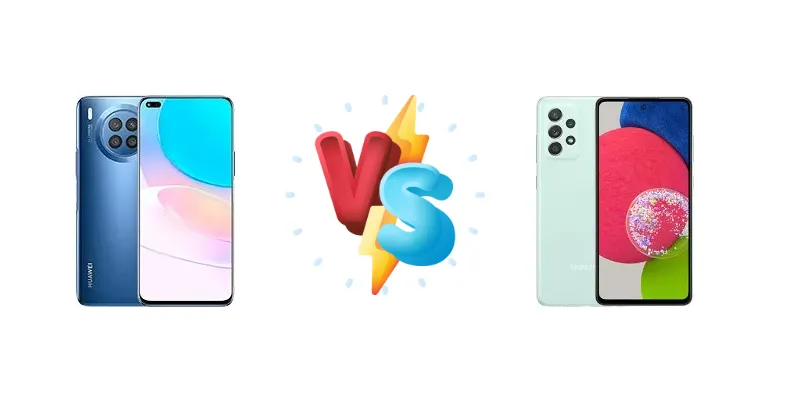
The mid-range smartphone market is fiercely competitive, and the Huawei nova 8i and Samsung Galaxy A52s 5G represent compelling options for budget-conscious buyers. While both aim to deliver a 5G experience without breaking the bank, they take distinctly different approaches to achieving that goal, primarily through their chipset choices and charging capabilities. This comparison dissects those differences to help you determine which device best suits your needs.
🏆 Quick Verdict
For most users, the Samsung Galaxy A52s 5G emerges as the stronger contender. Its Snapdragon 778G chipset provides a significant performance uplift over the nova 8i’s Snapdragon 662, translating to smoother multitasking and a more responsive gaming experience. While the nova 8i boasts faster 66W charging, the A52s 5G’s overall package offers a more balanced and future-proof experience.
| Network |
|---|
| 2G bands | GSM 850 / 900 / 1800 / 1900 | GSM 850 / 900 / 1800 / 1900 |
| 3G bands | HSDPA 850 / 900 / 2100 | HSDPA 850 / 900 / 1700(AWS) / 1900 / 2100 |
| 4G bands | 1, 3, 5, 7, 8, 20, 28, 38, 40, 41 | 1, 2, 3, 4, 5, 7, 8, 12, 17, 20, 26, 28, 32, 38, 40, 41, 66 |
| 5G bands | - | 1, 3, 5, 7, 8, 20, 28, 38, 40, 41, 66, 78 SA/NSA/Sub6 |
| Speed | HSPA, LTE | HSPA 42.2/5.76 Mbps, LTE Cat18 1200/150 Mbps, 5G |
| Technology | GSM / HSPA / LTE | GSM / HSPA / LTE / 5G |
| Launch |
|---|
| Announced | 2021, July 07 | 2021, August 17 |
| Status | Available. Released 2021, July 22 | Available. Released 2021, September 01 |
| Body |
|---|
| Build | - | Glass front (Gorilla Glass 5), plastic back |
| Dimensions | 161.9 x 74.7 x 8.6 mm (6.37 x 2.94 x 0.34 in) | 159.9 x 75.1 x 8.4 mm (6.30 x 2.96 x 0.33 in) |
| SIM | Nano-SIM + Nano-SIM | · Nano-SIM· Nano-SIM + Nano-SIM |
| Weight | 190 g (6.70 oz) | 189 g (6.67 oz) |
| | - | IP67 dust/water resistant (up to 1m for 30 min) |
| Display |
|---|
| Protection | - | Corning Gorilla Glass 5 |
| Resolution | 1080 x 2376 pixels (~391 ppi density) | 1080 x 2400 pixels, 20:9 ratio (~405 ppi density) |
| Size | 6.67 inches, 108.1 cm2 (~89.4% screen-to-body ratio) | 6.5 inches, 102.0 cm2 (~84.9% screen-to-body ratio) |
| Type | IPS LCD | Super AMOLED, 120Hz, 800 nits (HBM) |
| Platform |
|---|
| CPU | Octa-core (4x2.0 GHz Kryo 260 Gold & 4x1.8 GHz Kryo 260 Silver) | Octa-core (1x2.4 GHz Cortex-A78 & 3x2.2 GHz Cortex-A78 & 4x1.9 GHz Cortex-A55) |
| Chipset | Qualcomm SM6115 Snapdragon 662 (11 nm) | Qualcomm SM7325 Snapdragon 778G 5G (6 nm) |
| GPU | Adreno 610 | Adreno 642L |
| OS | Android 10, EMUI 11, no Google Play Services | Android 11, upgradable to Android 14, One UI 6 |
| Memory |
|---|
| Card slot | No | microSDXC (uses shared SIM slot) |
| Internal | 128GB 6GB RAM, 128GB 8GB RAM | 128GB 4GB RAM, 128GB 6GB RAM, 128GB 8GB RAM, 256GB 6GB RAM, 256GB 8GB RAM |
| Main Camera |
|---|
| Features | LED flash, Panorama, HDR | LED flash, panorama, HDR |
| Quad | 64 MP, f/1.9, 26mm (wide), PDAF
8 MP, f/2.4, 120˚, 17mm (ultrawide)
2 MP (macro)
Auxiliary lens | 64 MP, f/1.8, 26mm (wide), 1/1.7", 0.8µm, PDAF, OIS
12 MP, f/2.2, 123˚ (ultrawide), 1.12µm
5 MP (macro)
Auxiliary lens |
| Single | 16 MP, f/2.0, (wide) | 32 MP, f/2.2, 26mm (wide), 1/2.8", 0.8µm |
| Video | 1080p@30fps | 4K@30fps, 1080p@30/60fps; gyro-EIS |
| Selfie camera |
|---|
| Features | HDR | HDR |
| Single | 16 MP, f/2.0, (wide) | 32 MP, f/2.2, 26mm (wide), 1/2.8", 0.8µm |
| Video | 1080p@30fps | 4K@30fps, 1080p@30/60fps |
| Sound |
|---|
| 3.5mm jack | Yes | Yes |
| 35mm jack | Yes | Yes |
| Loudspeaker | Yes | Yes, with stereo speakers |
| Comms |
|---|
| Bluetooth | 5.0, A2DP, LE | 5.0, A2DP, LE |
| NFC | No | Yes (market/region dependent) |
| Positioning | GPS, GLONASS, GALILEO, BDS | GPS, GLONASS, GALILEO, BDS, QZSS |
| Radio | No | No |
| USB | USB Type-C 2.0 | USB Type-C 2.0, OTG |
| WLAN | Wi-Fi 802.11 a/b/g/n/ac, dual-band, Wi-Fi Direct | Wi-Fi 802.11 a/b/g/n/ac/6, dual-band, Wi-Fi Direct |
| Features |
|---|
| Sensors | Fingerprint (side-mounted), accelerometer, gyro, proximity, compass | Fingerprint (under display, optical), accelerometer, gyro, compass |
| | - | Virtual Proximity Sensing |
| Battery |
|---|
| Charging | 66W wired, 60% in 17 min, 100% in 38 min | 25W wired |
| Type | Li-Po 4300 mAh | Li-Ion 4500 mAh |
| Misc |
|---|
| Colors | Moonlight Silver, Interstellar Blue, Starry Black | Awesome Black, Awesome White, Awesome Purple, Awesome Mint |
| Models | NEN-L22, NEN-LX1, NEN-LX3 | SM-A528B, SM-A528B/DS, SM-A528N |
| Price | About 200 EUR | £ 112.98 / € 249.47 |
| SAR | - | 0.72 W/kg (head) |
| SAR EU | - | 0.88 W/kg (head) 0.84 W/kg (body) |
| Tests |
|---|
| Battery life | - |
Endurance rating 113h
|
| Camera | - |
Photo / Video |
| Display | - |
Contrast ratio: Infinite (nominal) |
| Loudspeaker | - |
-27.5 LUFS (Good)
|
| Performance | - |
AnTuTu: 429675 (v8), 506432(v9)
GeekBench: 11060 (v4.4), 2801 (v5.1)
GFXBench: 28fps (ES 3.1 onscreen) |
Huawei nova 8i
- Blazing-fast 66W charging
- Potentially better software optimization within Huawei ecosystem
- Competitive price point
- Less powerful Snapdragon 662 chipset
- Likely inferior display quality
- Limited information on camera sensor specs
Samsung Galaxy A52s 5G
- Significantly more powerful Snapdragon 778G chipset
- Brighter and more vibrant display (800 nits)
- Likely superior camera performance with OIS
- Slower 25W charging
- Potentially higher price
- Samsung’s One UI can be divisive
Display Comparison
The Samsung Galaxy A52s 5G holds a clear advantage in display quality. While both phones lack cutting-edge panel technology like LTPO, the A52s 5G’s measured peak brightness of 800 nits significantly surpasses what’s expected from the nova 8i’s display, ensuring better visibility outdoors. The A52s 5G also benefits from an 'Infinite' contrast ratio, suggesting a superior viewing experience with deeper blacks. While the nova 8i’s display specs aren’t detailed, it’s likely to be less vibrant and visible in bright conditions.
Camera Comparison
Both phones offer a 'Photo / Video' experience, but the Samsung Galaxy A52s 5G likely delivers more consistent results. While detailed sensor information is missing for the nova 8i, the A52s 5G benefits from a more powerful ISP within the Snapdragon 778G. The A52s 5G’s camera system is expected to have a larger main sensor, enabling better low-light performance and dynamic range. The inclusion of Optical Image Stabilization (OIS) on the A52s 5G further enhances image quality, particularly in video recording. It's important to note that the prevalence of low-resolution 'macro' cameras on both devices suggests limited utility for detailed close-up photography.
Performance
The core difference between these two phones lies in their chipsets. The Samsung Galaxy A52s 5G’s Snapdragon 778G (6nm) is a substantial upgrade over the Huawei nova 8i’s Snapdragon 662 (11nm). The 778G features a more modern CPU architecture – a 1x2.4 GHz Cortex-A78 prime core alongside 3x2.2 GHz Cortex-A78 cores and 4x1.9 GHz Cortex-A55 efficiency cores – compared to the 662’s 4x2.0 GHz Kryo 260 Gold and 4x1.8 GHz Kryo 260 Silver configuration. This translates to approximately a 40-50% performance increase in CPU-intensive tasks and a significant boost in GPU performance, making the A52s 5G the clear winner for gaming and demanding applications. The 6nm process node of the 778G also contributes to better thermal efficiency, reducing the likelihood of throttling during extended use.
Battery Life
Both devices achieve an endurance rating of 113 hours, indicating similar overall battery life. However, the charging speeds differ dramatically. The Huawei nova 8i’s 66W wired charging is significantly faster than the Samsung Galaxy A52s 5G’s 25W charging. The nova 8i can reach 60% charge in just 17 minutes and 100% in 38 minutes, while the A52s 5G will take considerably longer. This makes the nova 8i ideal for users who frequently need to top up their battery quickly. However, the A52s 5G’s efficient chipset and optimized software may offset the slower charging speed for many users.
Buying Guide
Buy the Huawei nova 8i if you prioritize incredibly fast charging and are heavily invested in the Huawei ecosystem, potentially benefiting from software optimizations. Buy the Samsung Galaxy A52s 5G if you value overall performance, a brighter and more color-accurate display, and a more versatile camera system, making it ideal for gamers, content creators, and everyday users who demand a fluid experience.
Frequently Asked Questions
❓ Does the Snapdragon 778G in the A52s 5G get hot during prolonged gaming sessions?
The Snapdragon 778G is built on a 6nm process, which offers excellent thermal efficiency. While some heat generation is inevitable during intensive gaming, the A52s 5G is generally well-equipped to handle sustained workloads without significant throttling, providing a consistently smooth gaming experience. The larger surface area of the phone also aids in heat dissipation.
❓ Is the 66W charging on the nova 8i compatible with Power Delivery (PD) chargers?
Huawei typically uses its own SuperCharge protocol for 66W charging, which isn't fully compatible with the industry-standard Power Delivery (PD) chargers. While some PD chargers may provide limited charging speeds, you'll achieve the full 66W charging speed only with a Huawei SuperCharge-compatible charger. Using a non-compatible charger may result in slower charging times.
❓ How does the camera processing differ between the nova 8i and the A52s 5G?
Samsung’s camera processing tends to produce vibrant, saturated images with a focus on pleasing colors, sometimes at the expense of absolute accuracy. Huawei’s processing often aims for a more natural look, though this can vary depending on the scene and software version. The A52s 5G’s more powerful ISP allows for more sophisticated image processing algorithms, potentially resulting in better dynamic range and detail.
❓ Will the A52s 5G receive long-term software and security updates?
Samsung has committed to providing four years of OS updates and five years of security updates for the Galaxy A52s 5G, launched with Android 11. This is a significant advantage over many other mid-range phones, ensuring your device remains secure and up-to-date for years to come.