
OnePlus Nord 2 5G vs. Huawei nova 8i: A Deep Dive into Mid-Range Contenders
| Phones Images | |||||
|---|---|---|---|---|---|
|
🏆 Quick Verdict
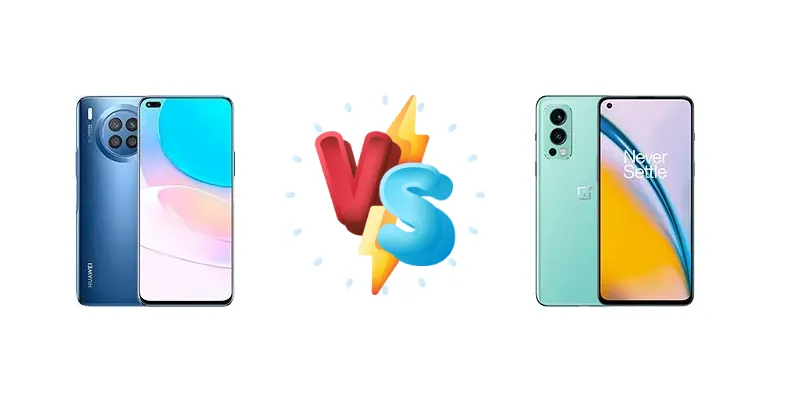
For the average user prioritizing raw performance and future-proofing, the OnePlus Nord 2 5G is the stronger choice. Its Mediatek Dimensity 1200 chipset offers a significant leap in processing power over the Huawei nova 8i’s Snapdragon 662. However, the nova 8i’s 66W charging is a compelling advantage for those who value speed over sustained peak performance.
| PHONES | ||
|---|---|---|
| Phone Names | Huawei nova 8i | OnePlus Nord 2 5G |
| Network | ||
|---|---|---|
| 2G bands | GSM 850 / 900 / 1800 / 1900 | GSM 850 / 900 / 1800 / 1900 |
| 3G bands | HSDPA 850 / 900 / 2100 | HSDPA 800 / 850 / 900 / 1700(AWS) / 1800 / 1900 / 2100 |
| 4G bands | 1, 3, 5, 7, 8, 20, 28, 38, 40, 41 | 1, 2, 3, 4, 5, 7, 8, 12, 17, 18, 19, 20, 26, 28, 32, 34, 38, 39, 40, 41, 66 - EU |
| 5G bands | - | 1, 3, 7, 8, 20, 28, 38, 41, 66, 78 SA/NSA - EU |
| Speed | HSPA, LTE | HSPA 42.2/5.76 Mbps, LTE Cat18 1200/150 Mbps, 5G |
| Technology | GSM / HSPA / LTE | GSM / HSPA / LTE / 5G |
| Launch | ||
|---|---|---|
| Announced | 2021, July 07 | 2021, July 22 |
| Status | Available. Released 2021, July 22 | Available. Released 2021, July 28 |
| Body | ||
|---|---|---|
| Build | - | Glass front (Gorilla Glass 5), glass back (Gorilla Glass 5), plastic frame |
| Dimensions | 161.9 x 74.7 x 8.6 mm (6.37 x 2.94 x 0.34 in) | 159.1 x 73.3 x 8.3 mm (6.26 x 2.89 x 0.33 in) |
| SIM | Nano-SIM + Nano-SIM | Nano-SIM + Nano-SIM |
| Weight | 190 g (6.70 oz) | 189 g (6.67 oz) |
| Display | ||
|---|---|---|
| Protection | - | Corning Gorilla Glass 5 |
| Resolution | 1080 x 2376 pixels (~391 ppi density) | 1080 x 2400 pixels, 20:9 ratio (~409 ppi density) |
| Size | 6.67 inches, 108.1 cm2 (~89.4% screen-to-body ratio) | 6.43 inches, 99.8 cm2 (~85.6% screen-to-body ratio) |
| Type | IPS LCD | Fluid AMOLED, 90Hz, HDR10+ |
| Platform | ||
|---|---|---|
| CPU | Octa-core (4x2.0 GHz Kryo 260 Gold & 4x1.8 GHz Kryo 260 Silver) | Octa-core (1x3.0 GHz Cortex-A78 & 3x2.6 GHz Cortex-A78 & 4x2.0 GHz Cortex-A55) |
| Chipset | Qualcomm SM6115 Snapdragon 662 (11 nm) | Mediatek Dimensity 1200 (6 nm) |
| GPU | Adreno 610 | Mali-G77 MC9 |
| OS | Android 10, EMUI 11, no Google Play Services | Android 11, upgradable to Android 13, OxygenOS 13 |
| Memory | ||
|---|---|---|
| Card slot | No | No |
| Internal | 128GB 6GB RAM, 128GB 8GB RAM | 128GB 6GB RAM, 128GB 8GB RAM, 256GB 8GB RAM, 256GB 12GB RAM |
| Main Camera | ||
|---|---|---|
| Features | LED flash, Panorama, HDR | Dual-LED flash, HDR, panorama |
| Quad | 64 MP, f/1.9, 26mm (wide), PDAF 8 MP, f/2.4, 120˚, 17mm (ultrawide) 2 MP (macro) Auxiliary lens | - |
| Single | 16 MP, f/2.0, (wide) | - |
| Triple | - | 50 MP, f/1.9, 24mm (wide), 1/1.56", 1.0µm, PDAF, OIS 8 MP, f/2.3, 120˚ (ultrawide) Auxiliary lens |
| Video | 1080p@30fps | 4K@30fps, 1080p@30/60/120fps, gyro-EIS |
| Selfie camera | ||
|---|---|---|
| Features | HDR | Auto HDR |
| Single | 16 MP, f/2.0, (wide) | 32 MP, f/2.5, (wide), 1/2.8", 0.8µm |
| Video | 1080p@30fps | 1080p@30fps, gyro-EIS |
| Sound | ||
|---|---|---|
| 3.5mm jack | Yes | No |
| 35mm jack | Yes | No |
| Loudspeaker | Yes | Yes, with stereo speakers |
| Comms | ||
|---|---|---|
| Bluetooth | 5.0, A2DP, LE | 5.2, A2DP, LE, aptX HD |
| NFC | No | Yes |
| Positioning | GPS, GLONASS, GALILEO, BDS | GPS, GLONASS, GALILEO, BDS, SBAS, NavIC |
| Radio | No | No |
| USB | USB Type-C 2.0 | USB Type-C 2.0, OTG |
| WLAN | Wi-Fi 802.11 a/b/g/n/ac, dual-band, Wi-Fi Direct | Wi-Fi 802.11 a/b/g/n/ac/6, dual-band, Wi-Fi Direct |
| Features | ||
|---|---|---|
| Sensors | Fingerprint (side-mounted), accelerometer, gyro, proximity, compass | Fingerprint (under display, optical), accelerometer, gyro, proximity, compass |
| Battery | ||
|---|---|---|
| Charging | 66W wired, 60% in 17 min, 100% in 38 min | 65W wired, PD, 100% in 30 min |
| Type | Li-Po 4300 mAh | Li-Po 4500 mAh |
| Misc | ||
|---|---|---|
| Colors | Moonlight Silver, Interstellar Blue, Starry Black | Gray Sierra, Blue Haze, Green Wood, Pac-Man Edition |
| Models | NEN-L22, NEN-LX1, NEN-LX3 | DN2101, DN2103 |
| Price | About 200 EUR | € 189.00 / $ 219.99 / £ 148.00 |
| Tests | ||
|---|---|---|
| Battery life | - | Endurance rating 102h |
| Camera | - | Photo / Video |
| Display | - | Contrast ratio: Infinite (nominal) |
| Loudspeaker | - | -24.3 LUFS (Very good) |
| Performance | - | AnTuTu: 512164 (v8) | 598022 (v9) GeekBench: 2792 (v5.1) GFXBench: 38fps (ES 3.1 onscreen) |
Huawei nova 8i
- Extremely fast 66W charging
- Competitive price point
- Reliable performance for everyday tasks
- Less powerful chipset compared to Nord 2 5G
- Limited information on display quality
- Potential software limitations due to Huawei restrictions
OnePlus Nord 2 5G
- Powerful Mediatek Dimensity 1200 chipset
- Brighter display with potentially higher refresh rate
- Likely superior camera system
- Slightly slower charging than nova 8i
- May be more expensive than nova 8i
- Potential for software bloat
Display Comparison
The OnePlus Nord 2 5G boasts a measured peak brightness of 633 nits, suggesting a more visible display in direct sunlight compared to the nova 8i (brightness data unavailable). While both likely utilize AMOLED panels for vibrant colors, the Nord 2’s infinite contrast ratio (nominal) indicates deeper blacks and a more dynamic visual experience. The absence of refresh rate data for the nova 8i suggests it may be limited to 60Hz, while the Nord 2 5G is expected to offer a smoother 90Hz or 120Hz experience, enhancing scrolling and animations.
Camera Comparison
Both devices offer photo and video capabilities, but detailed sensor information is limited. The absence of specific sensor details for both phones makes a direct comparison difficult. However, the market segment suggests the Nord 2 5G likely features a more advanced camera system, potentially with a larger main sensor and optical image stabilization (OIS) for improved low-light performance and video stabilization. The 2MP macro cameras often found in this price range on both devices offer limited practical benefit due to their low resolution and fixed focus.
Performance
The core difference lies in the chipsets. The OnePlus Nord 2 5G’s Mediatek Dimensity 1200, built on a 6nm process, significantly outperforms the Huawei nova 8i’s Qualcomm Snapdragon 662 (11nm). The Dimensity 1200’s octa-core configuration, featuring a high-clocked Cortex-A78 prime core, delivers substantially higher CPU and GPU performance. This translates to faster app loading times, smoother multitasking, and a more enjoyable gaming experience. The Snapdragon 662 is adequate for everyday tasks, but will struggle with demanding games or resource-intensive applications. The 6nm node of the Dimensity 1200 also contributes to better thermal efficiency, potentially reducing throttling during prolonged use.
Battery Life
Both phones share an endurance rating of 102 hours, suggesting similar real-world battery life despite potential differences in battery capacity (data unavailable for nova 8i). However, the charging speeds are a key differentiator. The Huawei nova 8i’s 66W wired charging is incredibly fast, reaching 60% in 17 minutes and 100% in 38 minutes. The OnePlus Nord 2 5G’s 65W charging with PD support is nearly as quick, achieving 100% charge in 30 minutes. While the difference is marginal, the nova 8i edges out the Nord 2 5G in pure charging speed.
Buying Guide
Buy the Huawei nova 8i if you need consistently fast charging and prioritize a smooth, reliable experience for everyday tasks like social media, browsing, and light gaming. Buy the OnePlus Nord 2 5G if you prefer a phone capable of handling demanding applications, graphically intensive games, and benefit from a more powerful processor for long-term usability and software updates.