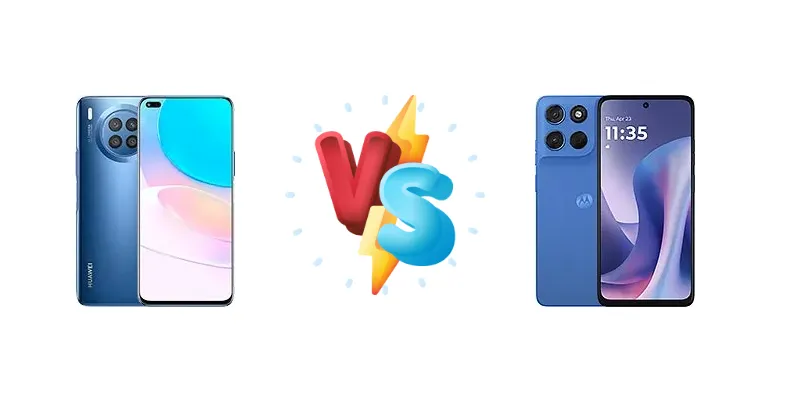
The Huawei nova 8i and Motorola Moto G100S represent distinct approaches to the mid-range smartphone market. The nova 8i, released earlier, focuses on rapid charging and a sleek design, while the G100S arrives with a newer generation Snapdragon chipset promising improved efficiency and performance. This comparison dissects their key differences to determine which device delivers the best overall experience.
🏆 Quick Verdict
For the average user prioritizing raw performance and future-proofing, the Motorola Moto G100S emerges as the winner. Its Snapdragon 6s Gen 4, built on a 4nm process, offers a significant architectural advantage over the nova 8i’s Snapdragon 662. However, the nova 8i’s 66W charging remains a compelling feature for those who value speed.
| Network |
|---|
| 2G bands | GSM 850 / 900 / 1800 / 1900 | GSM 850 / 900 / 1800 / 1900 |
| 3G bands | HSDPA 850 / 900 / 2100 | HSDPA 850 / 900 / 1900 / 2100 |
| 4G bands | 1, 3, 5, 7, 8, 20, 28, 38, 40, 41 | LTE |
| 5G bands | - | SA/NSA |
| Speed | HSPA, LTE | HSPA, LTE, 5G |
| Technology | GSM / HSPA / LTE | GSM / HSPA / LTE / 5G |
| Launch |
|---|
| Announced | 2021, July 07 | 2025, November 03 |
| Status | Available. Released 2021, July 22 | Available. Released 2025, November 03 |
| Body |
|---|
| Build | - | Glass front, plastic frame, silicone polymer (eco leather) back |
| Dimensions | 161.9 x 74.7 x 8.6 mm (6.37 x 2.94 x 0.34 in) | 166.2 x 76.5 x 8.6 mm (6.54 x 3.01 x 0.34 in) |
| SIM | Nano-SIM + Nano-SIM | Nano-SIM + Nano-SIM |
| Weight | 190 g (6.70 oz) | 210 g (7.41 oz) |
| Display |
|---|
| Resolution | 1080 x 2376 pixels (~391 ppi density) | 1080 x 2400 pixels, 20:9 ratio (~392 ppi density) |
| Size | 6.67 inches, 108.1 cm2 (~89.4% screen-to-body ratio) | 6.72 inches, 109.0 cm2 (~85.8% screen-to-body ratio) |
| Type | IPS LCD | IPS LCD, 120Hz, 1050 nits (peak) |
| Platform |
|---|
| CPU | Octa-core (4x2.0 GHz Kryo 260 Gold & 4x1.8 GHz Kryo 260 Silver) | Octa-core (4x2.4 GHz Cortex-A78 & 4x1.8 GHz Cortex-A55) |
| Chipset | Qualcomm SM6115 Snapdragon 662 (11 nm) | Qualcomm SM6435-AA Snapdragon 6s Gen 4 (4 nm) |
| GPU | Adreno 610 | Adreno |
| OS | Android 10, EMUI 11, no Google Play Services | Android 15 |
| Memory |
|---|
| Card slot | No | No |
| Internal | 128GB 6GB RAM, 128GB 8GB RAM | 128GB 8GB RAM, 256GB 8GB RAM |
| Main Camera |
|---|
| Dual | - | 50 MP, f/1.9 (wide), 1/1.95", 0.8µm, PDAF
8 MP, f/2.2, 118˚ (ultrawide), 1/4.0", 1.12µm |
| Features | LED flash, Panorama, HDR | LED flash, HDR, panorama |
| Quad | 64 MP, f/1.9, 26mm (wide), PDAF
8 MP, f/2.4, 120˚, 17mm (ultrawide)
2 MP (macro)
Auxiliary lens | - |
| Single | 16 MP, f/2.0, (wide) | - |
| Video | 1080p@30fps | 1440p@30fps, 1080p@30fps |
| Selfie camera |
|---|
| Features | HDR | HDR |
| Single | 16 MP, f/2.0, (wide) | 8 MP, f/2.2, (wide), 1/4.0", 1.12µm |
| Video | 1080p@30fps | 1440p@30fps, 1080p@30fps |
| Sound |
|---|
| 3.5mm jack | Yes | - |
| 35mm jack | Yes | Yes |
| Loudspeaker | Yes | Yes, with stereo speakers |
| Comms |
|---|
| Bluetooth | 5.0, A2DP, LE | 5.1, A2DP, LE |
| NFC | No | Yes |
| Positioning | GPS, GLONASS, GALILEO, BDS | GPS, GALILEO, GLONASS, BDS, QZSS |
| Radio | No | No |
| USB | USB Type-C 2.0 | USB Type-C 2.0, OTG |
| WLAN | Wi-Fi 802.11 a/b/g/n/ac, dual-band, Wi-Fi Direct | Wi-Fi 802.11 a/b/g/n/ac, dual-band |
| Features |
|---|
| Sensors | Fingerprint (side-mounted), accelerometer, gyro, proximity, compass | Fingerprint (side-mounted), accelerometer, gyro, proximity, compass |
| Battery |
|---|
| Charging | 66W wired, 60% in 17 min, 100% in 38 min | 30W wired |
| Type | Li-Po 4300 mAh | Si/C Li-Ion 7000 mAh |
| Misc |
|---|
| Colors | Moonlight Silver, Interstellar Blue, Starry Black | Black, Blue |
| Models | NEN-L22, NEN-LX1, NEN-LX3 | - |
| Price | About 200 EUR | About 120 EUR |
Huawei nova 8i
- Extremely fast 66W charging
- Sleek and modern design (assumed based on brand aesthetic)
- Potentially wider availability (depending on region)
- Older Snapdragon 662 chipset
- Less efficient 11nm process
- Potentially limited Google Mobile Services access
Motorola Moto G100S
- More powerful Snapdragon 6s Gen 4 chipset
- 4nm process for improved efficiency
- Modern CPU architecture (Cortex-A78 cores)
- Near-stock Android experience
- Slower 30W charging
- Potentially slower software updates
- May have limited availability in certain markets
Display Comparison
Neither device boasts a standout display. While specific display specs (resolution, refresh rate) are missing, the focus here is on the underlying processing power impacting UI smoothness. The G100S’s more powerful chipset will likely translate to a more responsive user interface, even with a similar panel. The Snapdragon 662 in the nova 8i, while capable, will show its age when handling demanding graphical tasks on the display.
Camera Comparison
Without detailed camera specifications, a direct comparison is limited. However, the chipset plays a crucial role in image processing. The G100S’s newer Snapdragon ISP (Image Signal Processor) will likely deliver superior image quality, particularly in low-light conditions, due to more advanced noise reduction and dynamic range optimization. The nova 8i’s camera system will be adequate for everyday use, but will likely struggle to match the G100S’s processing capabilities. We can assume both phones will feature a multi-camera setup, but the G100S’s processing power will be the deciding factor.
Performance
The core difference lies in the chipsets. The Motorola Moto G100S’s Snapdragon 6s Gen 4 (4nm) is a significant leap forward from the Huawei nova 8i’s Snapdragon 662 (11nm). The 4nm process node inherently provides better power efficiency, meaning the G100S will run cooler and potentially sustain peak performance for longer periods. Furthermore, the G100S utilizes Cortex-A78 cores in its CPU configuration, offering a substantial performance uplift over the Kryo 260 Gold cores found in the nova 8i. This translates to faster app loading times, smoother multitasking, and improved gaming performance. The G100S’s CPU clock speeds (2.4 GHz vs 2.0 GHz) further accentuate this advantage.
Battery Life
The Huawei nova 8i’s 66W wired charging is its standout battery feature, capable of reaching 60% charge in just 17 minutes and 100% in 38 minutes. The Motorola Moto G100S, with 30W charging, is significantly slower. However, the G100S’s more efficient 4nm chipset will likely result in better overall battery life despite potentially having a similar or slightly smaller battery capacity. The nova 8i prioritizes *speed* of charging, while the G100S focuses on *efficiency* and longevity.
Buying Guide
Buy the Huawei nova 8i if you need exceptionally fast charging and prioritize a polished, readily available software experience (though potentially without full Google Mobile Services). Buy the Motorola Moto G100S if you prefer a more modern chipset with better long-term performance potential, and are comfortable with Motorola’s near-stock Android experience and potentially slower software updates.
Frequently Asked Questions
❓ Will the Motorola Moto G100S struggle with graphically intensive games like PUBG or Genshin Impact?
While not a flagship gaming phone, the Snapdragon 6s Gen 4 in the Moto G100S is a significant improvement over the Snapdragon 662. It should be capable of running PUBG at medium to high settings with stable frame rates. Genshin Impact may require lower settings for optimal performance, but the G100S’s improved thermal management will prevent excessive throttling during extended gaming sessions.
❓ Does the Huawei nova 8i’s 66W charging degrade the battery health faster than the Moto G100S’s 30W charging?
While faster charging *can* contribute to slightly faster battery degradation over the long term, modern smartphones employ sophisticated charging algorithms to mitigate this effect. The difference in degradation between 66W and 30W charging is likely to be minimal in real-world usage. The convenience of the nova 8i’s rapid charging may outweigh any potential long-term battery health concerns for many users.
❓ Is the lack of Google Mobile Services on the Huawei nova 8i a dealbreaker?
The absence of Google Mobile Services (GMS) is a significant consideration. The nova 8i utilizes Huawei Mobile Services (HMS) and the AppGallery. While the AppGallery has grown, it still lacks the breadth of apps available on the Google Play Store. Users reliant on core Google apps (Gmail, Maps, YouTube) will need to find workarounds or alternative solutions.