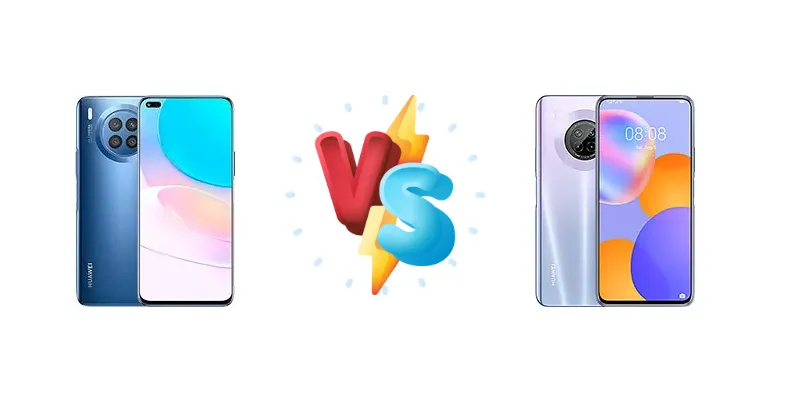
Huawei offers a range of mid-range smartphones, and the nova 8i and Y9a are two popular contenders. Both offer attractive designs and competitive features, but cater to slightly different needs. This comprehensive comparison will break down their strengths and weaknesses to help you make the right choice.
🏆 Quick Verdict
The Huawei nova 8i takes the crown thanks to its significantly faster charging and more powerful Snapdragon 662 chipset. While the Y9a boasts a larger battery and a solid camera, the nova 8i's performance and charging speed provide a more premium experience overall.
| Network |
|---|
| 2G bands | GSM 850 / 900 / 1800 / 1900 | GSM 900 / 1800 / 1900 |
| 3G bands | HSDPA 850 / 900 / 2100 | HSDPA 850 / 900 / 1700(AWS) / 1900 / 2100 |
| 4G bands | 1, 3, 5, 7, 8, 20, 28, 38, 40, 41 | 1, 2, 3, 4, 5, 7, 8, 20, 28, 38, 40, 41 - FRL-L22 |
| Speed | HSPA, LTE | HSPA, LTE |
| Technology | GSM / HSPA / LTE | GSM / HSPA / LTE |
| | - | 1, 2, 3, 4, 5, 7, 8, 20, 28, 38, 40, 41, 66 - FRL-L23 |
| Launch |
|---|
| Announced | 2021, July 07 | 2020, September 07. Released 2020, September 12 |
| Status | Available. Released 2021, July 22 | Discontinued |
| Body |
|---|
| Dimensions | 161.9 x 74.7 x 8.6 mm (6.37 x 2.94 x 0.34 in) | 163.5 x 76.5 x 9 mm (6.44 x 3.01 x 0.35 in) |
| SIM | Nano-SIM + Nano-SIM | Nano-SIM + Nano-SIM |
| Weight | 190 g (6.70 oz) | 197 g (6.95 oz) |
| Display |
|---|
| Resolution | 1080 x 2376 pixels (~391 ppi density) | 1080 x 2400 pixels, 20:9 ratio (~397 ppi density) |
| Size | 6.67 inches, 108.1 cm2 (~89.4% screen-to-body ratio) | 6.63 inches, 106.1 cm2 (~84.8% screen-to-body ratio) |
| Type | IPS LCD | IPS LCD |
| Platform |
|---|
| CPU | Octa-core (4x2.0 GHz Kryo 260 Gold & 4x1.8 GHz Kryo 260 Silver) | Octa-core (2x2.0 GHz Cortex-A75 & 6x1.8 GHz Cortex-A55) |
| Chipset | Qualcomm SM6115 Snapdragon 662 (11 nm) | Mediatek MT6769V/CU Helio G80 (12 nm) |
| GPU | Adreno 610 | Mali-G52 MC2 |
| OS | Android 10, EMUI 11, no Google Play Services | Android 10, EMUI 10.1, no Google Play Services |
| Memory |
|---|
| Card slot | No | Nano Memory (uses shared SIM slot) |
| Internal | 128GB 6GB RAM, 128GB 8GB RAM | 128GB 6GB RAM, 128GB 8GB RAM |
| | - | UFS 2.1 |
| Main Camera |
|---|
| Features | LED flash, Panorama, HDR | Quad-LED flash, HDR, panorama |
| Quad | 64 MP, f/1.9, 26mm (wide), PDAF
8 MP, f/2.4, 120˚, 17mm (ultrawide)
2 MP (macro)
Auxiliary lens | 64 MP, f/1.8, 26mm (wide), 1/1.73", 0.8µm, PDAF
8 MP, f/2.4, 120˚ (ultrawide)
2 MP (macro)
Auxiliary lens |
| Single | 16 MP, f/2.0, (wide) | - |
| Video | 1080p@30fps | 4K@30fps, 1080p@30fps, gyro-EIS |
| Selfie camera |
|---|
| Features | HDR | HDR |
| Single | 16 MP, f/2.0, (wide) | Motorized pop-up 16 MP, f/2.2, (wide), 1/3.1", 1.0µm |
| Video | 1080p@30fps | 1080p@30fps |
| Sound |
|---|
| 3.5mm jack | Yes | Yes |
| 35mm jack | Yes | Yes |
| Loudspeaker | Yes | Yes |
| Comms |
|---|
| Bluetooth | 5.0, A2DP, LE | 5.1, A2DP, LE |
| NFC | No | No |
| Positioning | GPS, GLONASS, GALILEO, BDS | GPS, GLONASS, BDS |
| Radio | No | No |
| USB | USB Type-C 2.0 | USB Type-C 2.0, OTG |
| WLAN | Wi-Fi 802.11 a/b/g/n/ac, dual-band, Wi-Fi Direct | Wi-Fi 802.11 a/b/g/n/ac, dual-band, Wi-Fi Direct |
| Features |
|---|
| Sensors | Fingerprint (side-mounted), accelerometer, gyro, proximity, compass | Fingerprint (side-mounted), accelerometer, gyro, proximity, compass |
| Battery |
|---|
| Charging | 66W wired, 60% in 17 min, 100% in 38 min | 22.5W / 40W wired (region dependent) |
| Type | Li-Po 4300 mAh | Li-Po 4200 mAh or 4300 mAh (region dependent) |
| Misc |
|---|
| Colors | Moonlight Silver, Interstellar Blue, Starry Black | Space Silver, Sakura Pink, Midnight Black |
| Models | NEN-L22, NEN-LX1, NEN-LX3 | FRL-22, FRL-23, FRL-L22, FRL-L23 |
| Price | About 200 EUR | About 200 EUR |
Huawei nova 8i
- Faster Charging (66W)
- More Powerful Chipset (Snapdragon 662)
- Sleeker Design (potentially)
- Smoother Performance
- Potentially less versatile camera
- Battery life may be slightly shorter than Y9a
Huawei Y9a
- Larger Battery Capacity (potentially longer battery life)
- Versatile Camera System (potentially)
- Good Value for Money
- Large Display
- Slower Charging (22.5W/40W)
- Less Powerful Chipset (Helio G80)
- Can feel sluggish under heavy load
Display Comparison
Both phones feature a 6.53-inch display, but the nova 8i typically has a slightly higher resolution (FHD+) and potentially better color accuracy. The Y9a's display is generally well-regarded for its brightness and viewing angles. The nova 8i may have a slightly more modern design with a smaller punch-hole camera.
Camera Comparison
The Y9a often features a more versatile camera system with a higher resolution main sensor (48MP) and potentially a dedicated macro lens. The nova 8i's camera is still capable, but may not offer the same level of detail or versatility. Both phones offer decent selfie cameras.
Performance
The nova 8i's Snapdragon 662 chipset offers a noticeable performance advantage over the Y9a's Helio G80. Expect smoother multitasking, faster app loading times, and better gaming performance on the nova 8i. The Y9a is still capable for everyday tasks, but may struggle with more demanding games.
Battery Life
The Y9a generally has a larger battery capacity (4000mAh vs nova 8i's 4000mAh, though real-world usage varies). However, the nova 8i's 66W fast charging drastically reduces charging times, making it a more convenient option.
Buying Guide
The Huawei nova 8i is ideal for users prioritizing performance, fast charging, and a smoother user experience. The Huawei Y9a is a better fit for those who value long battery life, a large display, and a capable camera system, especially if charging speed isn't a top concern.
Frequently Asked Questions
❓ Which phone is better for gaming?
The Huawei nova 8i is the better choice for gaming due to its more powerful Snapdragon 662 chipset.
❓ Does the Huawei Y9a support 5G?
No, neither the Huawei nova 8i nor the Huawei Y9a support 5G connectivity.
❓ Which phone has better software support?
Huawei's software support is a complex topic. Both phones run EMUI, but updates are often delayed and may lack Google Mobile Services (GMS).