
Huawei nova 8 vs Xiaomi Mi 11 Lite: Which Mid-Range Phone Reigns Supreme?
| Phones Images | |||||
|---|---|---|---|---|---|
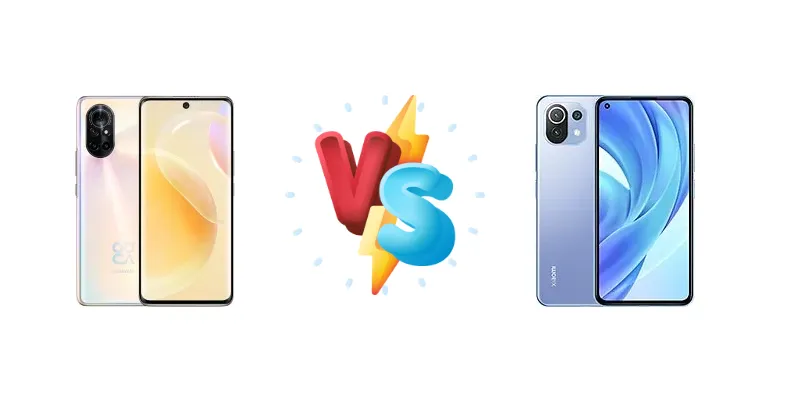
|
🏆 Quick Verdict
For the average user prioritizing rapid charging and potentially more raw processing power, the Huawei nova 8 is the better choice. Its 66W charging significantly outperforms the Mi 11 Lite’s 33W, and the Kirin 820E, despite being an older architecture, offers a competitive CPU performance. However, the Mi 11 Lite’s brighter display and wider availability with full Google Mobile Services are strong considerations.
| PHONES | ||
|---|---|---|
| Phone Names | Huawei nova 8 | Xiaomi Mi 11 Lite |
| Network | ||
|---|---|---|
| 2G bands | GSM 850 / 900 / 1800 / 1900 | GSM 850 / 900 / 1800 / 1900 |
| 3G bands | HSDPA 800 / 850 / 900 / 1700(AWS) / 1800 / 1900 / 2100 | HSDPA 850 / 900 / 1700(AWS) / 1900 / 2100 |
| 4G bands | 1, 2, 3, 4, 5, 6, 7, 8, 9, 18, 19, 26, 28, 34, 38, 39, 40, 41 - ANG-L22B, ANG-L02B | 1, 2, 3, 4, 5, 7, 8, 12, 17, 20, 28, 32, 38, 40, 41, 66 |
| Speed | HSPA, LTE, 5G | HSPA, LTE |
| Technology | GSM / HSPA / LTE | GSM / HSPA / LTE |
| Launch | ||
|---|---|---|
| Announced | 2021, August 05 | 2021, March 29 |
| Status | Available. Released 2021, August 05 | Available. Released 2021, April 16 |
| Body | ||
|---|---|---|
| Dimensions | 160.1 x 74.1 x 7.6 mm (6.30 x 2.92 x 0.30 in) | 160.5 x 75.7 x 6.8 mm (6.32 x 2.98 x 0.27 in) |
| SIM | · Nano-SIM· Nano-SIM + Nano-SIM | Nano-SIM + Nano-SIM |
| Weight | 169 g (5.96 oz) | 157 g (5.54 oz) |
| - | IP53, dust and splash resistant | |
| Display | ||
|---|---|---|
| Protection | - | Corning Gorilla Glass 5 |
| Resolution | 1080 x 2340 pixels, 19.5:9 ratio (~392 ppi density) | 1080 x 2400 pixels, 20:9 ratio (~402 ppi density) |
| Size | 6.57 inches, 106.0 cm2 (~89.3% screen-to-body ratio) | 6.55 inches, 103.6 cm2 (~85.3% screen-to-body ratio) |
| Type | OLED, 1B colors, HDR10, 90Hz | AMOLED, 1B colors, HDR10, 90Hz, 500 nits (typ), 800 nits |
| Platform | ||
|---|---|---|
| CPU | Hexa-core (3x2.22 GHz Cortex-A76 & 3x1.84 GHz Cortex-A55) | Octa-core (2x2.3 GHz Kryo 470 Gold & 6x1.8 GHz Kryo 470 Silver) |
| Chipset | Kirin 820E (7 nm) | Qualcomm SM7150 Snapdragon 732G (8 nm) |
| GPU | Mali-G57 (6-core) | Adreno 618 |
| OS | Android 11, EMUI 12, no Google Play Services | Android 11, MIUI 12 |
| Memory | ||
|---|---|---|
| Card slot | No | microSDXC (uses shared SIM slot) |
| Internal | 128GB 8GB RAM, 256GB 8GB RAM | 64GB 4GB RAM, 64GB 6GB RAM, 128GB 6GB RAM, 128GB 8GB RAM |
| - | UFS 2.2 | |
| Main Camera | ||
|---|---|---|
| Features | LED flash, panorama, HDR | Dual-LED dual-tone flash, HDR, panorama |
| Quad | 64 MP, f/1.9, 26mm (wide), PDAF 8 MP, f/2.4, 120˚, 17mm (ultrawide) 2 MP (macro) Auxiliary lens | - |
| Triple | - | 64 MP, f/1.8, 26mm (wide), 1/1.97", 0.7µm, PDAF 8 MP, f/2.2, 119˚ (ultrawide), 1/4.0", 1.12µm 5 MP (macro), AF |
| Video | 4K, 1080p, 720p@960fps, gyro-EIS | 4K@30fps, 1080p@30/60/120fps; gyro-EIS |
| Selfie camera | ||
|---|---|---|
| Features | HDR | HDR, panorama |
| Single | 32 MP, f/2.0, 26mm (wide) | 16 MP, f/2.5, (wide), 1/3.06" 1.0µm |
| Video | 4K | 1080p@30fps, 720p@120fps |
| Sound | ||
|---|---|---|
| 3.5mm jack | - | No |
| 35mm jack | No | No |
| Loudspeaker | Yes | Yes, with dual speakers |
| - | 24-bit/192kHz audio | |
| Comms | ||
|---|---|---|
| Bluetooth | 5.0, A2DP, LE | 5.1, A2DP, LE |
| Infrared port | - | Yes |
| NFC | Yes | Yes (market/region dependent) |
| Positioning | GPS, GLONASS, BDS, GALILEO, QZSS | GPS, GLONASS, BDS, GALILEO |
| Radio | No | No |
| USB | USB Type-C 2.0, OTG | USB Type-C 2.0, OTG |
| WLAN | Wi-Fi 802.11 a/b/g/n/ac, dual-band, Wi-Fi Direct | Wi-Fi 802.11 a/b/g/n/ac, dual-band, Wi-Fi Direct |
| Features | ||
|---|---|---|
| Sensors | Fingerprint (under display, optical), accelerometer, gyro, proximity, compass | Fingerprint (side-mounted), accelerometer, gyro, compass |
| - | Virtual proximity sensing | |
| Battery | ||
|---|---|---|
| Charging | 66W wired, 60% in 15 min, 100% in 35 min 5W reverse wired | 33W wired |
| Type | Li-Po 3800 mAh | Li-Po 4250 mAh |
| Misc | ||
|---|---|---|
| Colors | Powder Pink | Boba Black (Vinyl Black), Peach Pink (Tuscany Coral), Bubblegum Blue (Jazz Blue) |
| Models | ANG-L02B, ANG-L21B, ANG-L22B, ANG-LX1, ANG-LX2 | M2101K9AG, M2101K9AI |
| Price | About 420 EUR | £ 221.40 / € 106.34 |
| SAR | - | 1.07 W/kg (head) 0.82 W/kg (body) |
| SAR EU | - | 0.60 W/kg (head) 0.95 W/kg (body) |
| Tests | ||
|---|---|---|
| Battery life | - | Endurance rating 100h |
| Camera | - | Photo / Video |
| Display | - | Contrast ratio: Infinite (nominal) |
| Loudspeaker | - | -24.2 LUFS (Very good) |
| Performance | - | AnTuTu: 290172 (v8), 294251 (v9) GeekBench: 1796 (v5.1) GFXBench: 17fps (ES 3.1 onscreen) |
Huawei nova 8
- Significantly faster 66W charging
- Potentially stronger CPU performance with Kirin 820E
- 5W reverse wired charging for accessories
- Potential limitations with Google Mobile Services
- Display specs are less detailed than the Mi 11 Lite
Xiaomi Mi 11 Lite
- Brighter display (826 nits) for outdoor visibility
- Full Google Mobile Services support
- Lighter and more portable design
- Slower 33W charging
- Potentially weaker CPU performance compared to the nova 8
Display Comparison
The Xiaomi Mi 11 Lite boasts a significantly brighter display, reaching a measured 826 nits, compared to an unspecified brightness for the nova 8. This makes the Mi 11 Lite more usable outdoors under direct sunlight. While both displays have an 'infinite' (nominal) contrast ratio, the higher peak brightness of the Mi 11 Lite translates to a more vivid and punchy image. The lack of detailed display specs for the nova 8, such as refresh rate or panel type, puts it at a disadvantage in this category.
Camera Comparison
Both devices offer photo and video capabilities, but detailed sensor information is lacking. Without knowing megapixel counts, sensor sizes, or aperture values, a direct comparison is difficult. However, the absence of any mention of OIS (Optical Image Stabilization) on either device suggests that low-light photography may be a weakness for both. The prevalence of 2MP macro lenses on both phones suggests these are largely marketing features with limited practical utility. Image processing styles will likely differ, with Huawei traditionally favoring more saturated colors and Xiaomi aiming for a more natural look.
Performance
The Huawei nova 8’s Kirin 820E (7nm) and hexa-core CPU configuration face off against the Xiaomi Mi 11 Lite’s Snapdragon 732G (8nm) and octa-core setup. While the Snapdragon 732G benefits from a more modern 8nm process, the Kirin 820E’s Cortex-A76 cores offer a performance edge in single-core tasks. The Mi 11 Lite’s octa-core design may provide better multi-tasking capabilities. However, the Kirin 820E’s GPU is likely to deliver superior graphics performance, potentially benefiting gaming. The lack of LPDDR5/LPDDR5x RAM specifications for either device makes a definitive RAM speed comparison impossible.
Battery Life
Both the Huawei nova 8 and Xiaomi Mi 11 Lite achieve an endurance rating of 100 hours, suggesting similar overall battery life despite differing battery capacities (not specified). However, the nova 8’s 66W wired charging is a game-changer, achieving 60% charge in just 15 minutes and 100% in 35 minutes. The Mi 11 Lite’s 33W charging is considerably slower. The nova 8 also offers 5W reverse wired charging, a feature absent on the Mi 11 Lite, allowing it to top up accessories like earbuds.
Buying Guide
Buy the Huawei nova 8 if you need blazing-fast charging, frequently use demanding apps, and are comfortable with the Huawei ecosystem (and potential limitations regarding Google services). Buy the Xiaomi Mi 11 Lite if you prioritize a bright, color-accurate display for media consumption, prefer a cleaner Android experience with full Google support, and value a lighter, more portable design.