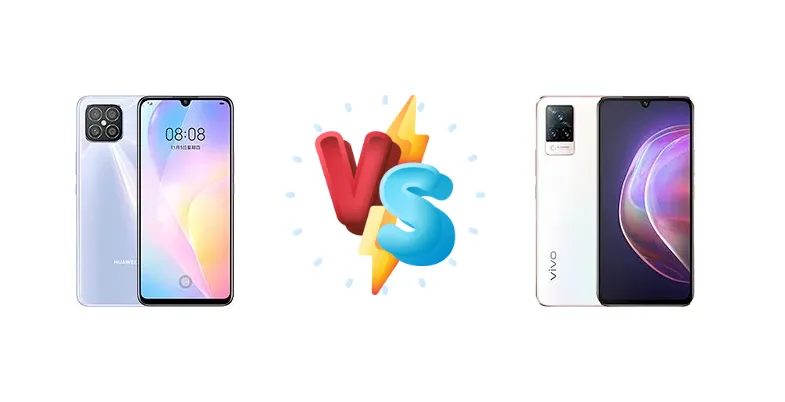
The Huawei nova 8 SE and vivo V21 5G represent compelling options in the increasingly competitive mid-range 5G smartphone market. While both aim to deliver a premium experience without the flagship price tag, they take different approaches to achieving this goal, particularly in chipset selection and charging technology. This comparison dissects their key specifications to determine which device offers the best overall package.
🏆 Quick Verdict
For the average user prioritizing raw performance and faster charging, the vivo V21 5G emerges as the stronger contender. Its consistent use of the Mediatek Dimensity 800U chipset and comparable battery endurance, despite slower charging, provide a smoother experience. However, the nova 8 SE’s 66W charging is a significant advantage for those who value speed above all else.
| Network |
|---|
| 2G bands | GSM 850 / 900 / 1800 / 1900 | GSM 850 / 900 / 1800 / 1900 |
| 3G bands | HSDPA 800 / 850 / 900 / 1700(AWS) / 1900 / 2100 | HSDPA 850 / 900 / 1700(AWS) / 1900 / 2100 |
| 4G bands | 1, 2, 3, 4, 5, 8, 18, 19, 26, 34, 38, 39, 40, 41 | 1, 2, 3, 4, 5, 8, 34, 38, 40, 41 - India |
| 5G bands | 1, 28, 41, 77, 78 SA/NSA | 78 Sub6 - India |
| Speed | HSPA, LTE, 5G | HSPA, LTE, 5G |
| Technology | GSM / CDMA / HSPA / LTE / 5G | GSM / HSPA / LTE / 5G |
| | CDMA 800 & TD-SCDMA | - |
| Launch |
|---|
| Announced | 2020, November 06. Released 2020, November 11 | 2021, April 27 |
| Status | Discontinued | Available. Released 2021, May 06 |
| Body |
|---|
| Build | - | Glass front, plastic frame, plastic back |
| Dimensions | 161.1 x 74.8 x 7.5 mm (6.34 x 2.94 x 0.30 in) | 159.7 x 73.9 x 7.3 mm (6.29 x 2.91 x 0.29 in) |
| SIM | Nano-SIM + Nano-SIM | Nano-SIM + Nano-SIM |
| Weight | 178 g (6.28 oz) | 176 g (6.21 oz) |
| Display |
|---|
| Resolution | 1080 x 2400 pixels, 20:9 ratio (~403 ppi density) | 1080 x 2400 pixels, 20:9 ratio (~409 ppi density) |
| Size | 6.53 inches, 102.9 cm2 (~85.4% screen-to-body ratio) | 6.44 inches, 100.1 cm2 (~84.8% screen-to-body ratio) |
| Type | OLED, HDR10 | AMOLED, 90Hz, HDR10+, 500 nits (typ) |
| Platform |
|---|
| CPU | Octa-core (2x2.0 GHz Cortex-A76 & 6x2.0 GHz Cortex-A55) - standard modelOcta-core (2x2.4 GHz Cortex-A76 & 6x2.0 GHz Cortex-A55) - premium model | Octa-core (2x2.4 GHz Cortex-A76 & 6x2.0 GHz Cortex-A55) |
| Chipset | Mediatek Dimensity 720 (7 nm) - standard modelMediatek Dimensity 800U (7 nm) - premium model | Mediatek Dimensity 800U (7 nm) |
| GPU | Mali-G57 MC3 | Mali-G57 MC3 |
| OS | Android 10, EMUI 10.1, no Google Play Services | Android 11, Funtouch 11.1 |
| Memory |
|---|
| Card slot | No | microSDXC (uses shared SIM slot) |
| Internal | 128GB 8GB RAM | 128GB 6GB RAM, 128GB 8GB RAM, 256GB 8GB RAM |
| | - | UFS 2.2 |
| Main Camera |
|---|
| Features | LED flash, Panorama, HDR | LED flash, HDR, panorama |
| Quad | 64 MP, f/1.9, 26mm (wide), PDAF
8 MP, f/2.4, 120˚, 17mm (ultrawide)
2 MP (macro)
Auxiliary lens | - |
| Single | - | 44 MP, f/2.0, (wide), AF, OIS |
| Triple | - | 64 MP, f/1.8, 26mm (wide), 1/1.72", 0.8µm, PDAF, OIS
8 MP, f/2.2, 120˚, 16mm (ultrawide), 1/4.0", 1.12µm
2 MP (macro) |
| Video | 4K@30fps, 1080p@30fps | 4K@30fps (no OIS), 1080p@30/60fps |
| Selfie camera |
|---|
| Features | HDR | Dual-LED flash, HDR |
| Single | 16 MP, f/2.0, (wide) | 44 MP, f/2.0, (wide), AF, OIS |
| Video | 1080p@30fps | 4K@30fps (no OIS), 1080p@30fps |
| Sound |
|---|
| 3.5mm jack | No | No |
| 35mm jack | No | No |
| Loudspeaker | Yes | Yes |
| Comms |
|---|
| Bluetooth | 5.1, A2DP, LE | 5.1, A2DP, LE |
| NFC | No | Yes (market/region dependent) |
| Positioning | GPS, GLONASS, GALILEO, BDS, QZSS | GPS, GLONASS, GALILEO, BDS |
| Radio | No | No |
| USB | USB Type-C 2.0, OTG | USB Type-C 2.0, OTG |
| WLAN | Wi-Fi 802.11 a/b/g/n/ac, dual-band, Wi-Fi Direct | Wi-Fi 802.11 a/b/g/n/ac, dual-band, Wi-Fi Direct |
| Features |
|---|
| Sensors | Fingerprint (under display, optical), accelerometer, gyro, proximity, compass | Fingerprint (under display, optical), accelerometer, gyro, proximity, compass |
| Battery |
|---|
| Charging | 66W wired, 60% in 15 min, 100% in 35 min | 33W wired, 63% in 30 min |
| Type | Li-Po 3800 mAh | 4000 mAh |
| Misc |
|---|
| Colors | Black, Deep Blue, Blue, Silver | Dusk Blue, Sunset Dazzle, Arctic White |
| Models | JSC-AN00 | V2050 |
| Price | About 330 EUR | About 190 EUR |
| SAR | - | 1.05 W/kg (head) 0.87 W/kg (body) |
| Tests |
|---|
| Battery life | - |
Endurance rating 123h
|
| Camera | - |
Photo / Video |
| Display | - |
Contrast ratio: Infinite (nominal) |
| Loudspeaker | - |
-28.2 LUFS (Average)
|
| Performance | - |
AnTuTu: 336699 (v8), 365055 (v9)
GeekBench: 6516 (v4.4), 1600 (v5.1)
GFXBench: 17fps (ES 3.1 onscreen) |
Huawei nova 8 SE
- Significantly faster 66W charging
- Potential for higher performance with Dimensity 800U variant
- Competitive battery endurance
- Chipset variability (Dimensity 720 vs 800U)
- Limited display brightness information
vivo V21 5G
- Consistent performance with Dimensity 800U
- Brighter display for better outdoor visibility
- Reliable battery endurance
- Slower 33W charging
- Limited camera specification details
Display Comparison
The vivo V21 5G boasts a notably brighter display, reaching a measured 761 nits, which translates to better visibility outdoors compared to the nova 8 SE (brightness data unavailable). While both displays feature an infinite (nominal) contrast ratio, the higher peak brightness of the V21 5G is a tangible advantage for media consumption and everyday use. The lack of detailed display specifications for the nova 8 SE makes a comprehensive comparison difficult, but the V21 5G’s brightness is a clear win.
Camera Comparison
Both devices offer photo and video capabilities, but detailed camera specifications are limited. Without information on sensor sizes, aperture values, or image processing algorithms, a direct comparison is challenging. The absence of details beyond 'Photo / Video' suggests a focus on general usability rather than advanced photographic features. It's likely both phones will perform adequately in good lighting conditions, but low-light performance will depend heavily on sensor size and software optimization – data currently unavailable for either device.
Performance
Here's where the biggest difference lies. The vivo V21 5G consistently utilizes the Mediatek Dimensity 800U (7nm), featuring an octa-core CPU with 2x2.4 GHz Cortex-A76 and 6x2.0 GHz Cortex-A55 cores. The Huawei nova 8 SE, however, comes in two variants: a standard model with the Dimensity 720 (7nm) and a premium model with the Dimensity 800U. The Dimensity 800U in the V21 5G offers a performance edge over the 720, particularly in graphics-intensive tasks. Even comparing the 800U versions, the V21 5G benefits from consistent performance, while nova 8 SE buyers need to verify which chipset they are receiving. Both phones utilize the same CPU core configuration, but the higher clock speeds of the Dimensity 800U provide a noticeable boost.
Battery Life
Both the Huawei nova 8 SE and vivo V21 5G achieve an endurance rating of 123 hours, indicating similar overall battery life. However, their charging approaches differ significantly. The nova 8 SE supports a blazing-fast 66W wired charging, capable of reaching 60% in 15 minutes and 100% in 35 minutes. The V21 5G, with its 33W wired charging, takes 30 minutes to reach 63%. While the V21 5G’s charging isn’t slow, the nova 8 SE’s speed is a game-changer for users who prioritize quick top-ups. The comparable endurance ratings suggest that the faster charging of the nova 8 SE doesn’t come at the expense of battery capacity.
Buying Guide
Buy the Huawei nova 8 SE if you absolutely need the fastest possible charging speeds and are willing to potentially accept slight performance variations depending on the model purchased. It’s ideal for users who frequently find themselves needing to top up their battery quickly. Buy the vivo V21 5G if you prioritize consistent performance, a brighter display, and a more streamlined user experience. This phone is best suited for users who value a balanced package and don’t want to gamble on chipset variations.
Frequently Asked Questions
❓ What if I purchase a Huawei nova 8 SE and receive the Dimensity 720 version? Will I notice a significant performance difference?
Yes, you will likely notice a performance difference, particularly in demanding games and applications. The Dimensity 800U offers higher clock speeds and improved GPU performance compared to the Dimensity 720. While the 720 is still a capable chip, the 800U provides a smoother and more responsive experience.
❓ Does the vivo V21 5G support any form of fast charging protocols beyond 33W, like Power Delivery or Quick Charge?
While vivo doesn't explicitly advertise Power Delivery or Quick Charge support for the V21 5G, it's likely compatible with some level of Quick Charge functionality. However, to achieve the full 33W charging speed, it's recommended to use the included vivo charger.
❓ How does the battery life of the nova 8 SE hold up with the 66W charging? Does fast charging degrade the battery faster?
The 123-hour endurance rating suggests the battery life is comparable to the V21 5G despite the faster charging. Modern smartphones employ battery management systems to mitigate the effects of fast charging on battery degradation. While fast charging *can* contribute to slightly faster degradation over the long term, the difference is often negligible for typical usage patterns.