
Huawei nova 8 SE vs Motorola Edge 20 Fusion: A Deep Dive into Mid-Range Performance
| Phones Images | |||||
|---|---|---|---|---|---|
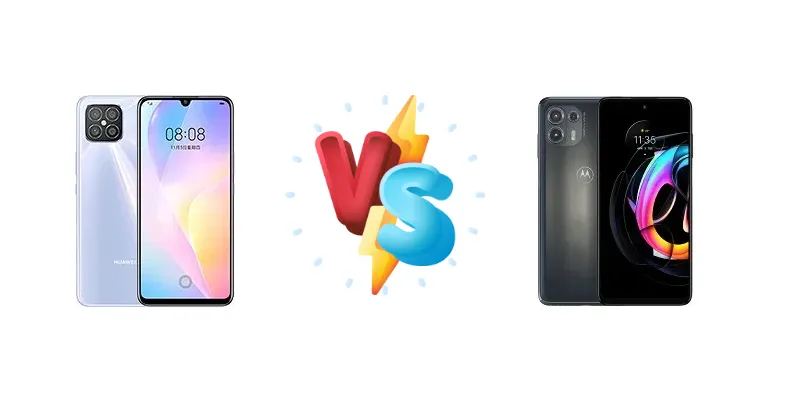
|
🏆 Quick Verdict
For users prioritizing rapid charging and potentially higher performance (with the premium nova 8 SE variant), the Huawei nova 8 SE is the stronger choice. However, the Motorola Edge 20 Fusion provides a consistently solid experience with its Dimensity 800U and a more balanced approach, making it ideal for those seeking reliable performance without compromise.
| PHONES | ||
|---|---|---|
| Phone Names | Huawei nova 8 SE | Motorola Edge 20 Fusion |
| Network | ||
|---|---|---|
| 2G bands | GSM 850 / 900 / 1800 / 1900 | GSM 850 / 900 / 1800 / 1900 |
| 3G bands | HSDPA 800 / 850 / 900 / 1700(AWS) / 1900 / 2100 | HSDPA 850 / 900 / 1700(AWS) / 1900 / 2100 |
| 4G bands | 1, 2, 3, 4, 5, 8, 18, 19, 26, 34, 38, 39, 40, 41 | 1, 2, 3, 4, 5, 7, 8, 12, 13, 17, 18, 19, 20, 26, 28, 32, 34, 38, 39, 40, 41, 42, 43, 66 |
| 5G bands | 1, 28, 41, 77, 78 SA/NSA | 1, 3, 5, 7, 8, 20, 28, 38, 40, 41, 77, 78, 66 SA/NSA/Sub6 |
| Speed | HSPA, LTE, 5G | HSPA 42.2/5.76 Mbps, LTE Cat18 1200/150 Mbps, 5G |
| Technology | GSM / CDMA / HSPA / LTE / 5G | GSM / HSPA / LTE / 5G |
| CDMA 800 & TD-SCDMA | - | |
| Launch | ||
|---|---|---|
| Announced | 2020, November 06. Released 2020, November 11 | 2021, August 17 |
| Status | Discontinued | Available. Released 2021, August 27 |
| Body | ||
|---|---|---|
| Build | - | Glass front |
| Dimensions | 161.1 x 74.8 x 7.5 mm (6.34 x 2.94 x 0.30 in) | 166 x 76 x 8.3 mm (6.54 x 2.99 x 0.33 in) |
| SIM | Nano-SIM + Nano-SIM | Nano-SIM + Nano-SIM |
| Weight | 178 g (6.28 oz) | 185 g (6.53 oz) |
| - | Water-repellent design | |
| Display | ||
|---|---|---|
| Resolution | 1080 x 2400 pixels, 20:9 ratio (~403 ppi density) | 1080 x 2400 pixels, 20:9 ratio (~393 ppi density) |
| Size | 6.53 inches, 102.9 cm2 (~85.4% screen-to-body ratio) | 6.7 inches, 108.4 cm2 (~85.9% screen-to-body ratio) |
| Type | OLED, HDR10 | OLED, 1B colors, 90Hz, HDR10+ |
| Platform | ||
|---|---|---|
| CPU | Octa-core (2x2.0 GHz Cortex-A76 & 6x2.0 GHz Cortex-A55) - standard modelOcta-core (2x2.4 GHz Cortex-A76 & 6x2.0 GHz Cortex-A55) - premium model | Octa-core (2x2.4 GHz Cortex-A76 & 6x2.0 GHz Cortex-A55) |
| Chipset | Mediatek Dimensity 720 (7 nm) - standard modelMediatek Dimensity 800U (7 nm) - premium model | Mediatek Dimensity 800U (7 nm) |
| GPU | Mali-G57 MC3 | Mali-G57 MC3 |
| OS | Android 10, EMUI 10.1, no Google Play Services | Android 11 |
| Memory | ||
|---|---|---|
| Card slot | No | microSDXC |
| Internal | 128GB 8GB RAM | 128GB 6GB RAM, 128GB 8GB RAM |
| Main Camera | ||
|---|---|---|
| Features | LED flash, Panorama, HDR | LED flash, HDR, panorama |
| Quad | 64 MP, f/1.9, 26mm (wide), PDAF 8 MP, f/2.4, 120˚, 17mm (ultrawide) 2 MP (macro) Auxiliary lens | - |
| Triple | - | 108 MP, f/1.9, (wide), 1/1.52", 0.7µm, PDAF 8 MP, f/2.2, 118˚ (ultrawide) Auxiliary lens |
| Video | 4K@30fps, 1080p@30fps | 4K@30fps, 1080p@30/60/120fps, gyro-EIS |
| Selfie camera | ||
|---|---|---|
| Features | HDR | HDR |
| Single | 16 MP, f/2.0, (wide) | 32 MP, f/2.3, (wide), 0.7µm |
| Video | 1080p@30fps | 1080p@30fps |
| Sound | ||
|---|---|---|
| 3.5mm jack | No | Yes |
| 35mm jack | No | Yes |
| Loudspeaker | Yes | Yes |
| Comms | ||
|---|---|---|
| Bluetooth | 5.1, A2DP, LE | 5.0, A2DP, LE |
| NFC | No | Yes |
| Positioning | GPS, GLONASS, GALILEO, BDS, QZSS | GPS, GLONASS, GALILEO |
| Radio | No | FM radio |
| USB | USB Type-C 2.0, OTG | USB Type-C 2.0 |
| WLAN | Wi-Fi 802.11 a/b/g/n/ac, dual-band, Wi-Fi Direct | Wi-Fi 802.11 a/b/g/n/ac, dual-band, Wi-Fi Direct |
| Features | ||
|---|---|---|
| Sensors | Fingerprint (under display, optical), accelerometer, gyro, proximity, compass | Fingerprint (side-mounted), accelerometer, gyro, proximity, compass |
| Battery | ||
|---|---|---|
| Charging | 66W wired, 60% in 15 min, 100% in 35 min | 30W wired |
| Type | Li-Po 3800 mAh | Li-Po 5000 mAh |
| Misc | ||
|---|---|---|
| Colors | Black, Deep Blue, Blue, Silver | Electric Graphite, Cyber Teal |
| Models | JSC-AN00 | - |
| Price | About 330 EUR | About 250 EUR |
Huawei nova 8 SE
- Significantly faster 66W charging
- Potential for higher performance with Dimensity 800U variant
- Huawei's often vibrant image processing
- Performance varies significantly between standard and premium models
- Software experience can be less streamlined than Motorola
Motorola Edge 20 Fusion
- Consistent performance with Dimensity 800U
- More predictable software experience (near-stock Android)
- Balanced feature set
- Slower 30W charging
- Potentially less vibrant camera output
Display Comparison
Neither device boasts a standout display. Both likely utilize AMOLED panels, common in this price bracket, but specific details like peak brightness and color gamut coverage are absent. The focus here isn't display quality, but rather the overall user experience. Bezels are likely comparable, and without specific data, it's difficult to declare a clear winner. The absence of high refresh rate information suggests both are likely capped at 60Hz.
Camera Comparison
Detailed camera specifications are lacking, making a definitive comparison challenging. However, the focus should be on the main sensor and image processing. Without knowing sensor sizes or apertures, it's difficult to assess low-light performance. The inclusion of a 2MP macro lens on either device is largely a marketing tactic, offering minimal practical benefit. Image processing styles will likely differ – Huawei often leans towards more saturated, vibrant images, while Motorola typically aims for a more natural look. The Edge 20 Fusion's consistent hardware provides a more predictable camera experience.
Performance
The performance landscape is where the key distinction lies. The Motorola Edge 20 Fusion consistently features the Mediatek Dimensity 800U, with its octa-core configuration of 2x2.4 GHz Cortex-A76 and 6x2.0 GHz Cortex-A55 cores. The Huawei nova 8 SE, however, comes in two variants: a standard model with the Dimensity 720 (slightly slower Cortex-A76 cores at 2.0 GHz) and a premium model with the Dimensity 800U. This means the Edge 20 Fusion and the premium nova 8 SE offer identical CPU performance. The Dimensity 800U’s superior GPU will benefit gamers and users running graphically intensive applications. The standard nova 8 SE will experience a noticeable performance deficit in these scenarios. Both devices likely utilize LPDDR4X RAM, a common choice for this segment.
Battery Life
The Motorola Edge 20 Fusion’s 30W charging is significantly slower than the Huawei nova 8 SE’s 66W wired charging. Huawei claims a 60% charge in 15 minutes and 100% in 35 minutes – a substantial advantage for users who prioritize quick top-ups. While battery capacity isn't specified, the faster charging of the nova 8 SE effectively mitigates any potential capacity disadvantage. The Edge 20 Fusion will require considerably longer to fully recharge, impacting convenience for power users.
Buying Guide
Buy the Huawei nova 8 SE if you need blazing-fast 66W charging and are willing to potentially pay a premium for the Dimensity 800U variant, offering a performance edge in demanding tasks. Buy the Motorola Edge 20 Fusion if you prefer a consistently smooth experience with a proven chipset, a more streamlined software experience, and a more predictable price point, prioritizing overall balance over peak performance.