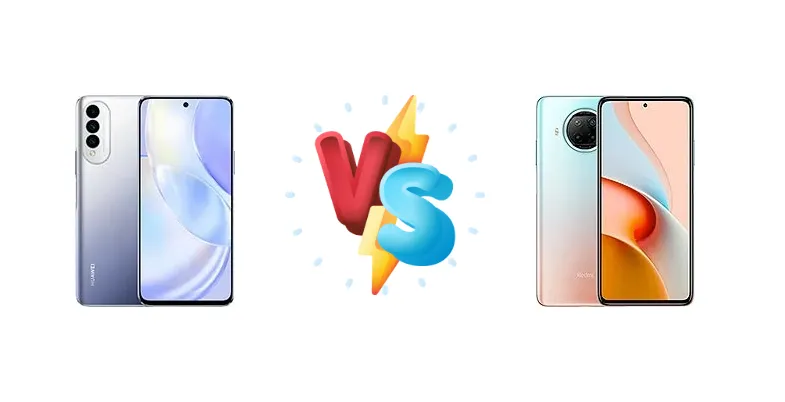
Both the Huawei Nova 8 SE Youth and the Xiaomi Redmi Note 9 Pro 5G target the competitive mid-range 5G smartphone market. However, they take distinctly different approaches to achieving affordability. The Nova 8 SE Youth relies on Huawei’s in-house Kirin chipset, while the Redmi Note 9 Pro 5G leverages Qualcomm’s Snapdragon 750G. This comparison dives deep into the core differences to help you decide which device best suits your needs.
🏆 Quick Verdict
For most users, the Xiaomi Redmi Note 9 Pro 5G emerges as the stronger choice. Its Snapdragon 750G, built on a more efficient 8nm process, delivers noticeably better performance and thermal management than the Kirin 710A. While the Nova 8 SE Youth boasts faster 40W charging, the Redmi Note 9 Pro 5G’s overall package offers a more compelling experience.
| Network |
|---|
| 2G bands | GSM 850 / 900 / 1800 / 1900 | GSM 850 / 900 / 1800 / 1900 |
| 3G bands | HSDPA 850 / 900 / 2100 | HSDPA 850 / 900 / 1900 / 2100 |
| 4G bands | LTE | 1, 3, 5, 7, 8, 34, 38, 39, 40, 41 |
| 5G bands | - | 1, 3, 41, 78, 79 SA/NSA/Sub6 |
| Speed | HSPA, LTE | HSPA, LTE, 5G |
| Technology | GSM / CDMA / HSPA / LTE | GSM / CDMA / HSPA / EVDO / LTE / 5G |
| | CDMA 800 | CDMA2000 1xEV-DO |
| Launch |
|---|
| Announced | 2021, July 28 | 2020, November 26 |
| Status | Available. Released 2021, August 13 | Available. Released 2020, December 01 |
| Body |
|---|
| Build | - | Glass front (Gorilla Glass 5), glass back (Gorilla Glass 5) |
| Dimensions | 160.7 x 73.3 x 8.4 mm (6.33 x 2.89 x 0.33 in) | 165.4 x 76.8 x 9 mm (6.51 x 3.02 x 0.35 in) |
| SIM | Nano-SIM + Nano-SIM | Nano-SIM + Nano-SIM |
| Weight | 179 g (6.31 oz) | 215 g (7.58 oz) |
| | - | IP53, dust and splash resistant |
| Display |
|---|
| Protection | - | Corning Gorilla Glass 5 |
| Resolution | 1080 x 2400 pixels, 20:9 ratio (~399 ppi density) | 1080 x 2400 pixels, 20:9 ratio (~395 ppi density) |
| Size | 6.6 inches, 105.2 cm2 (~89.3% screen-to-body ratio) | 6.67 inches, 107.4 cm2 (~84.6% screen-to-body ratio) |
| Type | IPS LCD | IPS LCD, HDR10, 120Hz, 450 nits (typ) |
| Platform |
|---|
| CPU | Octa-core (4x2.0 GHz Cortex-A73 & 4x1.7 GHz Cortex-A53) | Octa-core (2x2.2 GHz Kryo 570 & 6x1.8 GHz Kryo 570) |
| Chipset | Kirin 710A (14 nm) | Qualcomm SM7225 Snapdragon 750G 5G (8 nm) |
| GPU | Mali-G51 MP4 | Adreno 619 |
| OS | Android 10, EMUI 10.1, no Google Play Services | Android 10, MIUI 12 |
| Memory |
|---|
| Card slot | No | microSDXC (uses shared SIM slot) |
| Internal | 128GB 8GB RAM | 128GB 6GB RAM, 128GB 8GB RAM, 256GB 8GB RAM |
| | - | UFS 2.2 |
| Main Camera |
|---|
| Features | LED flash, Panorama, HDR | Dual-LED dual-tone flash, HDR, panorama |
| Quad | - | 108 MP, f/1.8, 26mm (wide), 1/1.52", 0.7µm, PDAF
8 MP, f/2.2, 118˚ (ultrawide), 1/4.0", 1.12µm
2 MP (macro)
Auxiliary lens |
| Single | 16 MP, f/2.0, (wide) | - |
| Triple | 48 MP, f/1.8, 26mm (wide), PDAF
2 MP (macro)
Auxiliary lens | - |
| Video | 1080p@30fps | 4K@30fps, 1080p@30/60fps, gyro-EIS |
| Selfie camera |
|---|
| Features | - | HDR, panorama |
| Single | 16 MP, f/2.0, (wide) | 16 MP, f/2.5, (wide), 1/3.06", 1.0µm |
| Video | 1080p@30fps | 1080p@30fps, gyro-EIS |
| Sound |
|---|
| 3.5mm jack | Yes | Yes |
| 35mm jack | Yes | Yes |
| Loudspeaker | Yes | Yes, with stereo speakers |
| | - | 24-bit/192kHz audio |
| Comms |
|---|
| Bluetooth | 5.1, A2DP, LE | 5.1, A2DP, LE |
| Infrared port | - | Yes |
| NFC | No | Yes |
| Positioning | GPS, GLONASS, GALILEO, BDS | GPS (L1+L5), GLONASS (G1), BDS (B1I+B2a), GALILEO (E1+E5a), QZSS (L1+L5) |
| Radio | FM radio | Unspecified |
| USB | USB Type-C 2.0, OTG | USB Type-C 2.0 |
| WLAN | Wi-Fi 802.11 a/b/g/n/ac, dual-band, Wi-Fi Direct | Wi-Fi 802.11 a/b/g/n/ac, dual-band, Wi-Fi Direct |
| Features |
|---|
| Sensors | Fingerprint (side-mounted), accelerometer, compass | Fingerprint (side-mounted), accelerometer, gyro, compass |
| | - | Virtual proximity sensing |
| Battery |
|---|
| Charging | 40W wired, 60% in 15 min, 100% in 35 min | 33W wired, 100% in 58 min |
| Type | Li-Po 4000 mAh | Li-Po 4820 mAh |
| Misc |
|---|
| Colors | Black, Silver | Gray, Blue, Red/Mint |
| Models | CHL-AL60 | M2007J17C |
| Price | About 250 EUR | About 370 EUR |
Huawei nova 8 SE Youth
- Faster 40W wired charging
- Potentially more competitive pricing (depending on region)
- Huawei’s aesthetic design language
- Less powerful Kirin 710A chipset
- Huawei Mobile Services (HMS) ecosystem limitations
- Potentially lower gaming performance
Xiaomi Redmi Note 9 Pro 5G
- More powerful and efficient Snapdragon 750G chipset
- Google Mobile Services (GMS) support
- Better 5G connectivity and performance
- Slower 33W wired charging
- Xiaomi’s MIUI software can be bloated
- Potentially less refined design
Display Comparison
Neither device boasts a standout display. Both likely feature LCD panels, common in this price bracket. However, detailed specs like resolution and refresh rate are missing. The key difference lies in the underlying chipsets’ ability to drive the display efficiently. Without knowing the panel technology, it’s difficult to declare a clear winner, but the Redmi Note 9 Pro 5G’s more powerful GPU suggests better handling of graphically intensive tasks on the display.
Camera Comparison
Without detailed camera sensor information, a direct comparison is challenging. However, the Redmi Note 9 Pro 5G’s brand reputation suggests a greater emphasis on camera quality. While both phones likely include multiple rear cameras, the Redmi Note 9 Pro 5G is more likely to feature a larger main sensor and more sophisticated image processing algorithms. The Nova 8 SE Youth may focus on software-based enhancements, but the underlying hardware limitations of the Kirin 710A’s ISP will likely be a bottleneck. We can assume both will have a standard set of modes, but the Redmi Note 9 Pro 5G will likely produce more detailed and dynamic images.
Performance
The Qualcomm Snapdragon 750G (8nm) in the Redmi Note 9 Pro 5G represents a significant architectural advantage over the Huawei Kirin 710A (14nm). The 8nm process inherently offers better power efficiency and thermal performance. The Snapdragon 750G’s Kryo 570 cores, with a peak clock speed of 2.2 GHz, also outperform the Kirin 710A’s Cortex-A73 cores (2.0 GHz). This translates to smoother multitasking, faster app loading times, and a more responsive gaming experience on the Redmi Note 9 Pro 5G. The Kirin 710A, while capable for everyday tasks, will likely struggle with demanding games and sustained workloads.
Battery Life
The Redmi Note 9 Pro 5G’s 33W charging takes 58 minutes for a full charge, while the Nova 8 SE Youth’s 40W charging achieves 100% in 35 minutes. This is a clear win for Huawei in terms of charging speed. However, battery life is a more complex equation. The Snapdragon 750G’s superior power efficiency means the Redmi Note 9 Pro 5G will likely deliver comparable, if not better, real-world battery life despite potentially having a similar or slightly smaller battery capacity. The faster charging of the Nova 8 SE Youth is beneficial, but it doesn’t compensate for a less efficient chipset.
Buying Guide
Buy the Huawei Nova 8 SE Youth if you prioritize extremely fast charging and are comfortable with the limitations of the Huawei Mobile Services ecosystem. Buy the Xiaomi Redmi Note 9 Pro 5G if you value superior performance, a more open software experience with Google Mobile Services, and a more efficient 5G chipset for longer gaming sessions and better battery life.
Frequently Asked Questions
❓ Will the Kirin 710A struggle with graphically demanding games like PUBG Mobile?
Yes, the Kirin 710A is likely to struggle with PUBG Mobile at higher settings. While playable at lower settings, you may experience frame drops and stuttering, especially during intense firefights. The Snapdragon 750G in the Redmi Note 9 Pro 5G offers a significantly smoother gaming experience.
❓ Does the Redmi Note 9 Pro 5G support VoLTE and VoWiFi on all carriers?
Support for VoLTE and VoWiFi varies by carrier and region. It’s crucial to check compatibility with your specific carrier before purchasing the Redmi Note 9 Pro 5G. Xiaomi typically provides a list of supported carriers on their website, but it’s always best to confirm directly with your provider.
❓ How does Huawei Mobile Services (HMS) differ from Google Mobile Services (GMS)?
Huawei Mobile Services lacks access to core Google apps like the Play Store, Gmail, and YouTube. Users must rely on the AppGallery and sideloading apps, which can be less convenient and pose security risks. GMS offers a more seamless and integrated app experience.
❓ Is the 40W charging on the Nova 8 SE Youth compatible with Power Delivery (PD) chargers?
While the Nova 8 SE Youth supports 40W charging, it likely uses Huawei’s proprietary SuperCharge protocol. While it *may* work with some PD chargers, it won’t necessarily achieve the full 40W charging speed. Using a Huawei SuperCharge charger is recommended for optimal charging performance.