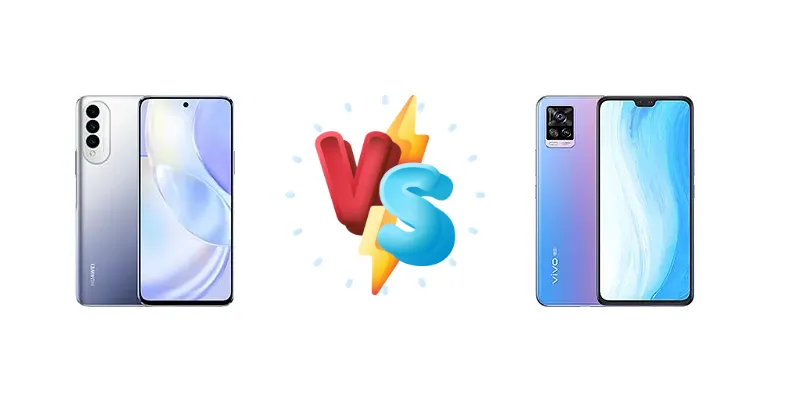
Both the Huawei nova 8 SE Youth and the vivo S7t target the competitive mid-range smartphone market, but they take distinctly different approaches. The nova 8 SE Youth prioritizes a streamlined experience with Huawei’s Kirin chipset, while the vivo S7t leverages the more powerful Mediatek Dimensity 820. This comparison dissects these choices, revealing which phone delivers the best performance and value for your money.
🏆 Quick Verdict
For the average user prioritizing performance and future-proofing, the vivo S7t is the clear winner. Its Dimensity 820 chipset offers a substantial performance leap over the Kirin 710A, making it better suited for gaming and demanding applications. While the nova 8 SE Youth offers respectable charging speeds, the S7t’s superior processing power justifies its slightly higher price.
| Network |
|---|
| 2G bands | GSM 850 / 900 / 1800 / 1900 | GSM 850 / 900 / 1800 / 1900 |
| 3G bands | HSDPA 850 / 900 / 2100 | HSDPA 850 / 900 / 1700(AWS) / 1900 / 2100 |
| 4G bands | LTE | 1, 3, 4, 5, 8, 34, 38, 39, 40, 41 |
| 5G bands | - | 1, 3, 41, 77, 78, 79 SA/NSA |
| Speed | HSPA, LTE | HSPA, LTE, 5G |
| Technology | GSM / CDMA / HSPA / LTE | GSM / CDMA / HSPA / CDMA2000 / LTE / 5G |
| | CDMA 800 | CDMA2000 1x |
| Launch |
|---|
| Announced | 2021, July 28 | 2021, February 04 |
| Status | Available. Released 2021, August 13 | Available. Released 2021, February 04 |
| Body |
|---|
| Dimensions | 160.7 x 73.3 x 8.4 mm (6.33 x 2.89 x 0.33 in) | 158.8 x 74.2 x 7.4 mm (6.25 x 2.92 x 0.29 in) |
| SIM | Nano-SIM + Nano-SIM | Nano-SIM + Nano-SIM |
| Weight | 179 g (6.31 oz) | 169 g (5.96 oz) |
| Display |
|---|
| Resolution | 1080 x 2400 pixels, 20:9 ratio (~399 ppi density) | 1080 x 2400 pixels, 20:9 ratio (~409 ppi density) |
| Size | 6.6 inches, 105.2 cm2 (~89.3% screen-to-body ratio) | 6.44 inches, 100.1 cm2 (~85.0% screen-to-body ratio) |
| Type | IPS LCD | AMOLED |
| Platform |
|---|
| CPU | Octa-core (4x2.0 GHz Cortex-A73 & 4x1.7 GHz Cortex-A53) | Octa-core (4x2.6 GHz Cortex-A76 & 4x2.0 GHz Cortex-A55) |
| Chipset | Kirin 710A (14 nm) | Mediatek Dimensity 820 (7 nm) |
| GPU | Mali-G51 MP4 | Mali-G57 MC5 |
| OS | Android 10, EMUI 10.1, no Google Play Services | Android 11, OriginOS 1.0 |
| Memory |
|---|
| Card slot | No | No |
| Internal | 128GB 8GB RAM | 128GB 8GB RAM, 256GB 8GB RAM |
| | - | UFS 2.1 |
| Main Camera |
|---|
| Features | LED flash, Panorama, HDR | Dual-LED dual-tone flash, HDR, panorama |
| Single | 16 MP, f/2.0, (wide) | - |
| Triple | 48 MP, f/1.8, 26mm (wide), PDAF
2 MP (macro)
Auxiliary lens | 64 MP, f/1.9, 26mm (wide), 1/1.72", 0.8µm, PDAF
8 MP, f/2.2, 120˚, 16mm (ultrawide), 1/4.0", 1.12µm
Auxiliary lens |
| Video | 1080p@30fps | 4K@30fps, 1080p@30fps, gyro-EIS |
| Selfie camera |
|---|
| Dual | - | 44 MP, f/2.0, (wide), AF
8 MP, f/2.3, 105˚ (ultrawide) |
| Features | - | HDR |
| Single | 16 MP, f/2.0, (wide) | - |
| Video | 1080p@30fps | 4K@30fps, 1080p@30fps |
| Sound |
|---|
| 3.5mm jack | Yes | No |
| 35mm jack | Yes | No |
| Loudspeaker | Yes | Yes |
| | - | 24-bit/192kHz audio |
| Comms |
|---|
| Bluetooth | 5.1, A2DP, LE | 5.1, A2DP, LE, aptX HD |
| NFC | No | Yes |
| Positioning | GPS, GLONASS, GALILEO, BDS | GPS, GLONASS, GALILEO, BDS, QZSS |
| Radio | FM radio | No |
| USB | USB Type-C 2.0, OTG | USB Type-C, OTG |
| WLAN | Wi-Fi 802.11 a/b/g/n/ac, dual-band, Wi-Fi Direct | Wi-Fi 802.11 a/b/g/n/ac, dual-band, Wi-Fi Direct |
| Features |
|---|
| Sensors | Fingerprint (side-mounted), accelerometer, compass | Fingerprint (under display, optical), accelerometer, proximity, compass |
| Battery |
|---|
| Charging | 40W wired, 60% in 15 min, 100% in 35 min | 33W wired, 66% in 30 min |
| Type | Li-Po 4000 mAh | 4000 mAh |
| Misc |
|---|
| Colors | Black, Silver | Black, White, Gradient Blue |
| Models | CHL-AL60 | V2080A |
| Price | About 250 EUR | About 340 EUR |
Huawei nova 8 SE Youth
- Faster wired charging (40W)
- Potentially more efficient processor for basic tasks
- Huawei ecosystem integration
- Significantly weaker processor compared to the Dimensity 820
- Likely limited gaming performance
- Older 14nm process technology
vivo S7t
- Much more powerful Dimensity 820 chipset
- Better gaming performance and multitasking
- More efficient 7nm process technology
- Slower wired charging (33W)
- Potentially higher price
- May lack Huawei-specific software features
Display Comparison
Neither device’s display specifications are provided, so a direct comparison is limited. However, given the market positioning, both likely feature LCD panels. The S7t, being a slightly more premium offering, *may* have a higher peak brightness and potentially better color accuracy. The absence of details like refresh rate or resolution makes it difficult to definitively assess display quality, but the S7t’s positioning suggests a slight advantage.
Camera Comparison
Without detailed camera specifications, a precise comparison is challenging. However, the Dimensity 820’s integrated ISP (Image Signal Processor) in the S7t generally offers more advanced image processing capabilities than the Kirin 710A’s ISP. This could result in better dynamic range, noise reduction, and overall image quality, particularly in low-light conditions. The S7t’s processor also supports more advanced camera features, potentially including 4K video recording at higher frame rates. We can assume both phones will have a primary camera, but the S7t’s chipset gives it an edge in image processing.
Performance
The performance gap between these two devices is significant. The vivo S7t’s Mediatek Dimensity 820, built on a 7nm process, is a substantial upgrade over the Huawei nova 8 SE Youth’s Kirin 710A (14nm). The Dimensity 820’s Cortex-A76 cores, clocked at 2.6 GHz, deliver considerably more processing power than the Kirin 710A’s Cortex-A73 cores at 2.0 GHz. This translates to faster app loading times, smoother multitasking, and a significantly better gaming experience on the S7t. The 7nm process also contributes to better thermal efficiency, reducing the likelihood of throttling during sustained workloads.
Battery Life
The Huawei nova 8 SE Youth boasts 40W wired charging, claiming 60% charge in 15 minutes and 100% in 35 minutes. The vivo S7t offers 33W wired charging, reaching 66% in 30 minutes. While the nova 8 SE Youth appears faster on paper, the Dimensity 820’s superior efficiency in the S7t could offset the lower charging wattage, resulting in comparable real-world charging times and potentially better overall battery life due to reduced power consumption during use. The actual battery capacity of both devices is unknown, but the S7t’s chipset efficiency is a key factor.
Buying Guide
Buy the Huawei nova 8 SE Youth if you need a reliable daily driver with a focus on efficient power consumption and are heavily invested in the Huawei ecosystem. It’s a good choice for users who prioritize a clean software experience and don’t require intensive gaming or multitasking capabilities. Buy the vivo S7t if you prefer a phone capable of handling demanding games, video editing, and multitasking with ease. It’s ideal for users who want a future-proof device with a more powerful processor and faster overall performance.
Frequently Asked Questions
❓ Will the vivo S7t’s Dimensity 820 handle demanding games like PUBG Mobile at high settings?
Yes, the Dimensity 820 is more than capable of running PUBG Mobile at high settings with smooth frame rates. Its powerful CPU and GPU provide the necessary horsepower for a fluid gaming experience, and the 7nm process helps prevent overheating during extended gaming sessions.
❓ Does the Huawei nova 8 SE Youth support 5G connectivity?
The context data does not explicitly state 5G support for the nova 8 SE Youth. However, given the Kirin 710A chipset and its release timeframe, it's likely to be a 4G-only device. The vivo S7t, powered by the Dimensity 820, inherently supports 5G connectivity.
❓ How does the Kirin 710A’s power efficiency compare to the Dimensity 820 in everyday use?
While the Kirin 710A is designed for efficiency, the Dimensity 820’s 7nm process provides a significant advantage. The smaller node size allows for more transistors in a smaller area, resulting in lower power consumption for the same level of performance. This translates to potentially longer battery life on the vivo S7t, even with its more powerful processor.