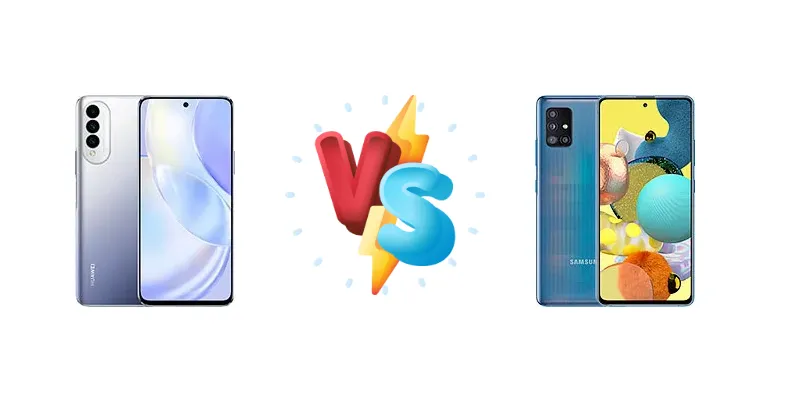
Both the Huawei nova 8 SE Youth and the Samsung Galaxy A51 5G UW represent compelling options in the increasingly competitive sub-$300 5G smartphone market. However, they approach this segment with fundamentally different philosophies: Huawei prioritizes rapid charging and a streamlined experience, while Samsung focuses on a more established ecosystem and a potentially broader 5G band compatibility. This comparison dissects their core components to determine which device best suits your needs.
🏆 Quick Verdict
For the average user prioritizing performance and future-proofing, the Samsung Galaxy A51 5G UW emerges as the stronger choice. Its Snapdragon 765G chipset, built on a more efficient 7nm process, delivers noticeably better CPU and GPU performance, offsetting the slower 15W charging. While the nova 8 SE Youth’s 40W charging is appealing, the A51 5G UW’s overall package offers a more balanced experience.
| Network |
|---|
| 2G bands | GSM 850 / 900 / 1800 / 1900 | GSM 850 / 900 / 1800 / 1900 |
| 3G bands | HSDPA 850 / 900 / 2100 | HSDPA 850 / 900 / 1900 / 2100 |
| 4G bands | LTE | 2, 4, 5, 13, 66 |
| 5G bands | - | 260, 261 mmWave |
| Speed | HSPA, LTE | HSPA, LTE, 5G |
| Technology | GSM / CDMA / HSPA / LTE | GSM / HSPA / LTE / 5G |
| | CDMA 800 | - |
| Launch |
|---|
| Announced | 2021, July 28 | 2020, August 14 |
| Status | Available. Released 2021, August 13 | Available. Released 2020, August 14 |
| Body |
|---|
| Build | - | Glass front (Gorilla Glass 3), plastic back, aluminum frame |
| Dimensions | 160.7 x 73.3 x 8.4 mm (6.33 x 2.89 x 0.33 in) | 158.8 x 73.4 x 8.6 mm (6.25 x 2.89 x 0.34 in) |
| SIM | Nano-SIM + Nano-SIM | Nano-SIM (pre-installed) |
| Weight | 179 g (6.31 oz) | 188.8 g (6.67 oz) |
| Display |
|---|
| Protection | - | Corning Gorilla Glass 3 |
| Resolution | 1080 x 2400 pixels, 20:9 ratio (~399 ppi density) | 1080 x 2400 pixels, 20:9 ratio (~405 ppi density) |
| Size | 6.6 inches, 105.2 cm2 (~89.3% screen-to-body ratio) | 6.5 inches, 102.0 cm2 (~87.5% screen-to-body ratio) |
| Type | IPS LCD | Super AMOLED |
| Platform |
|---|
| CPU | Octa-core (4x2.0 GHz Cortex-A73 & 4x1.7 GHz Cortex-A53) | Octa-core (1x2.4 GHz Kryo 475 Prime & 1x2.2 GHz Kryo 475 Gold & 6x1.8 GHz Kryo 475 Silver) |
| Chipset | Kirin 710A (14 nm) | Qualcomm SM7250 Snapdragon 765G 5G (7 nm) |
| GPU | Mali-G51 MP4 | Adreno 620 |
| OS | Android 10, EMUI 10.1, no Google Play Services | Android 10, One UI 2 |
| Memory |
|---|
| Card slot | No | microSDXC (uses shared SIM slot) |
| Internal | 128GB 8GB RAM | 128GB 6GB RAM |
| | - | UFS 2.1 |
| Main Camera |
|---|
| Features | LED flash, Panorama, HDR | LED flash, panorama, HDR |
| Quad | - | 48 MP, f/2.0, 26mm (wide), 1/2.0", 0.8µm, PDAF
12 MP, f/2.2, 123˚ (ultrawide)
5 MP (macro)
Auxiliary lens |
| Single | 16 MP, f/2.0, (wide) | 5 MP, AF |
| Triple | 48 MP, f/1.8, 26mm (wide), PDAF
2 MP (macro)
Auxiliary lens | - |
| Video | 1080p@30fps | 4K@30fps, 1080p@30/120fps; gyro-EIS |
| Selfie camera |
|---|
| Features | - | HDR |
| Single | 16 MP, f/2.0, (wide) | 32 MP, f/2.2, 26mm (wide), 1/2.8", 0.8µm |
| Video | 1080p@30fps | 4K@30fps, 1080p@30fps |
| Sound |
|---|
| 3.5mm jack | Yes | Yes |
| 35mm jack | Yes | Yes |
| Loudspeaker | Yes | Yes |
| Comms |
|---|
| Bluetooth | 5.1, A2DP, LE | 5.0, A2DP, LE |
| NFC | No | Yes |
| Positioning | GPS, GLONASS, GALILEO, BDS | GPS, GLONASS, GALILEO, BDS |
| Radio | FM radio | FM radio, RDS, recording |
| USB | USB Type-C 2.0, OTG | USB Type-C 2.0, OTG |
| WLAN | Wi-Fi 802.11 a/b/g/n/ac, dual-band, Wi-Fi Direct | Wi-Fi 802.11 a/b/g/n/ac, dual-band, Wi-Fi Direct |
| Features |
|---|
| Sensors | Fingerprint (side-mounted), accelerometer, compass | Fingerprint (under display, optical), accelerometer, gyro, proximity, compass |
| | - | ANT+ |
| Battery |
|---|
| Charging | 40W wired, 60% in 15 min, 100% in 35 min | 15W wired |
| Stand-by | - | Up to 672 h |
| Talk time | - | Up to 5 h |
| Type | Li-Po 4000 mAh | Li-Po 4500 mAh |
| Misc |
|---|
| Colors | Black, Silver | Prism Bricks Blue |
| Models | CHL-AL60 | SM-A516V |
| Price | About 250 EUR | About 470 EUR |
| SAR | - | 0.70 W/kg (head) 1.25 W/kg (body) |
| SAR EU | - | 0.59 W/kg (head) 1.32 W/kg (body) |
Huawei nova 8 SE Youth
- Extremely fast 40W wired charging
- Potentially more affordable price point
- Streamlined Huawei software experience (depending on user preference)
- Less powerful Kirin 710A chipset
- 14nm process leads to lower efficiency and potential throttling
- Limited 5G band support compared to Samsung
Samsung Galaxy A51 5G UW
- More powerful Snapdragon 765G chipset
- 7nm process for better efficiency and thermal management
- Wider 5G band support for greater carrier compatibility
- Slower 15W wired charging
- Samsung’s One UI can be resource-intensive
- Potentially higher price compared to the nova 8 SE Youth
Display Comparison
Neither device boasts a particularly standout display. While specific panel details (like OLED vs. LCD) are missing for the nova 8 SE Youth, both likely utilize LCD panels common in this price bracket. The A51 5G UW’s display benefits from Samsung’s color science, offering generally accurate and vibrant visuals. However, the real differentiator lies in processing power, which impacts UI smoothness, not display quality. Both will likely offer similar viewing experiences in everyday use.
Camera Comparison
Without detailed camera specs beyond the main sensors, a direct comparison is challenging. However, the Snapdragon 765G’s image signal processor (ISP) generally offers more advanced image processing capabilities than the Kirin 710A’s ISP. This means the A51 5G UW is likely to produce more detailed and dynamic photos, particularly in challenging lighting conditions. The presence of OIS (Optical Image Stabilization) on the A51 5G UW, if equipped, would further enhance image quality and video stabilization. The 2MP macro lenses found on both devices are largely marketing gimmicks and offer limited practical benefit.
Performance
The core difference between these phones resides in their chipsets. The Samsung Galaxy A51 5G UW’s Qualcomm Snapdragon 765G, fabricated on a 7nm process, represents a significant architectural leap over the Huawei nova 8 SE Youth’s Kirin 710A (14nm). The Snapdragon 765G’s Kryo CPU cores – a Prime, Gold, and Silver configuration – offer a more sophisticated power management strategy and superior single-core performance (2.4 GHz peak) compared to the Kirin 710A’s Cortex-A73 (2.0 GHz). This translates to snappier app launches, smoother multitasking, and a more enjoyable gaming experience on the Samsung device. The 7nm process also contributes to better thermal efficiency, reducing the likelihood of performance throttling during sustained loads.
Battery Life
The Huawei nova 8 SE Youth attempts to compensate for a potentially smaller battery capacity with its 40W wired charging, capable of reaching 60% charge in 15 minutes and 100% in 35 minutes. This is a significant advantage over the Samsung Galaxy A51 5G UW’s slower 15W charging. However, the Snapdragon 765G’s superior power efficiency means the A51 5G UW will likely deliver comparable, if not better, real-world battery life despite the slower charging speed. The efficiency gain from the 7nm process offsets the charging disparity for many users.
Buying Guide
Buy the Huawei nova 8 SE Youth if you absolutely prioritize the fastest possible charging speeds and are comfortable with the limitations of the Huawei ecosystem. This phone is ideal for users who frequently find themselves needing a quick power boost. Buy the Samsung Galaxy A51 5G UW if you value a more powerful processor for gaming and multitasking, a wider range of 5G band support, and the convenience of the Samsung ecosystem. It’s the better all-rounder for users who want a phone that will remain capable for longer.
Frequently Asked Questions
❓ Will the Samsung Galaxy A51 5G UW overheat during extended gaming sessions?
The Snapdragon 765G’s 7nm process and Samsung’s thermal management solutions generally prevent significant overheating during gaming. While some throttling may occur during prolonged, graphically intensive sessions, it’s unlikely to be severe enough to render the phone unusable. The Kirin 710A in the nova 8 SE Youth is more prone to throttling due to its less efficient 14nm process.
❓ Does the Huawei nova 8 SE Youth support Google Mobile Services (GMS)?
This is a critical consideration. Due to ongoing restrictions, the Huawei nova 8 SE Youth likely does *not* natively support Google Mobile Services (GMS). It relies on Huawei Mobile Services (HMS) and the AppGallery. This means access to popular apps like Google Maps, Gmail, and YouTube requires workarounds, which may not be ideal for all users.
❓ How does the 5G performance differ between these two phones?
The Samsung Galaxy A51 5G UW generally offers broader 5G band support, increasing its compatibility with different carriers and 5G networks globally. The Huawei nova 8 SE Youth’s 5G support may be limited to specific bands, potentially restricting its 5G functionality in certain regions.
❓ Is the 15W charging on the A51 5G UW painfully slow in 2024?
While 15W is slower than the nova 8 SE Youth's 40W, it's still adequate for overnight charging. The Snapdragon 765G's efficiency means you won't be constantly needing to top up, mitigating the slower charging speed. A full charge will still take a few hours, but it's a reasonable trade-off for the performance benefits.