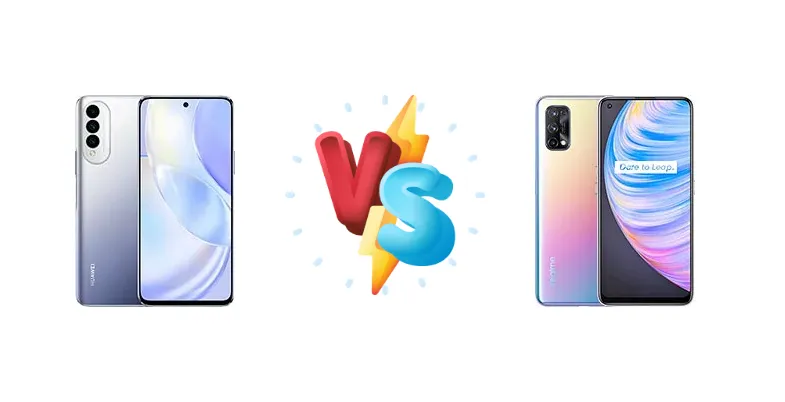
The Realme Q2 Pro and Huawei nova 8 SE Youth represent compelling options in the increasingly competitive mid-range 5G smartphone market. While both aim to deliver a connected experience without breaking the bank, they take distinctly different approaches to achieving this, primarily through their chipset choices and charging capabilities. This comparison dissects these differences to help you determine which device best suits your needs.
🏆 Quick Verdict
For the average user prioritizing performance and future-proofing, the Realme Q2 Pro is the clear winner. Its Mediatek Dimensity 800U chipset, built on a 7nm process, offers a substantial performance advantage over the Huawei’s Kirin 710A. The 65W charging is a game-changer, significantly reducing downtime. However, Huawei’s brand recognition may sway some buyers.
| Network |
|---|
| 2G bands | GSM 850 / 900 / 1800 / 1900 | GSM 850 / 900 / 1800 / 1900 |
| 3G bands | HSDPA 850 / 900 / 2100 | HSDPA 850 / 900 / 1700(AWS) / 1900 / 2100 |
| 4G bands | LTE | 1, 2, 3, 4, 5, 7, 8, 34, 38, 39, 40, 41 |
| 5G bands | - | 1, 41, 77, 78, 79 SA/NSA |
| Speed | HSPA, LTE | HSPA, LTE, 5G 2.3 Gbps DL |
| Technology | GSM / CDMA / HSPA / LTE | GSM / CDMA / HSPA / EVDO / LTE / 5G |
| | CDMA 800 | CDMA2000 1xEV-DO |
| Launch |
|---|
| Announced | 2021, July 28 | 2020, October 13. Released 2020, October 19 |
| Status | Available. Released 2021, August 13 | Discontinued |
| Body |
|---|
| Dimensions | 160.7 x 73.3 x 8.4 mm (6.33 x 2.89 x 0.33 in) | 160.9 x 74.4 x 8.1 mm (6.33 x 2.93 x 0.32 in) |
| SIM | Nano-SIM + Nano-SIM | Nano-SIM + Nano-SIM |
| Weight | 179 g (6.31 oz) | 175 g (6.17 oz) |
| Display |
|---|
| Protection | - | Corning Gorilla Glass |
| Resolution | 1080 x 2400 pixels, 20:9 ratio (~399 ppi density) | 1080 x 2400 pixels, 20:9 ratio (~411 ppi density) |
| Size | 6.6 inches, 105.2 cm2 (~89.3% screen-to-body ratio) | 6.4 inches, 98.9 cm2 (~82.6% screen-to-body ratio) |
| Type | IPS LCD | Super AMOLED, 600 nits (peak) |
| Platform |
|---|
| CPU | Octa-core (4x2.0 GHz Cortex-A73 & 4x1.7 GHz Cortex-A53) | Octa-core (2x2.4 GHz Cortex-A76 & 6x2.0 GHz Cortex-A55) |
| Chipset | Kirin 710A (14 nm) | Mediatek Dimensity 800U (7 nm) |
| GPU | Mali-G51 MP4 | Mali-G57 MC3 |
| OS | Android 10, EMUI 10.1, no Google Play Services | Android 10, Realme UI |
| Memory |
|---|
| Card slot | No | No |
| Internal | 128GB 8GB RAM | 128GB 8GB RAM, 256GB 8GB RAM |
| | - | UFS 2.1 |
| Main Camera |
|---|
| Features | LED flash, Panorama, HDR | LED flash, HDR, panorama |
| Quad | - | 48 MP, f/1.8, 25mm (wide), 1/2.0", 0.8µm, PDAF
8 MP, f/2.3, 119˚, 16mm (ultrawide), 1/4.0", 1.12µm
2 MP (macro)
Auxiliary lens |
| Single | 16 MP, f/2.0, (wide) | - |
| Triple | 48 MP, f/1.8, 26mm (wide), PDAF
2 MP (macro)
Auxiliary lens | - |
| Video | 1080p@30fps | 4K@30fps, 1080p@30/60/120fps, gyro-EIS |
| Selfie camera |
|---|
| Features | - | HDR, panorama |
| Single | 16 MP, f/2.0, (wide) | 16 MP, f/2.5, 26mm (wide), 1/3.1", 1.0µm |
| Video | 1080p@30fps | 1080p@30/120fps |
| Sound |
|---|
| 3.5mm jack | Yes | No |
| 35mm jack | Yes | No |
| Loudspeaker | Yes | Yes |
| | - | 24-bit/192kHz audio |
| Comms |
|---|
| Bluetooth | 5.1, A2DP, LE | 5.1, A2DP, LE |
| NFC | No | - |
| Positioning | GPS, GLONASS, GALILEO, BDS | GPS, GLONASS, GALILEO, QZSS, BDS |
| Radio | FM radio | No |
| USB | USB Type-C 2.0, OTG | USB Type-C 2.0 |
| WLAN | Wi-Fi 802.11 a/b/g/n/ac, dual-band, Wi-Fi Direct | Wi-Fi 802.11 a/b/g/n/ac, dual-band, Wi-Fi Direct |
| Features |
|---|
| Sensors | Fingerprint (side-mounted), accelerometer, compass | Fingerprint (under display, optical), accelerometer, gyro, proximity, compass |
| Battery |
|---|
| Charging | 40W wired, 60% in 15 min, 100% in 35 min | 65W wired |
| Type | Li-Po 4000 mAh | 4300 mAh |
| Misc |
|---|
| Colors | Black, Silver | Leather Gray, Rainbow, Sea Blue, Fantasy White |
| Models | CHL-AL60 | RMX2173 |
| Price | About 250 EUR | About 310 EUR |
Huawei nova 8 SE Youth
- Potentially more familiar brand ecosystem for some users.
- 40W charging is still relatively fast.
- May be more readily available in certain regions.
- Older, less efficient Kirin 710A chipset.
- Likely to exhibit more throttling under heavy load.
- Potentially slower app loading and multitasking.
Realme Q2 Pro
- Significantly faster and more efficient Dimensity 800U chipset.
- Ultra-fast 65W charging.
- Better potential for gaming and demanding applications.
- Realme’s software experience may not appeal to all users.
- May be less widely available than Huawei devices.
Display Comparison
Neither device’s display specifications are provided, so a direct comparison is limited. However, given the market positioning, both likely feature LCD panels. The Realme Q2 Pro, being a slightly more ambitious device, *may* have a higher refresh rate (90Hz is common in this segment) which would provide a smoother visual experience. The absence of details necessitates assuming similar brightness levels and color accuracy, though Realme generally focuses on vibrant displays.
Camera Comparison
Without detailed camera specifications, analysis is limited. However, the chipset difference indirectly impacts camera performance. The Dimensity 800U includes a more powerful ISP (Image Signal Processor) capable of faster image processing and better noise reduction. This doesn’t guarantee better photos, but it provides the *potential* for superior image quality. The absence of information regarding sensor sizes and lens apertures prevents a definitive judgment, but the Realme Q2 Pro’s chipset gives it an edge in computational photography.
Performance
The core difference lies in the chipsets. The Realme Q2 Pro’s Mediatek Dimensity 800U, fabricated on a 7nm process, is a significant leap forward compared to the Huawei nova 8 SE Youth’s Kirin 710A (14nm). The Dimensity 800U’s Cortex-A76 cores, clocked at 2.4GHz, offer substantially higher single-core performance than the Kirin 710A’s Cortex-A73 cores at 2.0GHz. This translates to snappier app launches, smoother multitasking, and a more enjoyable gaming experience. The 7nm process also contributes to better thermal efficiency, reducing the likelihood of throttling under sustained load. The Realme Q2 Pro will demonstrably outperform the Huawei in CPU-intensive tasks.
Battery Life
While battery capacities aren’t specified, the charging speeds are a major differentiator. The Realme Q2 Pro’s 65W wired charging is incredibly fast, capable of fully charging the device in under 40 minutes. The Huawei nova 8 SE Youth’s 40W charging, while respectable, takes 35 minutes to reach 100%. This difference is substantial for users who frequently need to top up their battery quickly. A larger battery capacity on the Huawei would be needed to offset the charging speed advantage of the Realme.
Buying Guide
Buy the Huawei nova 8 SE Youth if you prioritize a familiar brand ecosystem and are comfortable with a more modest performance profile for everyday tasks like social media and light browsing. Buy the Realme Q2 Pro if you demand faster processing speeds for gaming and multitasking, and value the convenience of incredibly rapid 65W charging, making it ideal for power users and those constantly on the go.
Frequently Asked Questions
❓ Will the Realme Q2 Pro’s Dimensity 800U handle demanding games like PUBG Mobile smoothly?
Yes, the Dimensity 800U is well-equipped to handle PUBG Mobile at high settings. Its Cortex-A76 cores and Mali-G57 MC4 GPU provide ample processing power for a smooth and responsive gaming experience. The 7nm process also helps to mitigate thermal throttling, allowing for sustained performance during longer gaming sessions.
❓ Is the 40W charging on the Huawei nova 8 SE Youth slow compared to the competition?
While 40W charging is not *slow* in absolute terms, it is significantly slower than the 65W charging offered by the Realme Q2 Pro. The Realme can fully charge in under 40 minutes, while the Huawei takes 35 minutes. For users who prioritize quick top-ups, the Realme is the better choice.
❓ Does the Kirin 710A chipset on the Huawei nova 8 SE Youth support 5G connectivity?
Yes, the Kirin 710A does support 5G connectivity. However, its 5G modem is less advanced than the one found in the Dimensity 800U, potentially resulting in slightly slower 5G speeds and less efficient power consumption when connected to 5G networks.