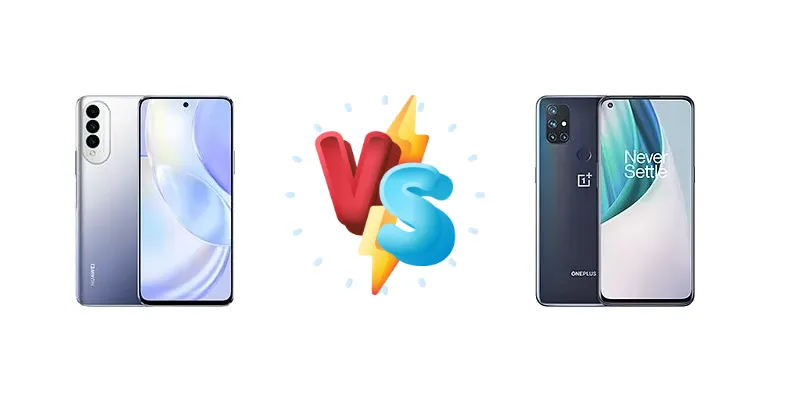
Both the Huawei Nova 8 SE Youth and the OnePlus Nord N10 5G target the competitive budget 5G smartphone market. However, they take different approaches to achieving affordability. The Nova 8 SE Youth relies on Huawei’s in-house Kirin 710A chipset, while the Nord N10 5G leverages Qualcomm’s Snapdragon 690 5G. This comparison dives deep into the nuances of each device to determine which offers the best value.
🏆 Quick Verdict
For most users, the OnePlus Nord N10 5G emerges as the stronger choice. While both phones offer similar battery endurance ratings, the Snapdragon 690’s more efficient 8nm process and generally better software optimization provide a smoother overall experience, particularly for demanding tasks. The Nova 8 SE Youth’s faster 40W charging is a notable advantage, but doesn't fully offset the performance gap.
| Network |
|---|
| 2G bands | GSM 850 / 900 / 1800 / 1900 | GSM 850 / 900 / 1800 / 1900 |
| 3G bands | HSDPA 850 / 900 / 2100 | HSDPA 850 / 900 / 1700(AWS) / 1900 / 2100 |
| 4G bands | LTE | 1, 2, 3, 4, 5, 7, 8, 12, 17, 20, 28, 38, 39, 40, 41, 66 - International |
| 5G bands | - | 1, 3, 7, 28, 41, 66, 78 SA/NSA - International |
| Speed | HSPA, LTE | HSPA 42.2/5.76 Mbps, LTE Cat18 1024/150 Mbps, 5G |
| Technology | GSM / CDMA / HSPA / LTE | GSM / CDMA / HSPA / LTE / 5G |
| | CDMA 800 | 2, 5, 25, 41, 66, 71 SA/NSA - USA |
| Launch |
|---|
| Announced | 2021, July 28 | 2020, October 26 |
| Status | Available. Released 2021, August 13 | Available. Released 2020, November 21 |
| Body |
|---|
| Build | - | Glass front (Gorilla Glass 3), plastic back, plastic frame |
| Dimensions | 160.7 x 73.3 x 8.4 mm (6.33 x 2.89 x 0.33 in) | 163 x 74.7 x 9 mm (6.42 x 2.94 x 0.35 in) |
| SIM | Nano-SIM + Nano-SIM | Nano-SIM + Nano-SIM |
| Weight | 179 g (6.31 oz) | 190 g (6.70 oz) |
| Display |
|---|
| Protection | - | Corning Gorilla Glass 3 |
| Resolution | 1080 x 2400 pixels, 20:9 ratio (~399 ppi density) | 1080 x 2400 pixels, 20:9 ratio (~406 ppi density) |
| Size | 6.6 inches, 105.2 cm2 (~89.3% screen-to-body ratio) | 6.49 inches, 101.7 cm2 (~83.5% screen-to-body ratio) |
| Type | IPS LCD | IPS LCD, 90Hz |
| Platform |
|---|
| CPU | Octa-core (4x2.0 GHz Cortex-A73 & 4x1.7 GHz Cortex-A53) | Octa-core (2x2.0 GHz Kryo 560 Gold & 6x1.7 GHz Kryo 560 Silver) |
| Chipset | Kirin 710A (14 nm) | Qualcomm SM6350 Snapdragon 690 5G (8 nm) |
| GPU | Mali-G51 MP4 | Adreno 619L |
| OS | Android 10, EMUI 10.1, no Google Play Services | Android 10, OxygenOS 10.5 |
| Memory |
|---|
| Card slot | No | microSDXC |
| Internal | 128GB 8GB RAM | 128GB 6GB RAM |
| | - | UFS 2.1 |
| Main Camera |
|---|
| Features | LED flash, Panorama, HDR | LED flash, HDR, panorama |
| Quad | - | 64 MP, f/1.8, (wide), 1/1.72", 0.8µm, PDAF
8 MP, f/2.3, 119˚ (ultrawide)
2 MP (macro)
Auxiliary lens |
| Single | 16 MP, f/2.0, (wide) | - |
| Triple | 48 MP, f/1.8, 26mm (wide), PDAF
2 MP (macro)
Auxiliary lens | - |
| Video | 1080p@30fps | 4K@30fps, 1080p@30/60/120fps; gyro-EIS |
| Selfie camera |
|---|
| Features | - | HDR |
| Single | 16 MP, f/2.0, (wide) | 16 MP, f/2.1 |
| Video | 1080p@30fps | 1080p@30/60fps, gyro-EIS |
| Sound |
|---|
| 3.5mm jack | Yes | Yes |
| 35mm jack | Yes | Yes |
| Loudspeaker | Yes | Yes, with dual speakers |
| Comms |
|---|
| Bluetooth | 5.1, A2DP, LE | 5.1, A2DP, LE |
| NFC | No | Yes |
| Positioning | GPS, GLONASS, GALILEO, BDS | GPS (L1+L5), GLONASS, GALILEO, BDS |
| Radio | FM radio | No |
| USB | USB Type-C 2.0, OTG | USB Type-C 2.0, OTG |
| WLAN | Wi-Fi 802.11 a/b/g/n/ac, dual-band, Wi-Fi Direct | Wi-Fi 802.11 a/b/g/n/ac, dual-band, Wi-Fi Direct |
| Features |
|---|
| Sensors | Fingerprint (side-mounted), accelerometer, compass | Fingerprint (rear-mounted), accelerometer, gyro, proximity, compass |
| Battery |
|---|
| Charging | 40W wired, 60% in 15 min, 100% in 35 min | 30W wired |
| Type | Li-Po 4000 mAh | Li-Po 4300 mAh |
| Misc |
|---|
| Colors | Black, Silver | Midnight Ice |
| Models | CHL-AL60 | BE2029, BE2025, BE2026, BE2028 |
| Price | About 250 EUR | About 250 EUR |
| Tests |
|---|
| Battery life | - |
Endurance rating 99h
|
| Camera | - |
Photo / Video |
| Loudspeaker | - |
-25.8 LUFS (Very good)
|
| Performance | - |
AnTuTu: 279579 (v8)
GeekBench: 1848 (v5.1)
GFXBench: 13fps (ES 3.1 onscreen) |
Huawei nova 8 SE Youth
- 40W SuperCharge for incredibly fast charging.
- Potentially vibrant display (based on Huawei’s typical tuning).
- Competitive price point.
- Kirin 710A chipset is less efficient than Snapdragon 690.
- Limited app availability due to Huawei Mobile Services.
- Lack of detailed camera specifications.
OnePlus Nord N10 5G
- More efficient Snapdragon 690 chipset.
- OxygenOS provides a clean and responsive software experience.
- Full Google Mobile Services support for broad app compatibility.
- Slower 30W charging compared to the Nova 8 SE Youth.
- Display brightness could be better.
- Build quality may feel less premium than some competitors.
Display Comparison
The OnePlus Nord N10 5G boasts a measured peak brightness of 440 nits and a 1447:1 contrast ratio. While the Nova 8 SE Youth’s display specifications aren’t provided, Huawei typically favors vibrant, saturated colors. The Nord N10 5G’s contrast ratio suggests deeper blacks and a more visually engaging experience, especially in darker environments. The lack of high refresh rate panels on either device is a common compromise at this price point, but the Nord N10 5G’s brightness advantage is a clear win for outdoor visibility.
Camera Comparison
Both devices are listed as having Photo/Video capabilities, but detailed camera specs are absent. Given the price bracket, we can expect both to rely heavily on software processing. The Snapdragon 690’s ISP (Image Signal Processor) generally offers superior image processing capabilities compared to the Kirin 710A’s ISP. Without knowing sensor sizes or aperture values, it’s difficult to definitively declare a winner, but Qualcomm’s image processing algorithms typically deliver more natural-looking photos with better dynamic range. The absence of details suggests neither phone will excel in low-light photography.
Performance
The core difference lies in the chipsets. The Qualcomm Snapdragon 690 (8nm) in the Nord N10 5G utilizes a more modern fabrication process than the Huawei Kirin 710A (14nm). This translates to better power efficiency and potentially lower thermal throttling under sustained load. While both CPUs feature octa-core configurations with similar clock speeds on their performance cores (2.0 GHz), the Snapdragon 690’s Kryo 560 Gold cores are architecturally more advanced than the Cortex-A73 cores in the Kirin 710A. This gives the Nord N10 5G an edge in CPU-intensive tasks and gaming. The Snapdragon 690 also benefits from a more capable Adreno 620 GPU, further enhancing its gaming performance.
Battery Life
Both the Huawei Nova 8 SE Youth and the OnePlus Nord N10 5G achieve an endurance rating of 99 hours, indicating comparable battery life under typical usage. However, the charging speeds differ significantly. The Nova 8 SE Youth supports 40W wired charging, claiming 60% charge in 15 minutes and 100% in 35 minutes. The Nord N10 5G offers 30W charging. While the Nord N10 5G’s charging isn’t as fast, the Snapdragon 690’s efficiency means it may not need to be charged as frequently. The Nova 8 SE Youth’s faster charging is a compelling feature for users who prioritize quick top-ups.
Buying Guide
Buy the Huawei Nova 8 SE Youth if you prioritize extremely fast charging and are comfortable with the limitations of the Huawei Mobile Services ecosystem. Its 40W charging can top up the battery significantly faster than the Nord N10 5G. Buy the OnePlus Nord N10 5G if you value a more responsive user experience, a cleaner software experience with OxygenOS, and broader app compatibility thanks to full Google Mobile Services support.
Frequently Asked Questions
❓ Does the Kirin 710A chipset struggle with graphically demanding games like PUBG Mobile?
The Kirin 710A can run PUBG Mobile, but you’ll likely need to lower the graphics settings to achieve a consistently smooth frame rate. The Snapdragon 690 in the Nord N10 5G offers a more comfortable gaming experience with higher settings and less frame rate fluctuation due to its more powerful GPU and efficient thermal management.
❓ How significant is the difference between Huawei Mobile Services (HMS) and Google Mobile Services (GMS)?
The difference is substantial. GMS provides access to the Google Play Store and a wide range of Google apps (Gmail, Maps, YouTube, etc.). HMS requires using Huawei’s AppGallery and alternative apps, which may not always be available or offer the same functionality. While HMS is improving, GMS remains the preferred ecosystem for most users.
❓ Is the 30W charging on the OnePlus Nord N10 5G slow compared to the 40W on the Huawei Nova 8 SE Youth?
While 40W is faster on paper, the Snapdragon 690’s efficiency means the Nord N10 5G doesn’t need to be charged as frequently. The difference in daily usage may not be as significant as the wattage suggests. The Nova 8 SE Youth excels at quick top-ups, but the Nord N10 5G offers acceptable charging speeds and longer intervals between charges.