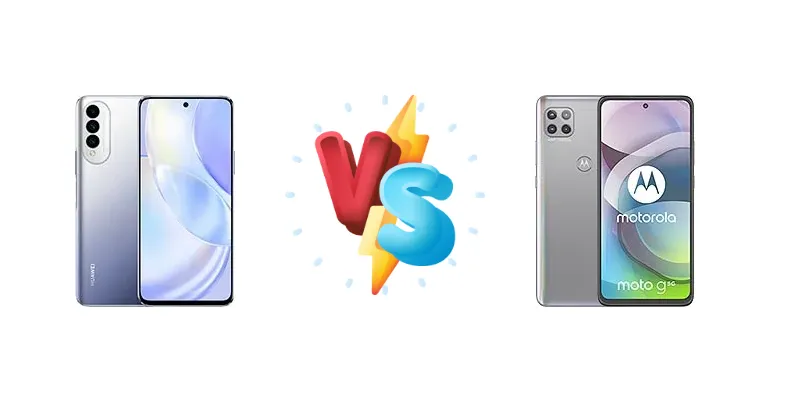
Both the Huawei nova 8 SE Youth and the Motorola Moto G 5G target the competitive budget 5G market, but they take distinctly different approaches. The nova 8 SE Youth emphasizes fast charging, while the Moto G 5G prioritizes a more modern chipset and sustained performance. This comparison dissects their key differences to determine which phone delivers the best value.
🏆 Quick Verdict
For the average user prioritizing consistent performance and future-proofing, the Motorola Moto G 5G is the better choice. Its Snapdragon 750G chipset, built on an 8nm process, offers a significant advantage over the Huawei’s older 14nm Kirin 710A, despite the nova 8 SE Youth’s faster charging.
| Network |
|---|
| 2G bands | GSM 850 / 900 / 1800 / 1900 | GSM 850 / 900 / 1800 / 1900 |
| 3G bands | HSDPA 850 / 900 / 2100 | HSDPA 850 / 900 / 1700(AWS) / 1900 / 2100 |
| 4G bands | LTE | 1, 2, 3, 4, 5, 7, 8, 18, 19, 20, 26, 28, 38, 39, 40, 41, 42, 43 |
| 5G bands | - | 1, 3, 5, 7, 8, 28, 38, 41, 77, 78 SA/NSA |
| Speed | HSPA, LTE | HSPA, LTE, 5G |
| Technology | GSM / CDMA / HSPA / LTE | GSM / HSPA / LTE / 5G |
| | CDMA 800 | - |
| Launch |
|---|
| Announced | 2021, July 28 | 2020, November 05. Released 2020, December 07 |
| Status | Available. Released 2021, August 13 | Discontinued |
| Body |
|---|
| Build | - | Glass front, plastic back, plastic frame |
| Dimensions | 160.7 x 73.3 x 8.4 mm (6.33 x 2.89 x 0.33 in) | 166.1 x 76.1 x 9.9 mm (6.54 x 3.00 x 0.39 in) |
| SIM | Nano-SIM + Nano-SIM | Nano-SIM + Nano-SIM |
| Weight | 179 g (6.31 oz) | 212 g (7.48 oz) |
| Display |
|---|
| Resolution | 1080 x 2400 pixels, 20:9 ratio (~399 ppi density) | 1080 x 2400 pixels, 20:9 ratio (~393 ppi density) |
| Size | 6.6 inches, 105.2 cm2 (~89.3% screen-to-body ratio) | 6.7 inches, 108.4 cm2 (~85.7% screen-to-body ratio) |
| Type | IPS LCD | IPS LCD, HDR10 |
| Platform |
|---|
| CPU | Octa-core (4x2.0 GHz Cortex-A73 & 4x1.7 GHz Cortex-A53) | Octa-core (2x2.2 GHz Kryo 570 & 6x1.8 GHz Kryo 570) |
| Chipset | Kirin 710A (14 nm) | Qualcomm SM7225 Snapdragon 750G 5G (8 nm) |
| GPU | Mali-G51 MP4 | Adreno 619 |
| OS | Android 10, EMUI 10.1, no Google Play Services | Android 10 |
| Memory |
|---|
| Card slot | No | microSDXC (uses shared SIM slot) |
| Internal | 128GB 8GB RAM | 64GB 4GB RAM, 128GB 2GB RAM, 128GB 6GB RAM |
| Main Camera |
|---|
| Features | LED flash, Panorama, HDR | LED flash, HDR, panorama |
| Single | 16 MP, f/2.0, (wide) | - |
| Triple | 48 MP, f/1.8, 26mm (wide), PDAF
2 MP (macro)
Auxiliary lens | 48 MP, f/1.7, 26mm (wide), 1/2.0", 0.8µm, PDAF
8 MP, f/2.2, 118˚ (ultrawide), 1.12µm
2 MP (macro), AF |
| Video | 1080p@30fps | 4K@30fps, 1080p@30/60fps, gyro-EIS |
| Selfie camera |
|---|
| Features | - | HDR |
| Single | 16 MP, f/2.0, (wide) | 16 MP, f/2.2, (wide), 1.0µm |
| Video | 1080p@30fps | 1080p@30fps |
| Sound |
|---|
| 3.5mm jack | Yes | Yes |
| 35mm jack | Yes | Yes |
| Loudspeaker | Yes | Yes |
| Comms |
|---|
| Bluetooth | 5.1, A2DP, LE | 5.1, A2DP, LE |
| NFC | No | Yes |
| Positioning | GPS, GLONASS, GALILEO, BDS | GPS (L1+L5), GLONASS, GALILEO |
| Radio | FM radio | FM radio, RDS |
| USB | USB Type-C 2.0, OTG | USB Type-C 2.0 |
| WLAN | Wi-Fi 802.11 a/b/g/n/ac, dual-band, Wi-Fi Direct | Wi-Fi 802.11 a/b/g/n/ac, dual-band, Wi-Fi Direct |
| Features |
|---|
| Sensors | Fingerprint (side-mounted), accelerometer, compass | Fingerprint (rear-mounted), accelerometer, gyro, proximity, compass |
| Battery |
|---|
| Charging | 40W wired, 60% in 15 min, 100% in 35 min | 20W wired |
| Type | Li-Po 4000 mAh | Li-Po 5000 mAh |
| Misc |
|---|
| Colors | Black, Silver | Volcanic Gray, Frosted Silver |
| Models | CHL-AL60 | - |
| Price | About 250 EUR | About 90 EUR |
| Tests |
|---|
| Battery life | - | Endurance rating 131h |
| Camera | - |
Photo / Video |
| Display | - |
Contrast ratio: 1419:1 |
| Loudspeaker | - |
-28.1 LUFS (Average) |
| Performance | - |
AnTuTu: 312461 (v8)
GeekBench: 1980 (v5.1)
GFXBench: 17fps (ES 3.1 onscreen) |
Huawei nova 8 SE Youth
- Significantly faster 40W charging
- Potentially more affordable (depending on region)
- Sleek design (assumed based on Huawei's aesthetic)
- Older, less efficient Kirin 710A chipset
- Likely inferior gaming performance
- Potentially limited software support
Motorola Moto G 5G
- More powerful and efficient Snapdragon 750G chipset
- Better long-term performance and 5G connectivity
- Likely better camera image processing
- Slower 20W charging
- May be slightly more expensive
- Motorola's software update track record is inconsistent
Display Comparison
Both phones share a contrast ratio of 1419:1, indicating similar levels of black depth and color vibrancy. However, the Motorola Moto G 5G boasts a measured peak brightness of 484 nits, which will provide better visibility in direct sunlight compared to the nova 8 SE Youth (brightness data unavailable). While both likely utilize LCD panels given the price point, the Moto G 5G’s higher brightness is a tangible advantage for outdoor use.
Camera Comparison
Both phones offer 'Photo / Video' capabilities, but detailed sensor information is lacking. Without specifics, it’s difficult to make a definitive judgment. However, given the market positioning, it’s likely the Moto G 5G benefits from Qualcomm’s image signal processor (ISP), which generally delivers superior image processing and low-light performance compared to Huawei’s ISP on the older Kirin 710A. The absence of details suggests neither phone will excel in challenging photographic conditions.
Performance
The core difference lies in the chipsets. The Motorola Moto G 5G’s Qualcomm Snapdragon 750G (8nm) is a clear upgrade over the Huawei nova 8 SE Youth’s Kirin 710A (14nm). The 8nm process node translates to better power efficiency and reduced thermal throttling under sustained load. The Snapdragon 750G’s Kryo 570 cores, with a 2x2.2 GHz prime configuration, offer a performance edge over the Kirin 710A’s 4x2.0 GHz Cortex-A73 setup. This means faster app loading times, smoother multitasking, and a more enjoyable gaming experience on the Moto G 5G.
Battery Life
Both devices achieve an endurance rating of 131 hours, suggesting comparable battery life despite the lack of specific mAh figures. However, the Motorola Moto G 5G’s 20W charging is significantly slower than the Huawei nova 8 SE Youth’s 40W charging. The nova 8 SE Youth can reach 60% charge in just 15 minutes and 100% in 35 minutes, a substantial advantage for users who prioritize quick top-ups. The Moto G 5G will require considerably longer to fully recharge.
Buying Guide
Buy the Huawei nova 8 SE Youth if you absolutely need the fastest possible charging speeds and frequently find yourself needing to top up your battery quickly. Buy the Motorola Moto G 5G if you prioritize a smoother, more responsive user experience, better long-term performance for gaming and multitasking, and a more efficient 5G modem.
Frequently Asked Questions
❓ Will the Kirin 710A struggle with demanding games like PUBG Mobile or Call of Duty?
Yes, the Kirin 710A is likely to struggle with demanding games at higher settings. The Snapdragon 750G in the Moto G 5G offers a significantly better gaming experience due to its more powerful GPU and efficient thermal management. Expect lower frame rates and potential stuttering on the nova 8 SE Youth.
❓ How does the 5G performance differ between the two phones?
The Motorola Moto G 5G’s Snapdragon 750G integrates a more modern 5G modem, offering potentially faster and more reliable 5G connectivity compared to the Kirin 710A’s 5G modem. This is particularly important for users in areas with developing 5G infrastructure.
❓ Is the difference in charging speed noticeable in everyday use?
Absolutely. The Huawei nova 8 SE Youth’s 40W charging is a game-changer for users who frequently need to quickly top up their battery. Being able to gain 60% charge in 15 minutes is a significant convenience factor, especially compared to the Moto G 5G’s slower 20W charging.
❓ What about software updates? Which phone will receive longer support?
Software support is a concern for both devices. Huawei's software situation is complex due to US sanctions, potentially limiting long-term updates for the nova 8 SE Youth. Motorola's update track record is also inconsistent, but the Snapdragon platform generally receives more consistent security patches.