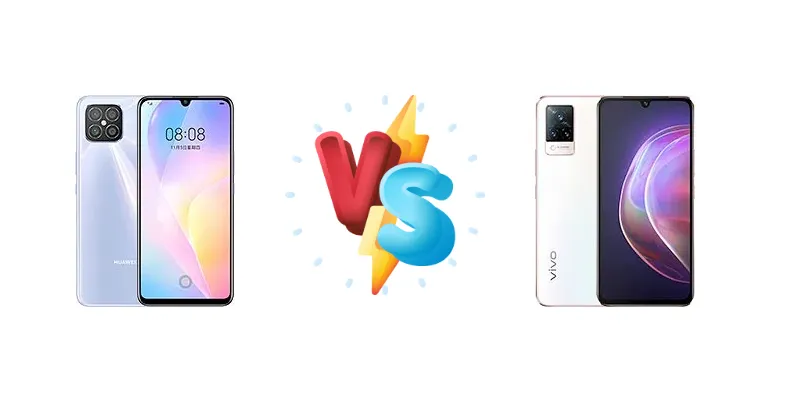
The Huawei nova 8 SE 4G and the vivo V21 5G represent compelling options in the crowded mid-range smartphone market. While both aim to deliver a balanced experience, they diverge in key areas like chipset architecture, connectivity, and charging speed. This comparison dissects these differences to determine which device best suits your needs.
🏆 Quick Verdict
For the average user prioritizing future-proofing and a brighter display, the vivo V21 5G is the better choice. Its Mediatek Dimensity 800U offers 5G connectivity and a more modern architecture, despite the nova 8 SE’s faster 66W charging. However, users heavily reliant on extremely fast charging may lean towards the Huawei.
| Network |
|---|
| 2G bands | GSM 850 / 900 / 1800 / 1900 | GSM 850 / 900 / 1800 / 1900 |
| 3G bands | HSDPA 800 / 850 / 900 / 1700(AWS) / 1900 / 2100 | HSDPA 850 / 900 / 1700(AWS) / 1900 / 2100 |
| 4G bands | 1, 2, 3, 4, 5, 8, 18, 19, 26, 34, 38, 39, 40, 41 | 1, 2, 3, 4, 5, 8, 34, 38, 40, 41 - India |
| 5G bands | - | 78 Sub6 - India |
| Speed | HSPA, LTE | HSPA, LTE, 5G |
| Technology | GSM / CDMA / HSPA / LTE | GSM / HSPA / LTE / 5G |
| | CDMA 800 | - |
| Launch |
|---|
| Announced | 2021, November 26 | 2021, April 27 |
| Status | Available. Released 2021, November 26 | Available. Released 2021, May 06 |
| Body |
|---|
| Build | - | Glass front, plastic frame, plastic back |
| Dimensions | 161.5 x 74.8 x 7.5 mm (6.36 x 2.94 x 0.30 in) | 159.7 x 73.9 x 7.3 mm (6.29 x 2.91 x 0.29 in) |
| SIM | Nano-SIM + Nano-SIM | Nano-SIM + Nano-SIM |
| Weight | 180 g (6.35 oz) | 176 g (6.21 oz) |
| Display |
|---|
| Resolution | 1080 x 2400 pixels, 20:9 ratio (~405 ppi density) | 1080 x 2400 pixels, 20:9 ratio (~409 ppi density) |
| Size | 6.5 inches, 102.0 cm2 (~84.4% screen-to-body ratio) | 6.44 inches, 100.1 cm2 (~84.8% screen-to-body ratio) |
| Type | OLED | AMOLED, 90Hz, HDR10+, 500 nits (typ) |
| Platform |
|---|
| CPU | Octa-core (4x2.0 GHz Cortex-A73 & 4x1.7 GHz Cortex-A53) | Octa-core (2x2.4 GHz Cortex-A76 & 6x2.0 GHz Cortex-A55) |
| Chipset | Kirin 710A (14 nm) | Mediatek Dimensity 800U (7 nm) |
| GPU | Mali-G51 MP4 | Mali-G57 MC3 |
| OS | HarmonyOS 2.0 | Android 11, Funtouch 11.1 |
| Memory |
|---|
| Card slot | No | microSDXC (uses shared SIM slot) |
| Internal | 128GB 8GB RAM | 128GB 6GB RAM, 128GB 8GB RAM, 256GB 8GB RAM |
| | - | UFS 2.2 |
| Main Camera |
|---|
| Features | LED flash, Panorama, HDR | LED flash, HDR, panorama |
| Quad | 64 MP, f/1.9, 26mm (wide), PDAF
8 MP, f/2.4, 120˚, 17mm (ultrawide)
2 MP (macro)
Auxiliary lens | - |
| Single | 16 MP, f/2.0, (wide) | 44 MP, f/2.0, (wide), AF, OIS |
| Triple | - | 64 MP, f/1.8, 26mm (wide), 1/1.72", 0.8µm, PDAF, OIS
8 MP, f/2.2, 120˚, 16mm (ultrawide), 1/4.0", 1.12µm
2 MP (macro) |
| Video | 1080p@30fps | 4K@30fps (no OIS), 1080p@30/60fps |
| Selfie camera |
|---|
| Features | - | Dual-LED flash, HDR |
| Single | 16 MP, f/2.0, (wide) | 44 MP, f/2.0, (wide), AF, OIS |
| Video | 1080p@30fps | 4K@30fps (no OIS), 1080p@30fps |
| Sound |
|---|
| 3.5mm jack | No | No |
| 35mm jack | No | No |
| Loudspeaker | Yes | Yes |
| Comms |
|---|
| Bluetooth | 5.1, A2DP, LE | 5.1, A2DP, LE |
| NFC | No | Yes (market/region dependent) |
| Positioning | GPS, GLONASS, GALILEO, BDS | GPS, GLONASS, GALILEO, BDS |
| Radio | No | No |
| USB | USB Type-C 2.0, OTG | USB Type-C 2.0, OTG |
| WLAN | Wi-Fi 802.11 a/b/g/n/ac, dual-band, Wi-Fi Direct | Wi-Fi 802.11 a/b/g/n/ac, dual-band, Wi-Fi Direct |
| Features |
|---|
| Sensors | Fingerprint (under display, optical), accelerometer, proximity, compass | Fingerprint (under display, optical), accelerometer, gyro, proximity, compass |
| Battery |
|---|
| Charging | 66W wired | 33W wired, 63% in 30 min |
| Type | Li-Po 3800 mAh | 4000 mAh |
| Misc |
|---|
| Colors | Black, Blue, Aurora, Silver | Dusk Blue, Sunset Dazzle, Arctic White |
| Models | JSC-AL50 | V2050 |
| Price | About 290 EUR | About 190 EUR |
| SAR | - | 1.05 W/kg (head) 0.87 W/kg (body) |
| Tests |
|---|
| Battery life | - |
Endurance rating 123h
|
| Camera | - |
Photo / Video |
| Display | - |
Contrast ratio: Infinite (nominal) |
| Loudspeaker | - |
-28.2 LUFS (Average)
|
| Performance | - |
AnTuTu: 336699 (v8), 365055 (v9)
GeekBench: 6516 (v4.4), 1600 (v5.1)
GFXBench: 17fps (ES 3.1 onscreen) |
Huawei nova 8 SE 4G
- Extremely fast 66W wired charging
- Competitive price point
- Decent battery endurance (123h)
- Limited to 4G connectivity
- Older 14nm Kirin 710A chipset
- Display brightness likely lower than V21 5G
vivo V21 5G
- 5G connectivity with Dimensity 800U
- Brighter 761 nit display
- More efficient 7nm chipset
- Slower 33W wired charging
- May be slightly more expensive
- Similar battery endurance to nova 8 SE
Display Comparison
The vivo V21 5G boasts a significant advantage in display quality, achieving a measured peak brightness of 761 nits. This translates to superior visibility outdoors compared to the nova 8 SE, which lacks published brightness data. While both displays are described as having an infinite contrast ratio (typical for OLED panels), the V21 5G’s higher brightness is a tangible benefit. The absence of refresh rate information for the nova 8 SE suggests a standard 60Hz panel, while the V21 5G’s display is likely similar, focusing on color accuracy and brightness rather than high refresh rates.
Camera Comparison
Both devices are listed as offering Photo/Video capabilities, but detailed sensor information is lacking. Without specifics on sensor size, aperture, or image stabilization (OIS), a direct comparison is difficult. However, the market positioning suggests the V21 5G likely prioritizes camera features more heavily, potentially offering better low-light performance and video stabilization. The absence of details on the nova 8 SE’s camera system suggests it may be a more basic implementation. It's safe to assume both phones will include standard features like portrait mode and HDR, but the V21 5G is likely to offer a more refined experience.
Performance
The core difference lies in the chipsets: the Huawei nova 8 SE 4G utilizes the Kirin 710A, a 14nm chip, while the vivo V21 5G features the Mediatek Dimensity 800U, built on a more efficient 7nm process. This process node difference is crucial; the 7nm Dimensity 800U offers better power efficiency and thermal performance. The CPU architecture also favors the V21 5G, with its Cortex-A76 cores (2x2.4 GHz) providing a performance boost over the nova 8 SE’s Cortex-A73 cores (4x2.0 GHz). While both are octa-core CPUs, the Dimensity 800U’s architecture is demonstrably more capable. The V21 5G also benefits from 5G connectivity, a feature absent in the nova 8 SE.
Battery Life
Both phones share an endurance rating of 123 hours, indicating similar overall battery life despite differing charging speeds. However, the charging experience is where they diverge significantly. The Huawei nova 8 SE 4G supports 66W wired charging, allowing for incredibly fast top-ups. The vivo V21 5G, with its 33W charging, can reach 63% charge in 30 minutes, but it’s considerably slower than the nova 8 SE. This means the nova 8 SE is ideal for users who need to quickly replenish their battery, while the V21 5G offers a more moderate, but still respectable, charging speed.
Buying Guide
Buy the Huawei nova 8 SE 4G if you absolutely need the fastest possible wired charging and are content with 4G connectivity. It’s ideal for users who frequently find themselves with limited charging windows. Buy the vivo V21 5G if you value 5G connectivity, a brighter and more visible display in sunlight, and a more efficient processor for sustained performance, even if it means slightly slower charging.
Frequently Asked Questions
❓ Does the Mediatek Dimensity 800U in the vivo V21 5G experience significant thermal throttling during extended gaming sessions?
The Dimensity 800U's 7nm process and efficient architecture generally result in good thermal management. While some throttling is inevitable during prolonged, demanding gaming, it's less likely to be severe compared to the 14nm Kirin 710A in the nova 8 SE, which is more prone to overheating under sustained load.
❓ Is the 66W charging on the Huawei nova 8 SE 4G compatible with Power Delivery (PD) chargers?
Huawei typically uses its own SuperCharge protocol for 66W charging. While it *may* work with some PD chargers, it's unlikely to achieve the full 66W speed. It's best to use the charger included in the box to ensure optimal charging performance and avoid potential compatibility issues.
❓ How does the 5G connectivity of the vivo V21 5G impact real-world battery life compared to the 4G-only nova 8 SE?
Actively using 5G will consume more battery than 4G. However, the Dimensity 800U's efficiency helps mitigate this impact. In areas with strong 5G coverage, the V21 5G's battery life will likely be comparable to the nova 8 SE, but in areas with weak 5G signal, the phone will constantly search for a better connection, leading to faster battery drain.