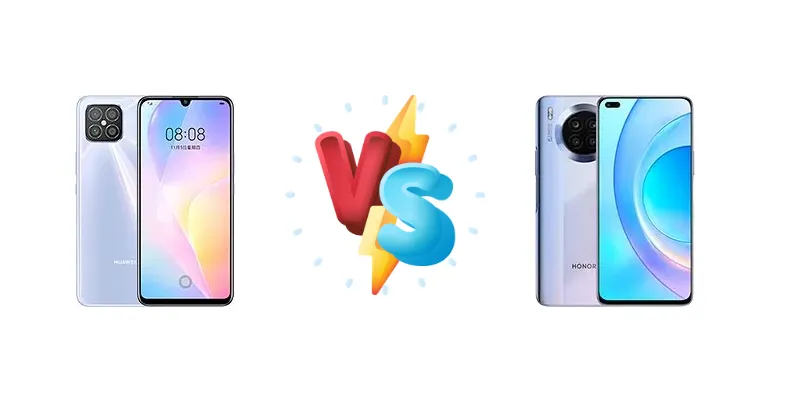
Both the Huawei nova 8 SE 4G and the Honor 50 Lite target the budget-conscious smartphone user, offering a compelling feature set at an accessible price point. The key similarity is their shared 66W fast charging capability, but a deeper look reveals significant differences in processing power and overall user experience, making the choice less straightforward.
🏆 Quick Verdict
For the average user prioritizing raw performance and responsiveness, the Huawei nova 8 SE 4G is the better choice due to its Kirin 710A chipset. However, if fast charging speed is paramount and the performance difference isn't a major concern, the Honor 50 Lite presents a viable alternative.
| Network |
|---|
| 2G bands | GSM 850 / 900 / 1800 / 1900 | GSM 850 / 900 / 1800 / 1900 |
| 3G bands | HSDPA 800 / 850 / 900 / 1700(AWS) / 1900 / 2100 | HSDPA 850 / 900 / 2100 |
| 4G bands | 1, 2, 3, 4, 5, 8, 18, 19, 26, 34, 38, 39, 40, 41 | 1, 3, 5, 7, 8, 20, 28 |
| Speed | HSPA, LTE | HSPA, LTE |
| Technology | GSM / CDMA / HSPA / LTE | GSM / HSPA / LTE |
| | CDMA 800 | - |
| Launch |
|---|
| Announced | 2021, November 26 | 2021, October 25 |
| Status | Available. Released 2021, November 26 | Available. Released 2021, November 17 |
| Body |
|---|
| Dimensions | 161.5 x 74.8 x 7.5 mm (6.36 x 2.94 x 0.30 in) | 161.8 x 74.7 x 8.5 mm (6.37 x 2.94 x 0.33 in) |
| SIM | Nano-SIM + Nano-SIM | Nano-SIM + Nano-SIM |
| Weight | 180 g (6.35 oz) | 192 g (6.77 oz) |
| Display |
|---|
| Resolution | 1080 x 2400 pixels, 20:9 ratio (~405 ppi density) | 1080 x 2376 pixels (~391 ppi density) |
| Size | 6.5 inches, 102.0 cm2 (~84.4% screen-to-body ratio) | 6.67 inches, 108.1 cm2 (~89.5% screen-to-body ratio) |
| Type | OLED | IPS LCD |
| Platform |
|---|
| CPU | Octa-core (4x2.0 GHz Cortex-A73 & 4x1.7 GHz Cortex-A53) | - |
| Chipset | Kirin 710A (14 nm) | - |
| GPU | Mali-G51 MP4 | - |
| OS | HarmonyOS 2.0 | Android 11, Magic UI 4.2 |
| Memory |
|---|
| Card slot | No | No |
| Internal | 128GB 8GB RAM | 128GB 6GB RAM, 128GB 8GB RAM |
| Main Camera |
|---|
| Features | LED flash, Panorama, HDR | LED flash, Panorama, HDR |
| Quad | 64 MP, f/1.9, 26mm (wide), PDAF
8 MP, f/2.4, 120˚, 17mm (ultrawide)
2 MP (macro)
Auxiliary lens | 64 MP, f/1.9, 26mm (wide), 1/1.7", PDAF
8 MP, f/2.4, 120˚, 17mm (ultrawide)
2 MP (macro)
Auxiliary lens |
| Single | 16 MP, f/2.0, (wide) | 16 MP, f/2.0, (wide) |
| Video | 1080p@30fps | 1080p@30fps |
| Selfie camera |
|---|
| Features | - | HDR |
| Single | 16 MP, f/2.0, (wide) | 16 MP, f/2.0, (wide) |
| Video | 1080p@30fps | 1080p@30fps |
| Sound |
|---|
| 3.5mm jack | No | Yes |
| 35mm jack | No | Yes |
| Loudspeaker | Yes | Yes |
| Comms |
|---|
| Bluetooth | 5.1, A2DP, LE | 5.0, A2DP, LE |
| NFC | No | Yes (market/region dependent) |
| Positioning | GPS, GLONASS, GALILEO, BDS | GPS, GLONASS, GALILEO, BDS |
| Radio | No | No |
| USB | USB Type-C 2.0, OTG | USB Type-C 2.0 |
| WLAN | Wi-Fi 802.11 a/b/g/n/ac, dual-band, Wi-Fi Direct | Wi-Fi 802.11 a/b/g/n/ac, dual-band, Wi-Fi Direct |
| Features |
|---|
| Sensors | Fingerprint (under display, optical), accelerometer, proximity, compass | Fingerprint (side-mounted), accelerometer, gyro, proximity, compass |
| Battery |
|---|
| Charging | 66W wired | 66W wired, 40% in 10 min |
| Type | Li-Po 3800 mAh | Li-Po 4300 mAh |
| Misc |
|---|
| Colors | Black, Blue, Aurora, Silver | Midnight Black, Space Silver, Deep Sea Blue |
| Models | JSC-AL50 | NTN-L22, NTN-LX1, NTN-LX3 |
| Price | About 290 EUR | About 160 EUR |
Huawei nova 8 SE 4G
- More powerful Kirin 710A chipset for better performance
- Faster overall system responsiveness
- Potentially better gaming experience
- May experience more thermal throttling under heavy load
- Limited information on display and camera specs
Honor 50 Lite
- Extremely fast 66W charging with advertised 10-minute boost
- Likely a more streamlined software experience (Honor UI)
- Potentially lower price point
- Less powerful chipset resulting in slower performance
- May struggle with demanding applications and multitasking
Display Comparison
Neither Huawei nor Honor provide display specifications beyond size in their marketing materials. Given the price points, both likely utilize IPS LCD panels. The absence of high refresh rates or advanced panel technologies like LTPO suggests a focus on cost reduction. Bezels are expected to be moderate, typical for this segment. Color accuracy will likely be adequate but not exceptional, leaning towards vibrant rather than color-accurate profiles.
Camera Comparison
Detailed camera specifications are lacking for both devices. However, the emphasis on 66W charging suggests compromises were made elsewhere, likely including the camera system. Expect a primary sensor on both, but image quality will heavily depend on sensor size and image processing algorithms. Without specific details, it's difficult to definitively declare a winner. The absence of Optical Image Stabilization (OIS) is highly probable on both, meaning low-light performance will be reliant on software processing. The inclusion of 2MP macro or depth sensors on either device should be viewed with skepticism, as their contribution to overall image quality is minimal.
Performance
The core differentiator lies in the chipset. The Huawei nova 8 SE 4G is powered by the Kirin 710A, a 14nm chip featuring an octa-core configuration with Cortex-A73 and A53 cores. This architecture, while not cutting-edge, provides a solid foundation for everyday tasks. The Honor 50 Lite’s chipset is unspecified, but given its positioning, it likely utilizes a less powerful MediaTek Helio or Snapdragon 400-series chip. The Kirin 710A’s Cortex-A73 cores offer a significant performance advantage over the typically found Cortex-A53 cores in the Honor 50 Lite, resulting in smoother app launches and better multitasking. Thermal management is likely adequate on both, but the 14nm process of the Kirin 710A may generate more heat under sustained load.
Battery Life
Both phones feature 66W wired charging, a standout feature in this price range. The Honor 50 Lite specifically advertises reaching 40% charge in just 10 minutes. While battery capacity remains undisclosed for both, the fast charging capability significantly mitigates the impact of a potentially smaller battery. Users can expect to quickly top up their devices, minimizing downtime. The 66W charging will be a boon for users who frequently find themselves with low battery levels and limited charging time.
Buying Guide
Buy the Huawei nova 8 SE 4G if you need a phone capable of handling moderately demanding tasks like gaming and multitasking with relative ease. Its Kirin 710A provides a noticeable performance edge. Buy the Honor 50 Lite if you prioritize extremely fast charging and a streamlined user experience, and your primary use case revolves around basic communication, social media, and light web browsing.
Frequently Asked Questions
❓ Is the 66W charging on the Honor 50 Lite compatible with all USB-C chargers?
While the Honor 50 Lite utilizes the USB-C standard, achieving the full 66W charging speed requires a compatible charger and cable. Using a lower wattage charger will still charge the device, but at a significantly slower rate. It's recommended to use the charger included in the box or a certified 66W USB-PD charger.
❓ Will the Kirin 710A in the Huawei nova 8 SE 4G handle popular games like PUBG Mobile smoothly?
The Kirin 710A is capable of running PUBG Mobile, but expect to make compromises in graphics settings. To maintain a stable frame rate, you'll likely need to lower the graphics to medium or low and adjust the frame rate settings. The phone may also experience some thermal throttling during extended gaming sessions.
❓ Does the Honor 50 Lite support Google Mobile Services (GMS)?
The Honor 50 Lite *does* support Google Mobile Services (GMS), meaning you'll have access to the Google Play Store and other essential Google apps. This is a significant advantage over some older Huawei devices that lacked GMS support.