
Huawei nova 8 Pro 5G vs Samsung Galaxy S21 5G: Which Mid-Range Champion Reigns Supreme?
| Phones Images | |||||
|---|---|---|---|---|---|
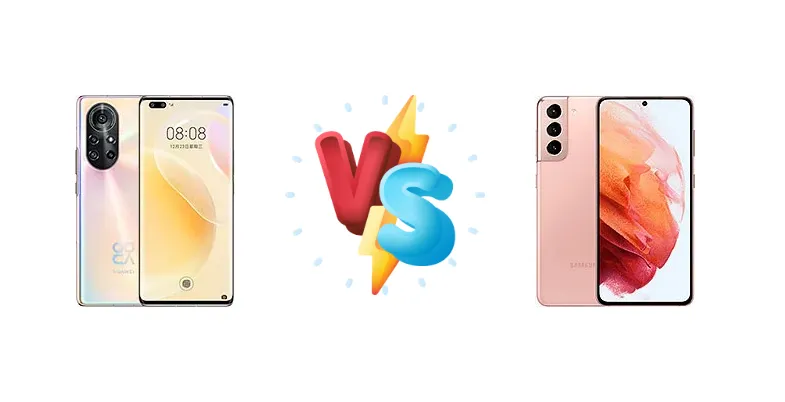
|
🏆 Quick Verdict
For the average user prioritizing raw performance and a more refined software experience, the Samsung Galaxy S21 5G emerges as the winner. Its Exynos 2100 (or Snapdragon 888) chipset provides a noticeable performance edge, and the 93-hour endurance rating offers peace of mind. However, the nova 8 Pro’s blazing-fast charging is a significant advantage for those constantly on the go.
| PHONES | ||
|---|---|---|
| Phone Names | Huawei nova 8 Pro 5G | Samsung Galaxy S21 5G |
| Network | ||
|---|---|---|
| 2G bands | GSM 850 / 900 / 1800 / 1900 | GSM 850 / 900 / 1800 / 1900 |
| 3G bands | HSDPA 800 / 850 / 900 / 1700(AWS) / 1900 / 2100 | HSDPA 850 / 900 / 1700(AWS) / 1900 / 2100 |
| 4G bands | 1, 2, 3, 4, 5, 6, 8, 9, 18, 19, 26, 34, 38, 39, 40, 41 | 1, 2, 3, 4, 5, 7, 8, 12, 13, 14, 18, 19, 20, 25, 26, 28, 30, 38, 39, 40, 41, 46, 48, 66, 71 - SM-G991U1 |
| 5G bands | 1, 3, 28, 38, 41, 77, 78, 79, 80, 83, 84 SA/NSA | 2, 5, 25, 41, 66, 71, 260, 261 SA/NSA/Sub6/mmWave - SM-G991U1 |
| EDGE | Yes | - |
| GPRS | Yes | - |
| Speed | HSPA, LTE, 5G | HSPA 42.2/5.76 Mbps, LTE (7CA) Cat20 2000/200 Mbps, 5G (5+ Gbps DL) |
| Technology | GSM / CDMA / HSPA / LTE / 5G | GSM / CDMA / HSPA / EVDO / LTE / 5G |
| - | 1, 3, 5, 7, 8, 20, 28, 38, 40, 41, 66, 77, 78 SA/NSA/Sub6 - SM-G991B | |
| Launch | ||
|---|---|---|
| Announced | 2020, December 23. Released 2021, January 08 | 2021, January 14 |
| Status | Discontinued | Available. Released 2021, January 29 |
| Body | ||
|---|---|---|
| Build | - | Glass front (Gorilla Glass Victus), plastic back, aluminum frame |
| Dimensions | 163.3 x 74.1 x 7.9 mm (6.43 x 2.92 x 0.31 in) | 151.7 x 71.2 x 7.9 mm (5.97 x 2.80 x 0.31 in) |
| SIM | Nano-SIM + Nano-SIM | · Nano-SIM + eSIM· Nano-SIM + Nano-SIM + eSIM (max 2 at a time) |
| Weight | 184 g (6.49 oz) | 169 g (Sub6), 171 g (mmWave) (5.96 oz) |
| - | IP68 dust/water resistant (up to 1.5m for 30 min) | |
| Display | ||
|---|---|---|
| Protection | - | Corning Gorilla Glass Victus |
| Resolution | 1236 x 2676 pixels, 19.5:9 ratio (~439 ppi density) | 1080 x 2400 pixels, 20:9 ratio (~421 ppi density) |
| Size | 6.72 inches, 110.9 cm2 (~91.7% screen-to-body ratio) | 6.2 inches, 94.1 cm2 (~87.2% screen-to-body ratio) |
| Type | OLED, 1B colors, HDR10, 120Hz | Dynamic AMOLED 2X, 120Hz, HDR10+, 1300 nits (peak) |
| - | Always-on display | |
| Platform | ||
|---|---|---|
| CPU | Octa-core (1x2.58 GHz Cortex-A76 & 3x2.40 GHz Cortex-A76 & 4x1.84 GHz Cortex-A55) | Octa-core (1x2.9 GHz Cortex-X1 & 3x2.80 GHz Cortex-A78 & 4x2.2 GHz Cortex-A55) - InternationalOcta-core (1x2.84 GHz Cortex-X1 & 3x2.42 GHz Cortex-A78 & 4x1.80 GHz Cortex-A55) - USA/China |
| Chipset | Kirin 985 5G (7 nm) | Exynos 2100 (5 nm) - InternationalQualcomm SM8350 Snapdragon 888 5G (5 nm) - USA/China |
| GPU | Mali-G77 (8-core) | Mali-G78 MP14 - InternationalAdreno 660 - USA/China |
| OS | Android 10, EMUI 11, no Google Play Services | Android 11, up to 4 major Android upgrades, One UI 6.1 |
| Memory | ||
|---|---|---|
| Card slot | No | No |
| Internal | 128GB 8GB RAM, 256GB 8GB RAM | 128GB 6GB RAM, 128GB 8GB RAM, 256GB 8GB RAM |
| - | UFS 3.1 | |
| Main Camera | ||
|---|---|---|
| Features | LED flash, panorama, HDR | LED flash, auto-HDR, panorama |
| Quad | 64 MP, f/1.8, 26mm (wide), PDAF 8 MP, f/2.4, 120˚, 17mm (ultrawide) 2 MP (macro) Auxiliary lens | - |
| Single | 3.15 MP | - |
| Triple | - | 12 MP, f/1.8, 26mm (wide), 1/1.76", 1.8µm, dual pixel PDAF, OIS 64 MP, f/2.0, 29mm (telephoto), 1/1.72", 0.8µm, PDAF, OIS, 1.1x optical zoom, 3x hybrid zoom 12 MP, f/2.2, 13mm, 120˚ (ultrawide), 1/2.55" 1.4µm, Super Steady video |
| Video | 4K, 1080p, 720p@960fps, gyro-EIS | 8K@24fps, 4K@30/60fps, 1080p@30/60/120/240fps, HDR10+, stereo sound rec., gyro-EIS |
| Selfie camera | ||
|---|---|---|
| Dual | 16 MP, f/2.0, (wide) 32 MP, f/2.4, 100˚ (ultrawide) | - |
| Features | HDR | HDR |
| Single | VGA | 10 MP, f/2.2, 26mm (wide), 1/3.24", 1.22µm, dual pixel PDAF |
| Video | 1080p@30fps | 4K@30/60fps, 1080p@30fps |
| Sound | ||
|---|---|---|
| 3.5mm jack | Yes | No |
| 35mm jack | No | No |
| Loudspeaker | Yes | Yes, with stereo speakers |
| - | 32-bit/384kHz audio Tuned by AKG | |
| Comms | ||
|---|---|---|
| Bluetooth | 5.2, A2DP, LE | 5.0, A2DP, LE |
| NFC | Yes | Yes |
| Positioning | GPS (L1+L5), GLONASS (L1), BDS (B1I+B1c+B2a+B2b), GALILEO (E1+E5a+E5b), QZSS (L1+L5), NavIC | GPS, GLONASS, BDS, GALILEO |
| Radio | No | FM radio (Snapdragon model only; market/operator dependent) |
| USB | USB Type-C 2.0, OTG | USB Type-C 3.2, OTG |
| WLAN | Wi-Fi 802.11 a/b/g/n/a/6, dual-band, Wi-Fi Direct | Wi-Fi 802.11 a/b/g/n/ac/6, dual-band, Wi-Fi Direct |
| Features | ||
|---|---|---|
| Sensors | Fingerprint (under display, optical), accelerometer, gyro, proximity, compass | Fingerprint (under display, ultrasonic), accelerometer, gyro, proximity, compass, barometer |
| - | Samsung DeX, Samsung Wireless DeX (desktop experience support) Bixby natural language commands and dictation Samsung Pay (Visa, MasterCard certified) | |
| Battery | ||
|---|---|---|
| Charging | 66W wired, 60% in 15 min, 100% in 35 min 5W reverse wired | 25W wired, PD3.0 15W wireless (Qi) 4.5W reverse wireless |
| Type | Li-Po 4000 mAh | Li-Ion 4000 mAh |
| Misc | ||
|---|---|---|
| Colors | Black, Blue, Green, White | Phantom Gray, Phantom White, Phantom Violet, Phantom Pink |
| Models | BRQ-AN00, BRQ-AL00 | SM-G991B, SM-G991B/DS, SM-G991U, SM-G991U1, SM-G991W, SM-G991N, SM-G9910, SM-G991Q, SCG09 |
| Price | About 600 EUR | € 194.00 / $ 153.58 / £ 149.99 |
| SAR | 1.25 W/kg (head) 1.04 W/kg (body) | 0.74 W/kg (head) 1.08 W/kg (body) |
| SAR EU | - | 0.46 W/kg (head) 1.51 W/kg (body) |
| Pricing | ||
|---|---|---|
| 128GB 8GB RAM | - | $ 249.00 |
| 256GB 8GB RAM | - | $ 289.99 |
| RENEWED | - | $ 317.00 |
| Tests | ||
|---|---|---|
| Battery life | - | Endurance rating 93h |
| Camera | - | Photo / Video |
| Display | - | Contrast ratio: Infinite (nominal) |
| Loudspeaker | - | -26.4 LUFS (Good) |
| Performance | - | AnTuTu: 584055 (v8) GeekBench: 3238 (v5.1) GFXBench: 60fps (ES 3.1 onscreen) |
Huawei nova 8 Pro 5G
- Blazing-fast 66W wired charging
- Sleek and modern design
- Competitive price point
- Kirin 985 chipset is less powerful than Snapdragon/Exynos
- Software ecosystem limitations
- Camera details are limited
Samsung Galaxy S21 5G
- Powerful Exynos 2100/Snapdragon 888 chipset
- Excellent battery life (93h endurance)
- Bright and vibrant display
- Slower 25W charging
- Higher price compared to nova 8 Pro
- Potential for Exynos overheating (depending on region)
Display Comparison
The Samsung Galaxy S21 5G boasts a brighter display, reaching a measured 856 nits, compared to an unspecified peak brightness for the nova 8 Pro. While the nova 8 Pro’s display quality isn’t detailed, Samsung’s display benefits from an 'Infinite' contrast ratio, suggesting deep blacks and vibrant colors. Both devices likely utilize OLED panels, but Samsung’s display technology is generally considered industry-leading. The S21’s smaller bezels contribute to a more immersive viewing experience.
Camera Comparison
Both phones offer capable camera systems, but details are limited. The Galaxy S21’s camera is known for its versatile performance in both photo and video, though specific sensor details aren’t provided. The nova 8 Pro’s camera specs are also vague, and the inclusion of a 2MP macro camera suggests a focus on quantity over quality. The larger sensors and advanced image processing typically found in Samsung’s flagships likely give the S21 an edge in low-light performance and overall image quality. The S21’s video capabilities are also likely superior.
Performance
The core difference lies in the chipsets. The Samsung Galaxy S21 5G, depending on the region, features either the Exynos 2100 (5nm) or the Qualcomm Snapdragon 888 5G (also 5nm). Both are built on a more advanced 5nm process compared to the Huawei nova 8 Pro 5G’s 7nm Kirin 985 5G. This translates to greater power efficiency and higher peak performance for the S21. The S21’s Cortex-X1 prime core (2.9 GHz or 2.84 GHz) significantly outperforms the Kirin 985’s Cortex-A76 core (2.58 GHz). While the nova 8 Pro has a more complex CPU core arrangement, the architectural advantages of the Exynos/Snapdragon combination provide a clear performance lead, particularly in demanding tasks and gaming.
Battery Life
The Samsung Galaxy S21 5G achieves an impressive 93-hour endurance rating, despite not having a massive battery capacity. This is likely due to the efficiency of the 5nm Exynos/Snapdragon chipset and Samsung’s software optimizations. The Huawei nova 8 Pro 5G compensates for a potentially smaller battery with its incredibly fast 66W wired charging, capable of reaching 60% charge in just 15 minutes and 100% in 35 minutes. While the S21 offers 25W wired and 15W wireless charging, the nova 8 Pro’s charging speed is a game-changer for users who frequently need to top up their battery.
Buying Guide
Buy the Huawei nova 8 Pro 5G if you prioritize incredibly fast charging speeds and a visually striking design, and are comfortable with the Huawei ecosystem. Buy the Samsung Galaxy S21 5G if you value a more powerful processor, a well-established software experience, and a longer-lasting battery, even if it means sacrificing some charging speed.