
Huawei nova 8 Pro 5G vs. OnePlus 9 Pro: A Detailed Comparison of Flagship Features
| Phones Images | |||||
|---|---|---|---|---|---|
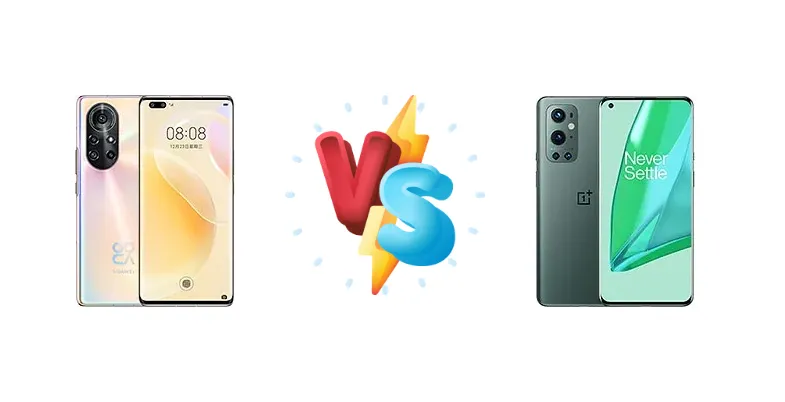
|
🏆 Quick Verdict
For most users, the OnePlus 9 Pro emerges as the stronger contender. Its Snapdragon 888 5G chipset delivers significantly higher processing power, translating to smoother multitasking and gaming. However, the Huawei nova 8 Pro 5G offers remarkably fast 66W charging, a compelling advantage for those prioritizing quick top-ups.
| PHONES | ||
|---|---|---|
| Phone Names | Huawei nova 8 Pro 5G | OnePlus 9 Pro |
| Network | ||
|---|---|---|
| 2G bands | GSM 850 / 900 / 1800 / 1900 | GSM 850 / 900 / 1800 / 1900 |
| 3G bands | HSDPA 800 / 850 / 900 / 1700(AWS) / 1900 / 2100 | HSDPA 800 / 850 / 900 / 1700(AWS) / 1800 / 1900 / 2100 |
| 4G bands | 1, 2, 3, 4, 5, 6, 8, 9, 18, 19, 26, 34, 38, 39, 40, 41 | 1, 2, 3, 4, 5, 7, 8, 12, 13, 17, 18, 19, 20, 25, 26, 28, 32, 38, 39, 40, 41, 66 - EU |
| 5G bands | 1, 3, 28, 38, 41, 77, 78, 79, 80, 83, 84 SA/NSA | 1, 3, 5, 7, 8, 20, 28, 38, 40, 41, 66, 78 SA/NSA - EU |
| EDGE | Yes | - |
| GPRS | Yes | - |
| Speed | HSPA, LTE, 5G | HSPA 42.2/5.76 Mbps, LTE Cat20 2000/200 Mbps, 5G |
| Technology | GSM / CDMA / HSPA / LTE / 5G | GSM / CDMA / HSPA / LTE / 5G |
| - | 1, 3, 28, 41, 78, 79 SA/NSA - CN | |
| Launch | ||
|---|---|---|
| Announced | 2020, December 23. Released 2021, January 08 | 2021, March 23 |
| Status | Discontinued | Available. Released 2021, March 30 |
| Body | ||
|---|---|---|
| Build | - | Glass front (Gorilla Glass 5), glass back (Gorilla Glass 5), aluminum frame |
| Dimensions | 163.3 x 74.1 x 7.9 mm (6.43 x 2.92 x 0.31 in) | 163.2 x 73.6 x 8.7 mm (6.43 x 2.90 x 0.34 in) |
| SIM | Nano-SIM + Nano-SIM | · Nano-SIM· Nano-SIM + Nano-SIM |
| Weight | 184 g (6.49 oz) | 197 g (6.95 oz) |
| - | IP68 dust/water resistant (up to 1.5m for 30 min) | |
| Display | ||
|---|---|---|
| Protection | - | Corning Gorilla Glass 5 |
| Resolution | 1236 x 2676 pixels, 19.5:9 ratio (~439 ppi density) | 1440 x 3216 pixels, 20:9 ratio (~525 ppi density) |
| Size | 6.72 inches, 110.9 cm2 (~91.7% screen-to-body ratio) | 6.7 inches, 108.4 cm2 (~90.3% screen-to-body ratio) |
| Type | OLED, 1B colors, HDR10, 120Hz | LTPO Fluid2 AMOLED, 1B colors, 120Hz, HDR10+, 1300 nits (peak) |
| - | Always-on display | |
| Platform | ||
|---|---|---|
| CPU | Octa-core (1x2.58 GHz Cortex-A76 & 3x2.40 GHz Cortex-A76 & 4x1.84 GHz Cortex-A55) | Octa-core (1x2.84 GHz Cortex-X1 & 3x2.42 GHz Cortex-A78 & 4x1.80 GHz Cortex-A55 |
| Chipset | Kirin 985 5G (7 nm) | Qualcomm SM8350 Snapdragon 888 5G (5 nm) |
| GPU | Mali-G77 (8-core) | Adreno 660 |
| OS | Android 10, EMUI 11, no Google Play Services | Android 11, upgradable to Android 14, OxygenOS 14 |
| Memory | ||
|---|---|---|
| Card slot | No | No |
| Internal | 128GB 8GB RAM, 256GB 8GB RAM | 128GB 8GB RAM, 256GB 8GB RAM, 256GB 12GB RAM |
| - | UFS 3.1 | |
| Main Camera | ||
|---|---|---|
| Features | LED flash, panorama, HDR | Laser AF, color spectrum sensor, Hasselblad Color Calibration, dual-LED flash, HDR, panorama |
| Quad | 64 MP, f/1.8, 26mm (wide), PDAF 8 MP, f/2.4, 120˚, 17mm (ultrawide) 2 MP (macro) Auxiliary lens | 48 MP, f/1.8, 23mm (wide), 1/1.43", 1.12µm, multi-directional PDAF, OIS 8 MP, f/2.4, 77mm (telephoto), 1.0µm, PDAF, OIS, 3.3x optical zoom 50 MP, f/2.2, 14mm (ultrawide), 1/1.56", 1.0µm, AF 2 MP, f/2.4, (monochrome) |
| Single | 3.15 MP | 16 MP, f/2.4, (wide), 1/3.06", 1.0µm |
| Video | 4K, 1080p, 720p@960fps, gyro-EIS | 8K@30fps, 4K@30/60/120fps, 1080p@30/60/240fps, Auto HDR, gyro-EIS |
| Selfie camera | ||
|---|---|---|
| Dual | 16 MP, f/2.0, (wide) 32 MP, f/2.4, 100˚ (ultrawide) | - |
| Features | HDR | HDR |
| Single | VGA | 16 MP, f/2.4, (wide), 1/3.06", 1.0µm |
| Video | 1080p@30fps | 1080p@30fps, gyro-EIS |
| Sound | ||
|---|---|---|
| 3.5mm jack | Yes | No |
| 35mm jack | No | No |
| Loudspeaker | Yes | Yes, with stereo speakers |
| - | 24-bit/192kHz audio | |
| Comms | ||
|---|---|---|
| Bluetooth | 5.2, A2DP, LE | 5.2, A2DP, LE, aptX HD |
| NFC | Yes | Yes |
| Positioning | GPS (L1+L5), GLONASS (L1), BDS (B1I+B1c+B2a+B2b), GALILEO (E1+E5a+E5b), QZSS (L1+L5), NavIC | GPS (L1+L5), GLONASS (G1), BDS (B1), GALILEO (E1+E5a) |
| Radio | No | No |
| USB | USB Type-C 2.0, OTG | USB Type-C 3.1, OTG |
| WLAN | Wi-Fi 802.11 a/b/g/n/a/6, dual-band, Wi-Fi Direct | Wi-Fi 802.11 a/b/g/n/ac/6, dual-band, Wi-Fi Direct, DLNA |
| Features | ||
|---|---|---|
| Sensors | Fingerprint (under display, optical), accelerometer, gyro, proximity, compass | Fingerprint (under display, optical), accelerometer, gyro, proximity, compass |
| Battery | ||
|---|---|---|
| Charging | 66W wired, 60% in 15 min, 100% in 35 min 5W reverse wired | 65W wired, PD, 100% in 29 min 50W wireless, 100% in 43 min 5W reverse wireless |
| Type | Li-Po 4000 mAh | Li-Po 4500 mAh |
| Misc | ||
|---|---|---|
| Colors | Black, Blue, Green, White | Morning Mist, Forest Green, Stellar Black |
| Models | BRQ-AN00, BRQ-AL00 | LE2121, LE2125, LE2123, LE2120, LE2127 |
| Price | About 600 EUR | € 246.17 / $ 264.95 / £ 287.00 |
| SAR | 1.25 W/kg (head) 1.04 W/kg (body) | - |
| Tests | ||
|---|---|---|
| Battery life | - | Endurance rating 86h |
| Camera | - | Photo / Video |
| Loudspeaker | - | -24.1 LUFS (Very good) |
Huawei nova 8 Pro 5G
- Faster initial wired charging (66W)
- Potentially more affordable price point
- Stylish design (based on market perception)
- Less powerful chipset (Kirin 985 vs Snapdragon 888)
- Limited software ecosystem due to Huawei restrictions
- Missing display specifications
OnePlus 9 Pro
- Superior performance with Snapdragon 888 5G
- Hasselblad-tuned camera system
- Bright and efficient LTPO display
- Slightly slower wired charging than Huawei
- Wireless charging adds bulk
- Higher price tag
Display Comparison
While both phones feature high-quality displays, the OnePlus 9 Pro boasts a measured peak brightness of 859 nits, suggesting a more visible screen in direct sunlight. The nova 8 Pro’s display specifications are not provided, but Huawei typically employs OLED panels with vibrant colors. The OnePlus 9 Pro’s display technology is likely LTPO, enabling variable refresh rates for improved power efficiency, a feature not confirmed for the nova 8 Pro. Bezels are likely comparable, but the OnePlus 9 Pro’s display is generally regarded as one of the best in its class.
Camera Comparison
Both devices are marketed with strong camera capabilities, but details are limited. The OnePlus 9 Pro benefits from Hasselblad color calibration, promising more accurate and natural-looking images. Sensor size and aperture details are missing for both, but the OnePlus 9 Pro’s camera system is known for its versatility, including wide, ultrawide, and telephoto lenses. The nova 8 Pro likely focuses on computational photography to enhance image quality. Without specific sensor information, it’s difficult to definitively declare a winner, but the OnePlus 9 Pro’s partnership with Hasselblad gives it an edge in image processing.
Performance
The core difference lies in the chipsets. The OnePlus 9 Pro’s Snapdragon 888 5G (5nm) demonstrably outperforms the Huawei nova 8 Pro 5G’s Kirin 985 5G (7nm). The Snapdragon 888’s Cortex-X1 prime core, clocked at 2.84 GHz, provides a significant performance boost over the Kirin 985’s Cortex-A76 cores. The 5nm fabrication process of the Snapdragon 888 also contributes to better thermal efficiency, reducing the likelihood of throttling during sustained workloads. Both phones utilize LPDDR5 RAM, but the Snapdragon 888’s superior GPU will provide a better gaming experience.
Battery Life
Both phones achieve an endurance rating of 86 hours, suggesting similar real-world battery life despite differing battery capacities (not specified for the nova 8 Pro). However, the charging speeds are a key differentiator. The OnePlus 9 Pro supports 65W wired charging (100% in 29 minutes), 50W wireless charging (100% in 43 minutes), and 5W reverse wireless charging. The Huawei nova 8 Pro 5G counters with 66W wired charging (60% in 15 minutes, 100% in 35 minutes) and 5W reverse wired charging. The nova 8 Pro’s faster initial charging speed is a significant advantage for quick power boosts, while the OnePlus 9 Pro offers the convenience of wireless charging.
Buying Guide
Buy the Huawei nova 8 Pro 5G if you prioritize exceptionally fast charging speeds and a stylish design, and are comfortable with the limitations of the Huawei ecosystem. Buy the OnePlus 9 Pro if you demand the highest possible performance for gaming and demanding applications, coupled with a clean Android experience and a versatile camera system.