
Huawei nova 8 Pro 4G vs Samsung Galaxy A72: A Detailed Comparison
| Phones Images | |||||
|---|---|---|---|---|---|
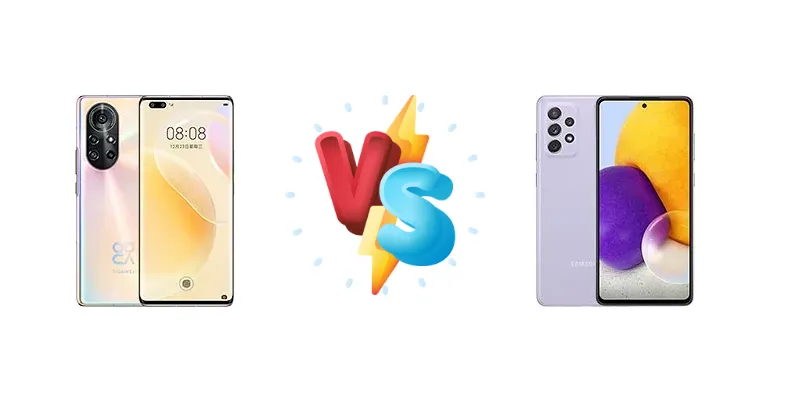
|
🏆 Quick Verdict
For users prioritizing rapid charging and a more powerful processor for demanding tasks, the Huawei nova 8 Pro 4G is the better choice. However, the Samsung Galaxy A72 offers a brighter display and a more familiar software experience, making it suitable for those valuing those aspects.
| PHONES | ||
|---|---|---|
| Phone Names | Huawei nova 8 Pro 4G | Samsung Galaxy A72 |
| Network | ||
|---|---|---|
| 2G bands | GSM 850 / 900 / 1800 / 1900 | GSM 850 / 900 / 1800 / 1900 |
| 3G bands | HSDPA 800 / 850 / 900 / 1700(AWS) / 1900 / 2100 | HSDPA 850 / 900 / 1700(AWS) / 1900 / 2100 |
| 4G bands | 1, 2, 3, 4, 5, 6, 8, 9, 18, 19, 26, 34, 38, 39, 40, 41 | 1, 2, 3, 4, 5, 7, 8, 12, 17, 20, 26, 28, 32, 38, 40, 41, 66 |
| Speed | HSPA, LTE | HSPA, LTE |
| Technology | GSM / CDMA / HSPA / LTE | GSM / HSPA / LTE |
| CDMA 800 | - | |
| Launch | ||
|---|---|---|
| Announced | 2021, April 26 | 2021, March 17 |
| Status | Available. Released 2021, June 18 | Available. Released 2021, March 26 |
| Body | ||
|---|---|---|
| Build | - | Glass front (Gorilla Glass 5), plastic frame, plastic back |
| Dimensions | 163.3 x 74.1 x 7.9 mm (6.43 x 2.92 x 0.31 in) | 165 x 77.4 x 8.4 mm (6.50 x 3.05 x 0.33 in) |
| SIM | Nano-SIM + Nano-SIM | · Nano-SIM· Nano-SIM + Nano-SIM |
| Weight | 184 g (6.49 oz) | 203 g (7.16 oz) |
| - | IP67 dust/water resistant (up to 1m for 30 min) | |
| Display | ||
|---|---|---|
| Protection | - | Corning Gorilla Glass 5 |
| Resolution | 1236 x 2676 pixels, 19.5:9 ratio (~439 ppi density) | 1080 x 2400 pixels, 20:9 ratio (~394 ppi density) |
| Size | 6.72 inches, 110.9 cm2 (~91.7% screen-to-body ratio) | 6.7 inches, 107.8 cm2 (~84.4% screen-to-body ratio) |
| Type | OLED, 1B colors, HDR10, 120Hz | Super AMOLED, 90Hz, 800 nits (HBM) |
| - | Always-on display | |
| Platform | ||
|---|---|---|
| CPU | Octa-core (1x2.58 GHz Cortex-A76 & 3x2.40 GHz Cortex-A76 & 4x1.84 GHz Cortex-A55) | Octa-core (2x2.3 GHz Kryo 465 Gold & 6x1.8 GHz Kryo 465 Silver) |
| Chipset | Kirin 985 5G (7 nm) | Qualcomm SM7125 Snapdragon 720G (8 nm) |
| GPU | Mali-G77 (8-core) | Adreno 618 |
| OS | Android 10, EMUI 11, no Google Play Services | Android 11, upgradable to Android 12, One UI 4.1 |
| Memory | ||
|---|---|---|
| Card slot | No | microSDXC (uses shared SIM slot) |
| Internal | 128GB 8GB RAM, 256GB 8GB RAM | 128GB 6GB RAM, 128GB 8GB RAM, 256GB 6GB RAM, 256GB 8GB RAM |
| UFS | - | |
| Main Camera | ||
|---|---|---|
| Dual | 16 MP, f/2.0, (wide) 32 MP, f/2.4, 100˚ (ultrawide) | - |
| Features | LED flash, panorama, HDR | LED flash, panorama, HDR |
| Quad | 64 MP, f/1.8, 26mm (wide), PDAF 8 MP, f/2.4, 120˚, 17mm (ultrawide) 2 MP (macro) Auxiliary lens | 64 MP, f/1.8, 26mm (wide), 1/1.7", 0.8µm, PDAF, OIS 8 MP, f/2.4, (telephoto), 1.0µm, PDAF, OIS, 3x optical zoom 12 MP, f/2.2, 123˚ (ultrawide), 1.12µm 5 MP (macro) |
| Video | 4K, 1080p, 720p@960fps, gyro-EIS | 4K@30fps, 1080p@30/60fps; gyro-EIS |
| Selfie camera | ||
|---|---|---|
| Dual | 16 MP, f/2.0, (wide) 32 MP, f/2.4, 100˚ (ultrawide) | - |
| Features | HDR | HDR |
| Single | - | 32 MP, f/2.2, 26mm (wide), 1/2.8", 0.8µm |
| Video | 1080p@30fps | 4K@30fps, 1080p@30fps |
| Sound | ||
|---|---|---|
| 3.5mm jack | No | Yes |
| 35mm jack | No | Yes |
| Loudspeaker | Yes | Yes, with stereo speakers |
| Comms | ||
|---|---|---|
| Bluetooth | 5.2, A2DP, LE | 5.0, A2DP, LE |
| NFC | Yes | Yes (market/region dependent) |
| Positioning | GPS (L1+L5), GLONASS (L1), BDS (B1I+B1c+B2a+B2b), GALILEO (E1+E5a+E5b), QZSS (L1+L5), NavIC | GPS, GLONASS, GALILEO, BDS |
| Radio | No | FM radio |
| USB | USB Type-C 2.0, OTG | USB Type-C 2.0, OTG |
| WLAN | Wi-Fi 802.11 a/b/g/n/a/6, dual-band, Wi-Fi Direct | Wi-Fi 802.11 a/b/g/n/ac, dual-band, Wi-Fi Direct |
| Features | ||
|---|---|---|
| Sensors | Fingerprint (under display, optical), accelerometer, gyro, proximity, compass | Fingerprint (under display, optical), accelerometer, gyro, compass |
| - | Virtual proximity sensing | |
| Battery | ||
|---|---|---|
| Charging | 66W wired, 60% in 15 min, 100% in 35 min 5W reverse wired | 25W wired |
| Type | Li-Po 4000 mAh | Li-Ion 5000 mAh |
| Misc | ||
|---|---|---|
| Colors | Black, Blue, Green, White | Awesome Black, Awesome White, Awesome Violet, Awesome Blue |
| Models | BRQ-AN00 | SM-A725F, SM-A725F/DS, SM-A725M, SM-A725M/DS |
| Price | - | £ 174.89 / € 359.99 |
| SAR EU | - | 0.23 W/kg (head) 1.17 W/kg (body) |
| Tests | ||
|---|---|---|
| Battery life | - | Endurance rating 117h |
| Camera | - | Photo / Video |
| Display | - | Contrast ratio: Infinite (nominal) |
| Loudspeaker | - | -26.4 LUFS (Good) |
| Performance | - | AnTuTu: 279342 (v8) GeekBench: 6483 (v4.4), 1627 (v5.1) GFXBench: 15fps (ES 3.1 onscreen) |
Huawei nova 8 Pro 4G
- Significantly faster 66W charging
- More powerful Kirin 985 processor
- Potential for better thermal efficiency with 7nm process
- Lack of detailed camera specifications
- Potential software ecosystem limitations
Samsung Galaxy A72
- Brighter 825 nit display
- Well-established Android experience with One UI
- Long-term software support from Samsung
- Slower 25W charging
- Less powerful Snapdragon 720G processor
Display Comparison
The Samsung Galaxy A72 boasts a significantly brighter display, reaching a measured 825 nits, making it more visible under direct sunlight. While the nova 8 Pro 4G’s display specs aren’t provided, Samsung’s advantage in peak brightness is clear. The A72 also features an 'Infinite' contrast ratio, typical of AMOLED panels, offering deeper blacks. However, without knowing the nova 8 Pro 4G’s panel type or brightness, a definitive judgment on color accuracy and overall visual quality is difficult, but the A72’s AMOLED panel is likely to offer superior contrast.
Camera Comparison
Both devices offer photo and video capabilities, but detailed sensor information is lacking for the nova 8 Pro 4G. The Galaxy A72 likely benefits from Samsung’s image processing algorithms, known for vibrant colors and detail. Without knowing the main sensor size or aperture of the nova 8 Pro 4G, it’s difficult to assess its low-light performance. The presence of OIS (Optical Image Stabilization) on either device is unknown, but would be a significant advantage for video recording and low-light photography. It's safe to assume both phones include a suite of software features to enhance image quality, but the A72's established reputation in camera performance gives it a slight edge.
Performance
The Huawei nova 8 Pro 4G’s Kirin 985 5G (7nm) chipset is architecturally more advanced than the Samsung Galaxy A72’s Qualcomm Snapdragon 720G (8nm). The Kirin 985 utilizes a combination of Cortex-A76 cores, suggesting stronger multi-core performance. The Snapdragon 720G, while efficient, relies on Kryo 465 cores, which are generally less powerful. This translates to a potential advantage for the nova 8 Pro 4G in tasks like video editing and demanding games. The 7nm process node of the Kirin 985 also suggests better power efficiency compared to the 8nm Snapdragon 720G, potentially mitigating thermal throttling during sustained workloads.
Battery Life
Both the Huawei nova 8 Pro 4G and Samsung Galaxy A72 achieve an endurance rating of 117 hours, indicating similar overall battery life. However, the charging speeds are drastically different. The nova 8 Pro 4G’s 66W wired charging is significantly faster, achieving 60% charge in just 15 minutes and 100% in 35 minutes. The Galaxy A72’s 25W charging is considerably slower. While both phones offer comparable battery endurance, the nova 8 Pro 4G’s charging speed provides a substantial convenience advantage, allowing for quick top-ups when needed. The 5W reverse wired charging on the nova 8 Pro 4G is a bonus for charging accessories.
Buying Guide
Buy the Huawei nova 8 Pro 4G if you need blazing-fast 66W charging, a processor capable of handling intensive gaming, and don't mind the potential limitations of the Huawei ecosystem. Buy the Samsung Galaxy A72 if you prefer a consistently bright display for outdoor use, a well-established Android experience with Samsung's One UI, and prioritize long-term software support.