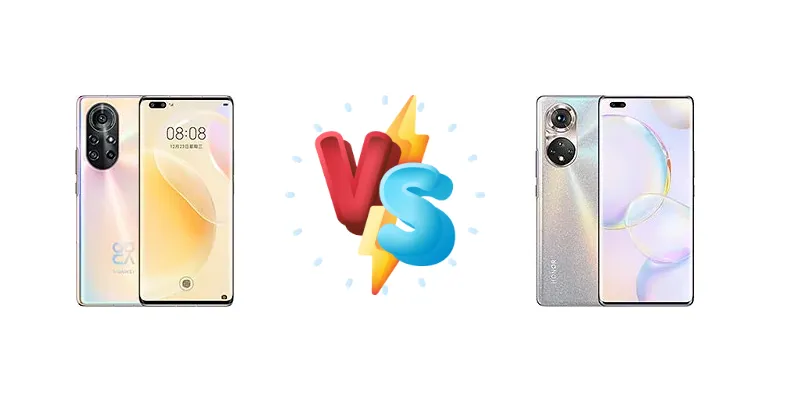
Both the Honor 50 Pro and Huawei Nova 8 Pro 4G represent compelling options in the mid-range smartphone market, but cater to slightly different priorities. The Nova 8 Pro, leveraging Huawei’s Kirin 985, aims for a balance of features, while the Honor 50 Pro, powered by the Qualcomm Snapdragon 778G, prioritizes charging speed and a streamlined software experience. This comparison dissects their key differences to help you choose.
🏆 Quick Verdict
For most users, the Honor 50 Pro emerges as the stronger choice. Its Snapdragon 778G, built on a more efficient 6nm process, offers comparable performance to the Kirin 985 while benefiting from Qualcomm’s optimized software. Crucially, the 100W charging significantly reduces downtime, a major advantage over the Nova 8 Pro’s 66W.
| Network |
|---|
| 2G bands | GSM 850 / 900 / 1800 / 1900 | GSM 850 / 900 / 1800 / 1900 |
| 3G bands | HSDPA 800 / 850 / 900 / 1700(AWS) / 1900 / 2100 | HSDPA 800 / 850 / 900 / 1700(AWS) / 1900 / 2100 |
| 4G bands | 1, 2, 3, 4, 5, 6, 8, 9, 18, 19, 26, 34, 38, 39, 40, 41 | 1, 2, 4, 5, 8, 19, 34, 38, 39, 40, 41 |
| 5G bands | - | 1, 5, 8, 41, 77, 78 SA/NSA |
| Speed | HSPA, LTE | HSPA, LTE, 5G |
| Technology | GSM / CDMA / HSPA / LTE | GSM / CDMA / HSPA / CDMA2000 / LTE / 5G |
| | CDMA 800 | CDMA2000 1x |
| Launch |
|---|
| Announced | 2021, April 26 | 2021, June 16 |
| Status | Available. Released 2021, June 18 | Available. Released 2021, June 25 |
| Body |
|---|
| Dimensions | 163.3 x 74.1 x 7.9 mm (6.43 x 2.92 x 0.31 in) | 163.5 x 74.7 x 8 mm (6.44 x 2.94 x 0.31 in) |
| SIM | Nano-SIM + Nano-SIM | Nano-SIM + Nano-SIM |
| Weight | 184 g (6.49 oz) | 187 g (6.60 oz) |
| Display |
|---|
| Resolution | 1236 x 2676 pixels, 19.5:9 ratio (~439 ppi density) | 1236 x 2676 pixels, 19.5:9 ratio (~439 ppi density) |
| Size | 6.72 inches, 110.9 cm2 (~91.7% screen-to-body ratio) | 6.72 inches, 110.9 cm2 (~90.8% screen-to-body ratio) |
| Type | OLED, 1B colors, HDR10, 120Hz | OLED, 1B colors, 120Hz |
| Platform |
|---|
| CPU | Octa-core (1x2.58 GHz Cortex-A76 & 3x2.40 GHz Cortex-A76 & 4x1.84 GHz Cortex-A55) | Octa-core (1x2.4 GHz Cortex-A78 & 3x2.2 GHz Cortex-A78 & 4x1.9 GHz Cortex-A55) |
| Chipset | Kirin 985 5G (7 nm) | Qualcomm SM7325 Snapdragon 778G 5G (6 nm) |
| GPU | Mali-G77 (8-core) | Adreno 642L |
| OS | Android 10, EMUI 11, no Google Play Services | Android 11, Magic UI 4.2, Google Play Services |
| Memory |
|---|
| Card slot | No | No |
| Internal | 128GB 8GB RAM, 256GB 8GB RAM | 256GB 8GB RAM, 256GB 12GB RAM |
| | UFS | - |
| Main Camera |
|---|
| Dual | 16 MP, f/2.0, (wide)
32 MP, f/2.4, 100˚ (ultrawide) | 12 MP, f/2.4, 18mm, 100˚ (ultrawide), 1/2.8", 1.25µm
32 MP, f/2.2, 22mm (wide), 1/3.14" |
| Features | LED flash, panorama, HDR | LED flash, HDR, panorama |
| Quad | 64 MP, f/1.8, 26mm (wide), PDAF
8 MP, f/2.4, 120˚, 17mm (ultrawide)
2 MP (macro)
Auxiliary lens | 108 MP, f/1.9, (wide), 1/1.52", 0.7µm, PDAF
8 MP, f/2.2, 120˚, 17mm (ultrawide)
2 MP (macro)
Auxiliary lens |
| Video | 4K, 1080p, 720p@960fps, gyro-EIS | 4K@30fps, 1080p@30/60fps, gyro-EIS |
| Selfie camera |
|---|
| Dual | 16 MP, f/2.0, (wide)
32 MP, f/2.4, 100˚ (ultrawide) | 12 MP, f/2.4, 18mm, 100˚ (ultrawide), 1/2.8", 1.25µm
32 MP, f/2.2, 22mm (wide), 1/3.14" |
| Features | HDR | - |
| Video | 1080p@30fps | 1080p@30fps |
| Sound |
|---|
| 3.5mm jack | No | No |
| 35mm jack | No | No |
| Loudspeaker | Yes | Yes |
| Comms |
|---|
| Bluetooth | 5.2, A2DP, LE | 5.2, A2DP, LE, aptX HD |
| NFC | Yes | Yes |
| Positioning | GPS (L1+L5), GLONASS (L1), BDS (B1I+B1c+B2a+B2b), GALILEO (E1+E5a+E5b), QZSS (L1+L5), NavIC | GPS, GLONASS, BDS |
| Radio | No | No |
| USB | USB Type-C 2.0, OTG | USB Type-C 2.0, OTG |
| WLAN | Wi-Fi 802.11 a/b/g/n/a/6, dual-band, Wi-Fi Direct | Wi-Fi 802.11 a/b/g/n/ac/6, dual-band, Wi-Fi Direct |
| Features |
|---|
| Sensors | Fingerprint (under display, optical), accelerometer, gyro, proximity, compass | Fingerprint (under display, optical), accelerometer, gyro, proximity, compass |
| Battery |
|---|
| Charging | 66W wired, 60% in 15 min, 100% in 35 min
5W reverse wired | 100W wired, 100% in 25 min |
| Type | Li-Po 4000 mAh | Li-Po 4000 mAh |
| Misc |
|---|
| Colors | Black, Blue, Green, White | Frost Crystal, Amber Red, Emerald Green, Midnight Black |
| Models | BRQ-AN00 | RNA-AN00 |
| Price | - | About 480 EUR |
Huawei nova 8 Pro 4G
- Feature-rich Huawei ecosystem
- 66W fast charging is still respectable
- Potentially lower price point (depending on region)
- Kirin 985 chipset is less efficient than Snapdragon 778G
- Slower charging compared to Honor 50 Pro
- Software updates may be less frequent
Honor 50 Pro
- Faster 100W charging
- More efficient Snapdragon 778G chipset
- Cleaner Android experience
- Strong gaming performance
- May be slightly more expensive
- Huawei ecosystem features are absent
Display Comparison
While both devices likely feature OLED panels (data not provided), the core difference lies in the underlying processors impacting display responsiveness. The Snapdragon 778G’s Adreno 642L GPU is well-suited for smooth visuals, but without display specs like refresh rate or peak brightness, a direct comparison is limited. However, the 6nm process of the Snapdragon 778G generally allows for more efficient power delivery to the display, potentially resulting in slightly better battery life during video playback.
Camera Comparison
Without detailed camera sensor information, a precise comparison is difficult. However, the Honor 50 Pro benefits from Qualcomm’s Spectra 570 ISP, known for its excellent image processing capabilities. The Snapdragon 778G’s ISP excels in low-light photography and video stabilization. While the Huawei Nova 8 Pro’s Kirin 985 also has an ISP, it’s generally considered less advanced. The absence of specific sensor sizes and apertures prevents a definitive judgment, but Qualcomm’s image processing typically delivers more consistent results.
Performance
The chipset battle is central here. The Honor 50 Pro’s Qualcomm SM7325 Snapdragon 778G 5G (6nm) boasts a Cortex-A78 prime core, offering a performance edge over the Kirin 985’s Cortex-A76. The Snapdragon 778G’s 6nm fabrication process is more efficient than the Kirin 985’s 7nm node, translating to better thermal management and sustained performance under load. While both CPUs feature octa-core configurations, the Snapdragon 778G’s architecture is newer and generally more capable. This difference will be most noticeable in demanding games and multitasking scenarios.
Battery Life
The Honor 50 Pro’s 100W charging is a game-changer, achieving a full charge in just 25 minutes. This drastically reduces downtime compared to the Huawei Nova 8 Pro’s 66W charging, which takes 35 minutes to reach 100%. While battery capacity isn’t specified, the Snapdragon 778G’s 6nm efficiency partially offsets any potential capacity difference, meaning the Honor 50 Pro is likely to offer comparable, if not better, real-world battery life despite the faster charging.
Buying Guide
Buy the Huawei Nova 8 Pro 4G if you prioritize a feature-rich experience within the Huawei ecosystem and don't mind potentially slower software updates. Buy the Honor 50 Pro if you value faster charging, a cleaner Android experience, and a chipset known for its gaming efficiency and thermal management.
Frequently Asked Questions
❓ Does the Kirin 985 in the Nova 8 Pro struggle with sustained gaming performance?
The Kirin 985, while capable, is built on a 7nm process which can lead to thermal throttling during extended gaming sessions. The Snapdragon 778G’s 6nm process in the Honor 50 Pro offers better thermal efficiency, resulting in more consistent frame rates over longer periods.
❓ How much faster is the 100W charging on the Honor 50 Pro compared to the Nova 8 Pro in real-world use?
The Honor 50 Pro can fully charge from 0-100% in approximately 25 minutes, while the Nova 8 Pro takes 35 minutes. This 10-minute difference is significant for users who frequently need to quickly top up their battery, offering a substantial convenience advantage.
❓ Will I notice a difference in app loading times between the two phones?
Yes, you will likely notice a difference. The Snapdragon 778G’s more modern CPU architecture and faster memory interface (likely LPDDR4X or LPDDR5) contribute to quicker app launch times and smoother multitasking compared to the Kirin 985.
❓ Does the Honor 50 Pro support Google Mobile Services (GMS)?
Yes, the Honor 50 Pro ships with full Google Mobile Services, providing access to the Google Play Store and all associated apps. This is a key advantage over some older Huawei devices that lacked GMS due to trade restrictions.