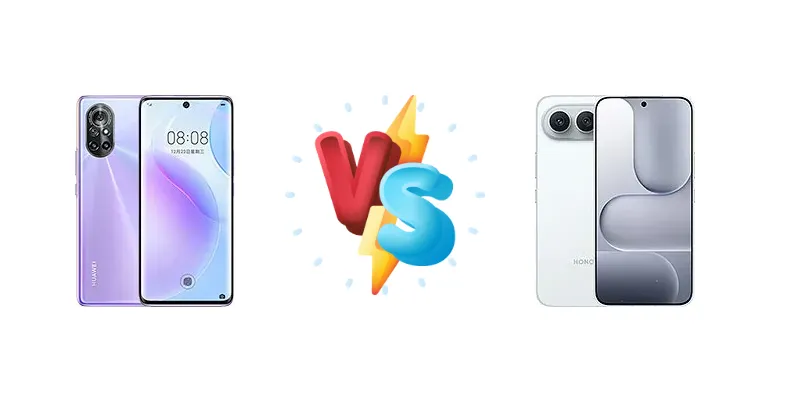
The Huawei nova 8 5G, released in 2020, represented a strong mid-range offering. Now, the Honor 500 enters the arena with a newer chipset and faster charging. This comparison dissects the key differences between these two devices, focusing on how the Snapdragon 8s Gen 4 impacts real-world performance and whether it justifies a potential price premium.
🏆 Quick Verdict
For most users, the Honor 500 is the superior choice. The Snapdragon 8s Gen 4’s 4nm process and newer CPU architecture provide a substantial performance advantage over the Kirin 985, particularly in demanding tasks like gaming and video editing. While the nova 8 5G offers competitive 66W charging, the Honor 500’s 80W charging further reduces downtime.
| Network |
|---|
| 2G bands | GSM 850 / 900 / 1800 / 1900 | GSM 850 / 900 / 1800 / 1900 |
| 3G bands | HSDPA 800 / 850 / 900 / 1700(AWS) / 1900 / 2100 | HSDPA 800 / 850 / 900 / 1700(AWS) / 1900 / 2100 |
| 4G bands | 1, 2, 3, 4, 5, 6, 8, 9, 18, 19, 26, 34, 38, 39, 40, 41 | LTE |
| 5G bands | 1, 3, 28, 38, 41, 77, 78, 80, 83, 84 SA/NSA | SA/NSA |
| Speed | HSPA, LTE, 5G | HSPA, LTE, 5G |
| Technology | GSM / CDMA / HSPA / LTE / 5G | GSM / HSPA / LTE / 5G |
| | CDMA 800 | - |
| Launch |
|---|
| Announced | 2020, December 23. Released 2021, January 05 | 2025, November 24 |
| Status | Discontinued | Available. Released 2025, November 27 |
| Body |
|---|
| Build | - | Glass front, aluminum frame |
| Dimensions | 160.1 x 74.1 x 7.6 mm (6.30 x 2.92 x 0.30 in) | 155.8 x 74.2 x 7.8 mm (6.13 x 2.92 x 0.31 in) |
| SIM | Nano-SIM + Nano-SIM | Nano-SIM + Nano-SIM |
| Weight | 169 g (5.96 oz) | 198 g (6.98 oz) |
| Display |
|---|
| Protection | - | Aluminosilicate glass |
| Resolution | 1080 x 2340 pixels, 19.5:9 ratio (~392 ppi density) | 1264 x 2736 pixels, 19.5:9 ratio (~460 ppi density) |
| Size | 6.57 inches, 106.0 cm2 (~89.3% screen-to-body ratio) | 6.55 inches, 105.4 cm2 (~91.2% screen-to-body ratio) |
| Type | OLED, 1B colors, HDR10, 90Hz | AMOLED, 1B colors, 120Hz, 3840Hz PWM, HDR Vivid, 6000 nits (peak) |
| Platform |
|---|
| CPU | Octa-core (1x2.58 GHz Cortex-A76 & 3x2.40 GHz Cortex-A76 & 4x1.84 GHz Cortex-A55) | Octa-core (1x3.21 GHz Cortex-X4 & 3x3.0 GHz Cortex-A720 & 2x2.8 GHz Cortex-A720 & 2x2.0 GHz Cortex-A720) |
| Chipset | Kirin 985 5G (7 nm) | Qualcomm SM8735 Snapdragon 8s Gen 4 (4 nm) |
| GPU | Mali-G77 (8-core) | Adreno 825 |
| OS | Android 10, EMUI 11, no Google Play Services | Android 16, MagicOS 10 |
| Memory |
|---|
| Card slot | No | No |
| Internal | 128GB 8GB RAM, 256GB 8GB RAM | 256GB 12GB RAM, 512GB 12GB RAM, 512GB 16GB RAM |
| | UFS | - |
| Main Camera |
|---|
| Dual | - | 200 MP, f/1.9, (wide), 1/1.4", 0.56µm, PDAF, OIS
12 MP, f/2.2, 117˚ (ultrawide), AF |
| Features | LED flash, panorama, HDR | LED flash, HDR, panorama |
| Quad | 64 MP, f/1.9, 26mm (wide), PDAF
8 MP, f/2.4, 120˚, 17mm (ultrawide)
2 MP (macro)
Auxiliary lens | - |
| Video | 4K, 1080p, 720p@960fps, gyro-EIS | 4K, 1080p, gyro-EIS, OIS |
| Selfie camera |
|---|
| Features | HDR | HDR |
| Single | 32 MP, f/2.0, 26mm (wide) | 50 MP, f/2.0, (wide) |
| Video | 4K | 4K, 1080p, gyro-EIS |
| Sound |
|---|
| 3.5mm jack | No | - |
| 35mm jack | No | No |
| Loudspeaker | Yes | Yes, with stereo speakers |
| Comms |
|---|
| Bluetooth | 5.1, A2DP, LE | 6.0, A2DP, LE, aptX HD, aptX Adaptive, aptX Lossless, LHDC 5, Auracast, ASHA |
| Infrared port | - | Yes |
| NFC | Yes | Yes |
| Positioning | GPS, GLONASS, BDS, GALILEO, QZSS | GPS (L1+L5), GLONASS (L1), BDS (B1I+B1c+B2a+B2b), GALILEO (E1+E5a+E5b), QZSS (L1+L5), NavIC (L5) |
| Radio | No | No |
| USB | USB Type-C 2.0, OTG | USB Type-C 2.0, OTG |
| WLAN | Wi-Fi 802.11 a/b/g/n/ac, dual-band, Wi-Fi Direct | Wi-Fi 802.11 a/b/g/n/ac/6/7, dual-band, Wi-Fi Direct |
| Features |
|---|
| Sensors | Fingerprint (under display, optical), accelerometer, gyro, proximity, compass | Fingerprint (under display, optical), accelerometer, gyro, proximity, compass (ultrasound) |
| Battery |
|---|
| Charging | 66W wired, 60% in 15 min, 100% in 35 min
5W reverse wired | 80W wired
5W reverse wired |
| Type | Li-Po 3800 mAh | Si/C Li-Ion 8000 mAh |
| Misc |
|---|
| Colors | Black, Blue, Green, White | Black, Silver, Blue, Pink |
| Models | ANG-AN00 | MEY-AN00 |
| Price | About 410 EUR | About 330 EUR |
Huawei nova 8 5G
- Established Huawei ecosystem
- Competitive 66W fast charging
- Potentially lower price point (due to age)
- Older Kirin 985 chipset
- Less efficient 7nm process
- Potentially outdated software
Honor 500
- Powerful Snapdragon 8s Gen 4 chipset
- Efficient 4nm process
- Faster 80W wired charging
- May be more expensive
- Honor's software experience may differ from Huawei's
- Newer device, potential for early software bugs
Display Comparison
Neither device's display specifications are provided, so a direct comparison is limited. However, given the nova 8 5G's release date, it likely features an OLED panel. The Honor 500, being a newer device, may benefit from advancements in panel technology like higher peak brightness and improved color accuracy. The Snapdragon 8s Gen 4’s ISP could also contribute to better display calibration and image processing for content displayed on the Honor 500’s screen.
Camera Comparison
Without detailed camera specifications, a direct comparison is challenging. However, the Snapdragon 8s Gen 4’s image signal processor (ISP) is likely more advanced than the Kirin 985’s, offering improved noise reduction, dynamic range, and image processing capabilities. The Honor 500 will likely benefit from better computational photography features. The Kirin 985 is a capable chip, but the newer ISP in the Snapdragon 8s Gen 4 provides a distinct advantage in image quality, especially in low-light conditions.
Performance
The core difference lies in the chipsets. The Honor 500’s Qualcomm SM8735 Snapdragon 8s Gen 4 (4nm) is a clear upgrade over the Huawei nova 8 5G’s Kirin 985 5G (7nm). The 4nm process node of the Snapdragon 8s Gen 4 translates to significantly improved power efficiency and thermal management, reducing throttling during sustained workloads. The Snapdragon 8s Gen 4’s CPU configuration – 1x3.21 GHz Cortex-X4, 3x3.0 GHz Cortex-A720, 2x2.8 GHz Cortex-A720, and 2x2.0 GHz Cortex-A720 – represents a generational leap in CPU architecture compared to the Kirin 985’s 1x2.58 GHz Cortex-A76, 3x2.40 GHz Cortex-A76, and 4x1.84 GHz Cortex-A55. This means faster app launch times, smoother multitasking, and a more responsive user experience on the Honor 500.
Battery Life
Both devices offer 5W reverse wired charging, a useful feature for topping up accessories. However, the Honor 500’s 80W wired charging is significantly faster than the Huawei nova 8 5G’s 66W charging. The Honor 500 claims a full charge in less time, minimizing downtime. While battery capacity isn’t specified, the Snapdragon 8s Gen 4’s improved power efficiency could offset a potentially smaller battery size in the Honor 500, resulting in comparable or even better real-world battery life.
Buying Guide
Buy the Huawei nova 8 5G if you prioritize a proven track record and can find it at a significantly discounted price. Its 66W charging and established software ecosystem may appeal to users already invested in the Huawei ecosystem. Buy the Honor 500 if you demand the best possible performance in this price bracket, value faster charging speeds, and want a phone built on a more modern platform with the latest Snapdragon silicon.
Frequently Asked Questions
❓ Will the Snapdragon 8s Gen 4 in the Honor 500 handle demanding games like Genshin Impact at high settings?
Yes, the Snapdragon 8s Gen 4 is a capable chipset for gaming. Its Adreno GPU and efficient 4nm process should allow for smooth gameplay at high settings in most titles, including Genshin Impact. The improved thermal management will also help prevent throttling during extended gaming sessions.
❓ How much faster is the 80W charging on the Honor 500 compared to the 66W charging on the Huawei nova 8 5G?
While exact times depend on battery capacity, the Honor 500’s 80W charging will likely reduce charging time by approximately 10-20% compared to the nova 8 5G’s 66W charging. This translates to less time tethered to a charger and more time using the device.
❓ Does the Kirin 985 in the Huawei nova 8 5G still receive software updates?
Software update support for the Huawei nova 8 5G may be limited, especially given its release date. Huawei's software support has been impacted by geopolitical factors. The Honor 500, being a newer device, is more likely to receive regular software updates and security patches.