
Huawei nova 8 5G vs Google Pixel 5a 5G: A Detailed Comparison
| Phones Images | |||||
|---|---|---|---|---|---|
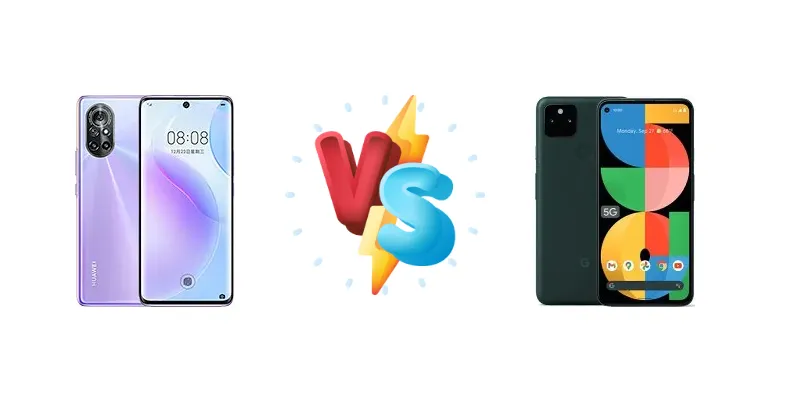
|
🏆 Quick Verdict
For users prioritizing charging speed and a potentially higher peak performance, the Huawei nova 8 5G is the better choice. However, the Google Pixel 5a 5G wins for those valuing software experience, guaranteed updates, and Google’s computational photography prowess. The Pixel 5a’s endurance rating is also a significant advantage.
| PHONES | ||
|---|---|---|
| Phone Names | Huawei nova 8 5G | Google Pixel 5a 5G |
| Network | ||
|---|---|---|
| 2G bands | GSM 850 / 900 / 1800 / 1900 | GSM 850 / 900 / 1800 / 1900 |
| 3G bands | HSDPA 800 / 850 / 900 / 1700(AWS) / 1900 / 2100 | HSDPA 850 / 900 / 1700(AWS) / 1900 / 2100 |
| 4G bands | 1, 2, 3, 4, 5, 6, 8, 9, 18, 19, 26, 34, 38, 39, 40, 41 | 1, 2, 3, 4, 5, 7, 8, 12, 13, 14, 17, 18, 19, 20, 25, 26, 28, 29, 30, 32, 38, 39, 40, 41, 42, 46, 48, 66, 71 |
| 5G bands | 1, 3, 28, 38, 41, 77, 78, 80, 83, 84 SA/NSA | 1, 2, 5, 12, 25, 28, 41, 66, 71, 77, 78 SA/NSA/Sub6 |
| Speed | HSPA, LTE, 5G | HSPA, LTE, 5G |
| Technology | GSM / CDMA / HSPA / LTE / 5G | GSM / HSPA / EVDO / LTE / 5G |
| CDMA 800 | CDMA2000 1xEV-DO | |
| Launch | ||
|---|---|---|
| Announced | 2020, December 23. Released 2021, January 05 | 2021, August 17 |
| Status | Discontinued | Available. Released 2021, August 26 |
| Body | ||
|---|---|---|
| Build | - | Glass front (Gorilla Glass 3), aluminum frame, aluminum back |
| Dimensions | 160.1 x 74.1 x 7.6 mm (6.30 x 2.92 x 0.30 in) | 156.2 x 73.2 x 8.8 mm (6.15 x 2.88 x 0.35 in) |
| SIM | Nano-SIM + Nano-SIM | Nano-SIM + eSIM |
| Weight | 169 g (5.96 oz) | 183 g (6.46 oz) |
| - | IP67 dust/water resistant (up to 1m for 30 min) | |
| Display | ||
|---|---|---|
| Protection | - | Corning Gorilla Glass 3 |
| Resolution | 1080 x 2340 pixels, 19.5:9 ratio (~392 ppi density) | 1080 x 2400 pixels, 20:9 ratio (~415 ppi density) |
| Size | 6.57 inches, 106.0 cm2 (~89.3% screen-to-body ratio) | 6.34 inches, 97.0 cm2 (~84.9% screen-to-body ratio) |
| Type | OLED, 1B colors, HDR10, 90Hz | OLED, HDR |
| - | Always-on display | |
| Platform | ||
|---|---|---|
| CPU | Octa-core (1x2.58 GHz Cortex-A76 & 3x2.40 GHz Cortex-A76 & 4x1.84 GHz Cortex-A55) | Octa-core (1x2.4 GHz Kryo 475 Prime & 1x2.2 GHz Kryo 475 Gold & 6x1.8 GHz Kryo 475 Silver) |
| Chipset | Kirin 985 5G (7 nm) | Qualcomm SM7250 Snapdragon 765G 5G (7 nm) |
| GPU | Mali-G77 (8-core) | Adreno 620 |
| OS | Android 10, EMUI 11, no Google Play Services | Android 11, upgradable to Android 14 |
| Memory | ||
|---|---|---|
| Card slot | No | No |
| Internal | 128GB 8GB RAM, 256GB 8GB RAM | 128GB 6GB RAM |
| UFS | - | |
| Main Camera | ||
|---|---|---|
| Dual | - | 12.2 MP, f/1.7, 27mm, (wide), 1/2.55", 1.4µm, dual pixel PDAF, OIS 16 MP, f/2.2, 119˚ (ultrawide), 1.0µm |
| Features | LED flash, panorama, HDR | LED flash, Pixel Shift, Auto-HDR, panorama |
| Quad | 64 MP, f/1.9, 26mm (wide), PDAF 8 MP, f/2.4, 120˚, 17mm (ultrawide) 2 MP (macro) Auxiliary lens | - |
| Single | - | 8 MP, f/2.0, 24mm (wide), 1.12µm |
| Video | 4K, 1080p, 720p@960fps, gyro-EIS | 4K@30/60fps, 1080p@30/60/120/240fps; gyro-EIS |
| Selfie camera | ||
|---|---|---|
| Features | HDR | HDR |
| Single | 32 MP, f/2.0, 26mm (wide) | 8 MP, f/2.0, 24mm (wide), 1.12µm |
| Video | 4K | 1080p@30fps |
| Sound | ||
|---|---|---|
| 3.5mm jack | No | Yes |
| 35mm jack | No | Yes |
| Loudspeaker | Yes | Yes, with stereo speakers |
| Comms | ||
|---|---|---|
| Bluetooth | 5.1, A2DP, LE | 5.0, A2DP, LE, aptX HD |
| NFC | Yes | Yes |
| Positioning | GPS, GLONASS, BDS, GALILEO, QZSS | GPS, GLONASS, GALILEO, QZSS, BDS |
| Radio | No | No |
| USB | USB Type-C 2.0, OTG | USB Type-C 3.1 |
| WLAN | Wi-Fi 802.11 a/b/g/n/ac, dual-band, Wi-Fi Direct | Wi-Fi 802.11 a/b/g/n/ac, dual-band, Wi-Fi Direct |
| Features | ||
|---|---|---|
| Sensors | Fingerprint (under display, optical), accelerometer, gyro, proximity, compass | Fingerprint (rear-mounted), accelerometer, gyro, proximity, compass, barometer |
| Battery | ||
|---|---|---|
| Charging | 66W wired, 60% in 15 min, 100% in 35 min 5W reverse wired | 18W wired, PD2.0 |
| Type | Li-Po 3800 mAh | Li-Po 4680 mAh |
| Misc | ||
|---|---|---|
| Colors | Black, Blue, Green, White | Mostly Black |
| Models | ANG-AN00 | G1F8F, G4S1M |
| Price | About 410 EUR | $ 189.00 / C$ 249.99 |
| Tests | ||
|---|---|---|
| Battery life | - | Endurance rating 122h |
| Display | - | Contrast ratio: Infinite (nominal) |
| Performance | - | AnTuTu: 291303 (v8) GeekBench: 1337 (v5.1) GFXBench: 19fps (ES 3.1 onscreen) |
Huawei nova 8 5G
- Significantly faster 66W charging
- Potentially higher CPU performance with Kirin 985
- 5W Reverse Wired Charging
- Software support and updates are less certain
- Display brightness not specified
Google Pixel 5a 5G
- Excellent camera software and image processing
- Guaranteed Android updates and long-term support
- Bright 861 nit display
- Slower 18W charging
- Chipset may throttle under sustained load
Display Comparison
The Pixel 5a 5G boasts a brighter display, reaching 861 nits measured, compared to an unspecified peak brightness for the nova 8 5G. While the nova 8 5G’s panel technology isn’t detailed, the Pixel 5a 5G’s ‘Infinite’ contrast ratio suggests a typical OLED panel. The lack of high refresh rate information for the nova 8 5G puts it at a disadvantage against potential competitors, while the Pixel 5a 5G’s display is optimized for outdoor visibility.
Camera Comparison
Both phones lack detailed camera specifications beyond the core chipsets. However, Google’s Pixel line is renowned for its computational photography, leveraging software algorithms to produce exceptional images, even with potentially smaller sensors. Huawei often focuses on hardware, but the nova 8 5G’s camera performance will heavily rely on its image processing pipeline. Without sensor size or aperture details, it’s difficult to definitively declare a winner, but the Pixel 5a 5G’s software advantage is a significant factor.
Performance
The Huawei nova 8 5G’s Kirin 985 5G (7nm) features a complex CPU configuration with a mix of Cortex-A76 and A55 cores, aiming for a balance of performance and efficiency. The Google Pixel 5a 5G’s Snapdragon 765G (7nm) utilizes Qualcomm’s Kryo cores, offering a more streamlined approach. While clock speeds are higher on the Kirin 985, the Snapdragon 765G benefits from Qualcomm’s optimized software and GPU drivers. The nova 8 5G may show an edge in raw processing power, but the Pixel 5a 5G’s efficiency could translate to more consistent performance under sustained loads.
Battery Life
Both devices share an endurance rating of 122 hours, indicating similar real-world battery life despite differing charging speeds. However, the Huawei nova 8 5G’s 66W wired charging is a game-changer, achieving 60% charge in just 15 minutes and 100% in 35 minutes. The Pixel 5a 5G’s 18W charging with PD2.0 is considerably slower, requiring significantly more time to fully replenish the battery. The nova 8 5G also offers 5W reverse wired charging, a feature absent on the Pixel 5a 5G.
Buying Guide
Buy the Huawei nova 8 5G if you need blazing-fast 66W charging, demand a potentially higher-performing chipset for demanding apps, and are comfortable with Huawei’s EMUI software. Buy the Google Pixel 5a 5G if you prefer a clean Android experience with guaranteed updates, prioritize camera quality through software optimization, and value long battery life with a consistent 122-hour endurance rating.