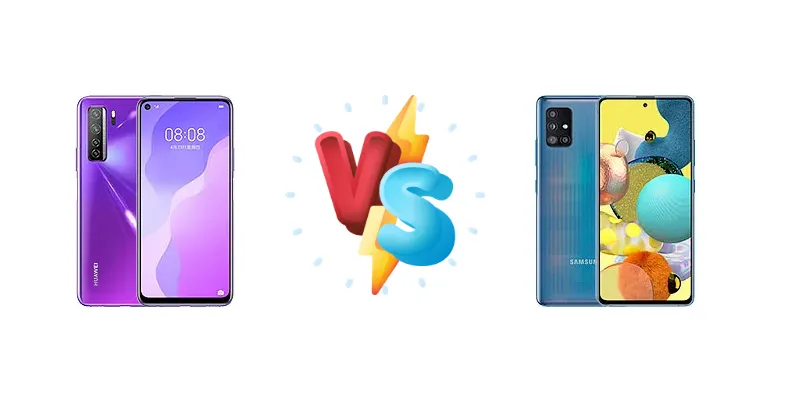
The Huawei nova 7 SE and Samsung Galaxy A51 5G UW represent compelling options in the increasingly crowded mid-range 5G smartphone market. While both aim to deliver 5G connectivity at a reasonable price, they take different approaches to achieving this, particularly in chipset choice and charging technology. This comparison dissects those differences to determine which device offers the best value.
🏆 Quick Verdict
For the average user prioritizing fast charging and potentially slightly better sustained performance, the Huawei nova 7 SE is the stronger choice. Its 40W charging significantly outperforms the A51 5G UW’s 15W, and the Kirin 820 offers a competitive CPU architecture. However, Samsung’s software ecosystem and wider carrier support remain key considerations.
| Network |
|---|
| 2G bands | GSM 850 / 900 / 1800 / 1900 | GSM 850 / 900 / 1800 / 1900 |
| 3G bands | HSDPA 800 / 850 / 900 / 1700(AWS) / 1900 / 2100 | HSDPA 850 / 900 / 1900 / 2100 |
| 4G bands | 1, 2, 3, 4, 5, 6, 7, 8, 12, 17, 18, 19, 20, 26, 28, 34, 38, 39, 40, 41, 66 - International | 2, 4, 5, 13, 66 |
| 5G bands | 1, 3, 28, 38, 41, 77, 78, 79 SA/NSA - International | 260, 261 mmWave |
| Speed | HSPA, LTE, 5G | HSPA, LTE, 5G |
| Technology | GSM / CDMA / HSPA / LTE / 5G | GSM / HSPA / LTE / 5G |
| Launch |
|---|
| Announced | 2020, April 23. Released 2020, April 28 | 2020, August 14 |
| Status | Discontinued | Available. Released 2020, August 14 |
| Body |
|---|
| Build | - | Glass front (Gorilla Glass 3), plastic back, aluminum frame |
| Dimensions | 162.3 x 75 x 8.6 mm (6.39 x 2.95 x 0.34 in) | 158.8 x 73.4 x 8.6 mm (6.25 x 2.89 x 0.34 in) |
| SIM | Nano-SIM + Nano-SIM | Nano-SIM (pre-installed) |
| Weight | 189 g (6.67 oz) | 188.8 g (6.67 oz) |
| Display |
|---|
| Protection | - | Corning Gorilla Glass 3 |
| Resolution | 1080 x 2400 pixels, 20:9 ratio (~405 ppi density) | 1080 x 2400 pixels, 20:9 ratio (~405 ppi density) |
| Size | 6.5 inches, 102.0 cm2 (~83.8% screen-to-body ratio) | 6.5 inches, 102.0 cm2 (~87.5% screen-to-body ratio) |
| Type | IPS LCD, HDR10 | Super AMOLED |
| Platform |
|---|
| CPU | Octa-core (1x2.36 GHz Cortex-A76 & 3x2.22 GHz Cortex-A76 & 4x1.84 GHz Cortex-A55) | Octa-core (1x2.4 GHz Kryo 475 Prime & 1x2.2 GHz Kryo 475 Gold & 6x1.8 GHz Kryo 475 Silver) |
| Chipset | Kirin 820 5G (7 nm) | Qualcomm SM7250 Snapdragon 765G 5G (7 nm) |
| GPU | Mali-G57 (6-core) | Adreno 620 |
| OS | Android 10, EMUI 10.1, no Google Play Services | Android 10, One UI 2 |
| Memory |
|---|
| Card slot | Nano Memory (uses shared SIM slot) | microSDXC (uses shared SIM slot) |
| Internal | 128GB 6GB RAM, 128GB 8GB RAM, 256GB 8GB RAM | 128GB 6GB RAM |
| | - | UFS 2.1 |
| Main Camera |
|---|
| Features | LED flash, Panorama, HDR | LED flash, panorama, HDR |
| Quad | 64 MP, f/1.8, 26mm (wide), PDAF
8 MP, f/2.4, 17mm (ultrawide)
2 MP (macro)
Auxiliary lens | 48 MP, f/2.0, 26mm (wide), 1/2.0", 0.8µm, PDAF
12 MP, f/2.2, 123˚ (ultrawide)
5 MP (macro)
Auxiliary lens |
| Single | - | 5 MP, AF |
| Video | 4K, 1080p, 720p@960fps | 4K@30fps, 1080p@30/120fps; gyro-EIS |
| Selfie camera |
|---|
| Features | HDR | HDR |
| Single | 16 MP, f/2.0, (wide) | 32 MP, f/2.2, 26mm (wide), 1/2.8", 0.8µm |
| Video | 1080p | 4K@30fps, 1080p@30fps |
| Sound |
|---|
| 3.5mm jack | Yes | Yes |
| 35mm jack | Yes | Yes |
| Loudspeaker | Yes | Yes |
| Comms |
|---|
| Bluetooth | 5.1, A2DP, LE | 5.0, A2DP, LE |
| NFC | No | Yes |
| Positioning | GPS, GLONASS, GALILEO, BDS, QZSS | GPS, GLONASS, GALILEO, BDS |
| Radio | No | FM radio, RDS, recording |
| USB | USB Type-C 2.0, OTG | USB Type-C 2.0, OTG |
| WLAN | Wi-Fi 802.11 a/b/g/n/ac, dual-band, Wi-Fi Direct | Wi-Fi 802.11 a/b/g/n/ac, dual-band, Wi-Fi Direct |
| Features |
|---|
| Sensors | Fingerprint (side-mounted), accelerometer, gyro, proximity, compass | Fingerprint (under display, optical), accelerometer, gyro, proximity, compass |
| | - | ANT+ |
| Battery |
|---|
| Charging | 40W wired, 70% in 30 min
5W reverse wired | 15W wired |
| Stand-by | - | Up to 672 h |
| Talk time | - | Up to 5 h |
| Type | Li-Po 4000 mAh | Li-Po 4500 mAh |
| Misc |
|---|
| Colors | Black, Space Silver, Midsummer Purple, Crush Green | Prism Bricks Blue |
| Models | CDY-AN00, CDY-NX9B, CDY-TN00, CDY-AN20, CDL-AN50 | SM-A516V |
| Price | About 320 EUR | About 470 EUR |
| SAR | - | 0.70 W/kg (head) 1.25 W/kg (body) |
| SAR EU | - | 0.59 W/kg (head) 1.32 W/kg (body) |
Huawei nova 7 SE
- Significantly faster 40W charging
- Potentially stronger CPU performance with Kirin 820
- Reverse wired charging capability
- Reliance on Huawei Mobile Services (HMS) instead of Google Mobile Services (GMS)
- Potential software update concerns
Samsung Galaxy A51 5G UW
- Samsung’s One UI software experience
- Broader carrier compatibility, especially with Verizon’s UW network
- Established brand reputation
- Slow 15W charging
- Potentially less powerful CPU compared to Kirin 820
Display Comparison
Neither Huawei nor Samsung provided display specs in the context data. However, given the market positioning, both likely utilize FHD+ AMOLED panels. The key differentiator will be peak brightness and color accuracy. Samsung typically excels in display calibration, but without specific data, it's difficult to definitively state which offers a superior visual experience. Expect both to feature high refresh rates, though this is not confirmed.
Camera Comparison
Without sensor details, a direct camera comparison is limited. However, the market segment suggests both phones will feature multi-camera setups with a primary sensor, ultrawide, and potentially a macro lens. The absence of sensor size information makes it difficult to assess low-light performance. Image processing philosophies differ significantly between Huawei and Samsung; Huawei often leans towards vibrant, saturated colors, while Samsung typically aims for more natural tones. The A51 5G UW’s UW support suggests a focus on Verizon’s network, potentially impacting camera performance in areas with limited coverage.
Performance
The core of the difference lies in the chipsets. The Huawei nova 7 SE’s Kirin 820 5G (7nm) features a tri-cluster Cortex-A76 arrangement alongside Cortex-A55 cores, suggesting strong multi-core performance. The Samsung Galaxy A51 5G UW’s Snapdragon 765G (7nm) employs Qualcomm’s Kryo architecture. While both are 7nm chips, the Kirin 820’s A76 cores are generally considered more efficient than the Kryo 475 Gold cores. This translates to potentially better sustained performance under load, though thermal management will be crucial. The Snapdragon 765G benefits from Qualcomm’s optimized software and modem integration, which could provide a more stable 5G experience.
Battery Life
The Huawei nova 7 SE’s 40W wired charging is a significant advantage. The ability to reach 70% charge in just 30 minutes is a game-changer for users who prioritize quick top-ups. The Samsung Galaxy A51 5G UW’s 15W charging is comparatively slow. While battery capacity isn’t specified, the faster charging of the nova 7 SE effectively mitigates any potential capacity disadvantage. The 5W reverse wired charging on the nova 7 SE is a niche feature, useful for topping up accessories but not a primary selling point.
Buying Guide
Buy the Huawei nova 7 SE if you need rapid charging, a potentially more powerful processor for demanding tasks, and don't mind navigating the Huawei ecosystem. Buy the Samsung Galaxy A51 5G UW if you prioritize Samsung’s One UI software, broader carrier compatibility in the US (specifically with UW support), and a more established brand reputation. The A51 5G UW is also a safer bet for those heavily reliant on Google Mobile Services.
Frequently Asked Questions
❓ Does the Huawei nova 7 SE’s lack of Google Mobile Services significantly impact app availability?
Yes, the absence of GMS means you’ll rely on Huawei’s AppGallery and potentially sideloading apps. While AppGallery has grown, it still lacks some popular apps readily available on the Google Play Store. Huawei provides workarounds like the Petal Search widget, but the experience isn’t as seamless.
❓ Is the Snapdragon 765G in the Galaxy A51 5G UW capable of handling demanding games like PUBG or Call of Duty?
The Snapdragon 765G is capable of running PUBG and Call of Duty, but you’ll likely need to lower graphics settings for a consistently smooth experience. The Kirin 820 in the nova 7 SE may offer slightly better performance in these scenarios, but both phones are mid-range devices and won’t deliver flagship-level gaming.
❓ How does the 5G performance differ between the two phones, considering the A51 5G UW is optimized for Verizon’s Ultra Wideband (UW)?
The Galaxy A51 5G UW is specifically tuned for Verizon’s UW network, meaning it will achieve faster 5G speeds in areas with UW coverage. The nova 7 SE’s 5G performance will depend on the carrier and network infrastructure. If you’re a Verizon customer and prioritize the fastest possible 5G speeds, the A51 5G UW is the better choice.