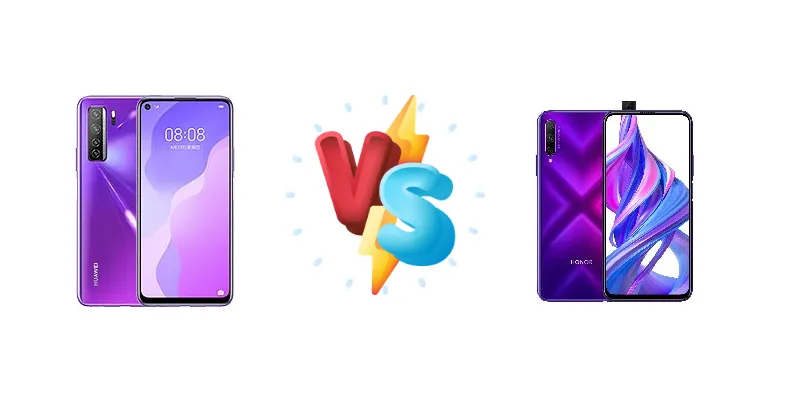
Both the Huawei nova 7 SE and the Honor 9X Pro represent compelling options in the mid-range 5G smartphone market. However, they cater to slightly different priorities. The nova 7 SE prioritizes faster processing and charging, while the 9X Pro focuses on endurance and a respectable display experience. This comparison will dissect their key differences to determine which device best suits your needs.
🏆 Quick Verdict
For most users, the Huawei nova 7 SE emerges as the stronger choice. Its Kirin 820 chipset offers a noticeable performance uplift over the 9X Pro’s Kirin 810, and the 40W fast charging is a game-changer compared to the 9X Pro’s sluggish 10W charging. While the 9X Pro boasts excellent battery endurance, the nova 7 SE’s speed advantage is more impactful for daily use.
| Network |
|---|
| 2G bands | GSM 850 / 900 / 1800 / 1900 | GSM 850 / 900 / 1800 / 1900 |
| 3G bands | HSDPA 800 / 850 / 900 / 1700(AWS) / 1900 / 2100 | HSDPA 850 / 900 / 2100 |
| 4G bands | 1, 2, 3, 4, 5, 6, 7, 8, 12, 17, 18, 19, 20, 26, 28, 34, 38, 39, 40, 41, 66 - International | 1, 3, 7, 8, 20, 38, 40, 41 - International |
| 5G bands | 1, 3, 28, 38, 41, 77, 78, 79 SA/NSA - International | - |
| Speed | HSPA, LTE, 5G | HSPA 42.2/5.76 Mbps, LTE (2CA) Cat12 600/50 Mbps |
| Technology | GSM / CDMA / HSPA / LTE / 5G | GSM / CDMA / HSPA / EVDO / LTE |
| | - | 1, 3, 5, 8, 38, 39, 40, 41 - China |
| Launch |
|---|
| Announced | 2020, April 23. Released 2020, April 28 | 2019, July 23. Released 2019, August 09 |
| Status | Discontinued | Discontinued |
| Body |
|---|
| Build | - | Glass front, glass back, aluminum frame |
| Dimensions | 162.3 x 75 x 8.6 mm (6.39 x 2.95 x 0.34 in) | 163.5 x 77.3 x 8.8 mm (6.44 x 3.04 x 0.35 in) |
| SIM | Nano-SIM + Nano-SIM | Nano-SIM + Nano-SIM |
| Weight | 189 g (6.67 oz) | 202 g (7.13 oz) |
| Display |
|---|
| Resolution | 1080 x 2400 pixels, 20:9 ratio (~405 ppi density) | 1080 x 2340 pixels, 19.5:9 ratio (~391 ppi density) |
| Size | 6.5 inches, 102.0 cm2 (~83.8% screen-to-body ratio) | 6.59 inches, 106.6 cm2 (~84.3% screen-to-body ratio) |
| Type | IPS LCD, HDR10 | IPS LCD |
| Platform |
|---|
| CPU | Octa-core (1x2.36 GHz Cortex-A76 & 3x2.22 GHz Cortex-A76 & 4x1.84 GHz Cortex-A55) | Octa-core (2x2.27 GHz Cortex-A76 & 6x1.88 GHz Cortex-A55) |
| Chipset | Kirin 820 5G (7 nm) | Kirin 810 (7 nm) |
| GPU | Mali-G57 (6-core) | Mali-G52 MP6 |
| OS | Android 10, EMUI 10.1, no Google Play Services | Android 9.0 (Pie), upgradable to Android 10, EMUI 9.1, no Google Play Services |
| Memory |
|---|
| Card slot | Nano Memory (uses shared SIM slot) | microSDXC (uses shared SIM slot) |
| Internal | 128GB 6GB RAM, 128GB 8GB RAM, 256GB 8GB RAM | 128GB 8GB RAM, 256GB 6GB RAM, 256GB 8GB RAM |
| Main Camera |
|---|
| Features | LED flash, Panorama, HDR | LED flash, HDR, panorama |
| Quad | 64 MP, f/1.8, 26mm (wide), PDAF
8 MP, f/2.4, 17mm (ultrawide)
2 MP (macro)
Auxiliary lens | - |
| Triple | - | 48 MP, f/1.8, (wide), 1/2.0", 0.8µm, PDAF
8 MP, f/2.4, 120˚ (ultrawide)
Auxiliary lens |
| Video | 4K, 1080p, 720p@960fps | 1080p@30fps, gyro-EIS |
| Selfie camera |
|---|
| Features | HDR | - |
| Single | 16 MP, f/2.0, (wide) | Motorized pop-up 16 MP, f/2.2, 26mm (wide), 1/3.06", 1.0µm |
| Video | 1080p | 1080p@60fps |
| Sound |
|---|
| 3.5mm jack | Yes | Yes |
| 35mm jack | Yes | Yes |
| Loudspeaker | Yes | Yes |
| Comms |
|---|
| Bluetooth | 5.1, A2DP, LE | 4.2, A2DP, LE (International)5.0, A2DP, LE (China) |
| NFC | No | No |
| Positioning | GPS, GLONASS, GALILEO, BDS, QZSS | GPS, GLONASS, BDS |
| Radio | No | FM radio |
| USB | USB Type-C 2.0, OTG | USB Type-C 2.0 |
| WLAN | Wi-Fi 802.11 a/b/g/n/ac, dual-band, Wi-Fi Direct | Wi-Fi 802.11 a/b/g/n/ac, dual-band, Wi-Fi Direct |
| Features |
|---|
| Sensors | Fingerprint (side-mounted), accelerometer, gyro, proximity, compass | Fingerprint (side-mounted), accelerometer, gyro, proximity, compass |
| Battery |
|---|
| Charging | 40W wired, 70% in 30 min
5W reverse wired | 10W wired |
| Type | Li-Po 4000 mAh | Li-Po 4000 mAh, non-removable |
| Misc |
|---|
| Colors | Black, Space Silver, Midsummer Purple, Crush Green | Midnight Black, Phantom Purple |
| Models | CDY-AN00, CDY-NX9B, CDY-TN00, CDY-AN20, CDL-AN50 | HLK-AL10, HLK-TL10, HLK-L41, HLK-L42 |
| Price | About 320 EUR | About 230 EUR |
| Tests |
|---|
| Battery life | - |
Endurance rating 104h
|
| Camera | - |
Photo / Video |
| Display | - |
Contrast ratio: 1319:1 (nominal) |
| Loudspeaker | - |
-31.1 LUFS (Below average)
|
| Performance | - |
AnTuTu: 312668 (v8)
GeekBench: 7836 (v4.4), 1911 (v5.1)
GFXBench: 18fps (ES 3.1 onscreen) |
Huawei nova 7 SE
- Significantly faster 40W charging
- More powerful Kirin 820 chipset
- Potentially better camera performance (based on brand reputation)
- Battery capacity not specified, potentially smaller than 9X Pro
- Reverse charging may not be useful for all users
Honor 9X Pro
- Excellent 104-hour battery endurance
- Respectable display brightness and contrast
- More affordable price point (likely)
- Extremely slow 10W charging
- Less powerful Kirin 810 chipset
- Limited camera details suggest a basic implementation
Display Comparison
The Honor 9X Pro features a display with a measured peak brightness of 517 nits and a 1319:1 contrast ratio. While respectable, the nova 7 SE’s display specifications are not provided, but given Huawei’s typical display quality, it’s likely comparable. The 1319:1 contrast ratio on the 9X Pro indicates good black levels, enhancing media consumption. However, without knowing the nova 7 SE’s panel technology (e.g., OLED vs. LCD) or refresh rate, a definitive display winner is difficult to declare. The 9X Pro’s brightness is sufficient for indoor use, but may struggle in direct sunlight.
Camera Comparison
Both phones offer photo and video capabilities, but detailed camera specifications are limited. Without sensor size, aperture, or image processing details, a direct comparison is challenging. However, Huawei generally emphasizes camera performance in its nova series, suggesting the nova 7 SE may have a more refined camera system. The absence of specific details on the 9X Pro’s camera suggests it’s a more basic implementation. The presence of a 2MP macro camera on either device is unlikely to significantly impact image quality, serving primarily as a marketing feature.
Performance
The core difference lies in the chipsets. The Huawei nova 7 SE is powered by the Kirin 820 5G (7nm), featuring a more complex CPU configuration – a 2.36 GHz Cortex-A76, three 2.22 GHz Cortex-A76 cores, and four 1.84 GHz Cortex-A55 cores. The Honor 9X Pro utilizes the Kirin 810 (7nm) with two 2.27 GHz Cortex-A76 cores and six 1.88 GHz Cortex-A55 cores. The nova 7 SE’s additional high-performance core and higher clock speeds translate to faster application loading, smoother multitasking, and improved gaming performance. The Kirin 820 also benefits from a more advanced NPU for AI processing. While both are 7nm chips, the architectural differences give the nova 7 SE a clear edge.
Battery Life
The Honor 9X Pro boasts an impressive endurance rating of 104 hours, indicating excellent battery life. However, this is offset by its extremely slow 10W wired charging. The Huawei nova 7 SE, with its 40W wired charging, can reach 70% charge in just 30 minutes. This drastically reduces downtime and provides a much more convenient charging experience. While the 9X Pro may last longer on a single charge, the nova 7 SE’s rapid charging mitigates the impact of a potentially smaller battery capacity (spec not provided).
Buying Guide
Buy the Huawei nova 7 SE if you need a phone that can handle demanding apps, games, and benefit from significantly faster charging. This is the phone for users who prioritize responsiveness and don't want to be tethered to a charger for hours. Buy the Honor 9X Pro if you prioritize maximizing battery life above all else and are comfortable with slower charging speeds. This phone is ideal for users who frequently travel or have limited access to power outlets.
Frequently Asked Questions
❓ How much faster is the Kirin 820 in the nova 7 SE compared to the Kirin 810 in the 9X Pro for gaming?
The Kirin 820’s more powerful CPU and GPU, combined with its higher clock speeds, result in a noticeable improvement in gaming performance. Expect smoother frame rates and faster loading times in demanding titles. While both chips can handle most games, the nova 7 SE will provide a more consistent and enjoyable gaming experience.
❓ Is the 40W charging on the nova 7 SE compatible with Power Delivery (PD) chargers?
Huawei’s 40W charging utilizes its own SuperCharge protocol. While it may work with some PD chargers, it’s not guaranteed to achieve the full 40W charging speed. It’s recommended to use the charger included in the box for optimal charging performance.
❓ Does the Honor 9X Pro’s battery life suffer significantly with 5G enabled?
Yes, enabling 5G on the Honor 9X Pro will noticeably reduce battery life. 5G connectivity is more power-hungry than 4G. However, the phone’s large battery capacity (though not specified) helps mitigate this impact, but expect a shorter runtime when actively using 5G networks.