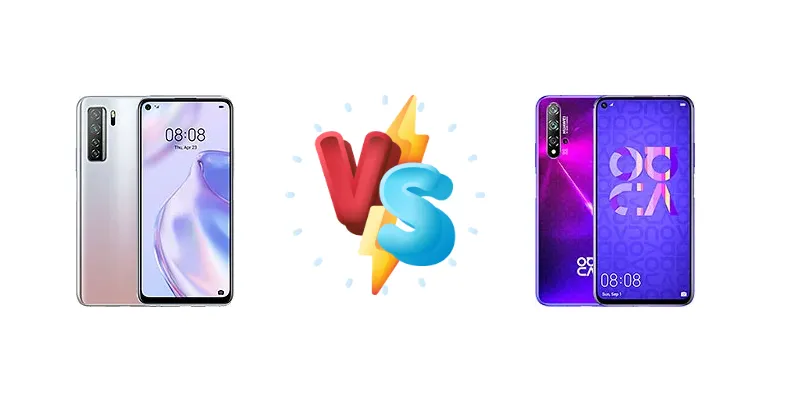
Huawei offers a range of compelling mid-range smartphones, and the Nova 7 SE 5G Youth and Nova 5T are two popular choices. Both offer attractive designs and capable cameras, but cater to slightly different needs. This comprehensive comparison will help you determine which phone best suits your priorities.
🏆 Quick Verdict
The Nova 7 SE 5G Youth wins on 5G connectivity and faster charging, while the Nova 5T boasts a slightly more powerful processor and a more refined camera system. Ultimately, the choice depends on whether 5G and rapid charging are essential or if raw performance and camera quality are your top priorities.
| Network |
|---|
| 2G bands | GSM 850 / 900 / 1800 / 1900 | GSM 850 / 900 / 1800 / 1900 |
| 3G bands | HSDPA 800 / 850 / 900 / 1700(AWS) / 1900 / 2100 | HSDPA 800 / 850 / 900 / 1700(AWS) / 1900 / 2100 |
| 4G bands | 1, 2, 3, 4, 5, 8, 18, 19, 26, 34, 38, 39, 40, 41 | 1, 2, 3, 4, 5, 7, 8, 18, 19, 20, 26, 28, 38, 40, 41 |
| 5G bands | 1, 41, 77, 78 SA/NSA | - |
| Speed | HSPA, LTE, 5G | HSPA, LTE |
| Technology | GSM / CDMA / HSPA / LTE / 5G | GSM / HSPA / LTE |
| | CDMA 800 & TD-SCDMA | - |
| Launch |
|---|
| Announced | 2020, October 16. Released 2020, October 16 | 2019, August 27. Released 2019, September 05 |
| Status | Discontinued | Discontinued |
| Body |
|---|
| Build | - | Glass front, glass back, aluminum frame |
| Dimensions | 162.3 x 75 x 8.6 mm (6.39 x 2.95 x 0.34 in) | 154.3 x 74 x 7.8 mm (6.07 x 2.91 x 0.31 in) |
| SIM | Nano-SIM + Nano-SIM | Nano-SIM + Nano-SIM |
| Weight | 189 g (6.67 oz) | 174 g (6.14 oz) |
| Display |
|---|
| Resolution | 1080 x 2400 pixels, 20:9 ratio (~405 ppi density) | 1080 x 2340 pixels, 19.5:9 ratio (~412 ppi density) |
| Size | 6.5 inches, 102.0 cm2 (~83.8% screen-to-body ratio) | 6.26 inches, 96.2 cm2 (~84.2% screen-to-body ratio) |
| Type | IPS LCD, HDR10 | IPS LCD |
| Platform |
|---|
| CPU | Octa-core (2x2.4 GHz Cortex-A76 & 6x2.0 GHz Cortex-A55) | Octa-core (2x2.6 GHz Cortex-A76 & 2x1.92 GHz Cortex-A76 & 4x1.8 GHz Cortex-A55) |
| Chipset | Mediatek Dimensity 800U (7 nm) | Kirin 980 (7 nm) |
| GPU | Mali-G57 MC3 | Mali-G76 MP10 |
| OS | Android 10, EMUI 10.1, no Google Play Services | Android 9.0 (Pie), upgradable to Android 10, EMUI 10 |
| Memory |
|---|
| Card slot | No | No |
| Internal | 128GB 8GB RAM | 128GB 6GB RAM, 128GB 8GB RAM |
| | - | UFS 2.1 |
| Main Camera |
|---|
| Features | LED flash, Panorama, HDR | LED flash, HDR, panorama |
| Quad | 64 MP, f/1.8, 26mm (wide), PDAF
8 MP, f/2.4, 17mm (ultrawide)
2 MP (macro)
Auxiliary lens | 48 MP, f/1.8, 28mm (wide), 1/2.0", 0.8µm, PDAF
16 MP, f/2.2, 13mm (ultrawide), 1/3.1"
2 MP (macro)
Auxiliary lens |
| Video | 4K@30fps, 1080p@30fps | 4K@30fps, 1080p@30/60fps; gyro-EIS |
| Selfie camera |
|---|
| Features | HDR | HDR |
| Single | 16 MP, f/2.0, (wide) | 32 MP, f/2.0, 26mm (wide), 1/2.8", 0.8µm |
| Video | 1080p@30fps | 1080p@30fps, gyro-EIS |
| Sound |
|---|
| 3.5mm jack | Yes | No |
| 35mm jack | Yes | No |
| Loudspeaker | Yes | Yes |
| | - | 32-bit/192kHz audio |
| Comms |
|---|
| Bluetooth | 5.1, A2DP, LE | 5.0, A2DP, aptX HD, LE |
| NFC | No | Yes |
| Positioning | GPS, GLONASS, GALILEO, BDS, QZSS | GPS (L1+L5), GLONASS (L1), BDS (B1), GALILEO (E1+E5a), QZSS (L1+L5) |
| Radio | No | No |
| USB | USB Type-C 2.0, OTG | USB Type-C 2.0, OTG |
| WLAN | Wi-Fi 802.11 a/b/g/n/ac, dual-band, Wi-Fi Direct | Wi-Fi 802.11 a/b/g/n/ac, dual-band, Wi-Fi Direct |
| Features |
|---|
| Sensors | Fingerprint (side-mounted), accelerometer, proximity, compass | Fingerprint (side-mounted), accelerometer, gyro, proximity, compass |
| Battery |
|---|
| Charging | 40W wired, 70% in 30 min
5W reverse wired | 22.5W wired, 50% in 24 min |
| Type | Li-Po 4000 mAh | Li-Po 3750 mAh, non-removable |
| Misc |
|---|
| Colors | Crush Green, Space Silver, Midnight Black, Purple | Black, Crush Blue, Midsummer Purple, Crush Green |
| Models | CND-AN00 | YAL-L21, YAL-L61, YAL-L71, YAL-L61D |
| Price | About 290 EUR | About 340 EUR |
| Tests |
|---|
| Performance | - |
AnTuTu: 313024 (v7), 395503 (v8)
GeekBench: 10013 (v4.4), 2504 (v5.1)
GFXBench: 29fps (ES 3.1 onscreen) |
Huawei nova 7 SE 5G Youth
- 5G Connectivity
- 40W Fast Charging
- Modern Design
- Decent Camera
- Slightly Less Powerful Processor
- Software Updates Uncertain
Huawei nova 5T
- Stronger Processor (Kirin 980)
- Slightly Better Camera
- Established Software Experience
- Good Value
- Slower Charging (22.5W)
- No 5G
Display Comparison
Both phones feature OLED displays, offering vibrant colors and deep blacks. The Nova 5T has a slightly higher resolution (1080 x 2340) compared to the Nova 7 SE 5G Youth (1080 x 2340), though the difference is minimal and unlikely to be noticeable in everyday use. Both have punch-hole front cameras.
Camera Comparison
The Nova 5T's camera system is generally considered slightly superior. It features a 48MP main sensor, 8MP ultrawide, and 2MP depth sensor. The Nova 7 SE 5G Youth has a 64MP main sensor, 8MP ultrawide, and 2MP macro sensor. While megapixels aren't everything, the Nova 5T's image processing often produces more natural-looking results. Both phones offer decent selfie cameras.
Performance
The Nova 5T's Kirin 980 chipset generally outperforms the Nova 7 SE 5G Youth's Dimensity 800U in benchmarks and real-world usage. While the Dimensity 800U is capable, the Kirin 980 offers smoother multitasking and better gaming performance. The Nova 7 SE 5G Youth's 5G modem is a significant advantage for future-proofing.
Battery Life
The Nova 7 SE 5G Youth has a clear advantage with its 40W fast charging, allowing it to reach 70% in just 30 minutes. The Nova 5T's 22.5W charging is slower. Battery capacities are similar, around 4000mAh, so real-world battery life should be comparable, assuming similar usage patterns.
Buying Guide
The Huawei Nova 7 SE 5G Youth is ideal for users who want 5G connectivity, fast charging, and a modern design. The Huawei Nova 5T is a better choice for those prioritizing performance, a slightly better camera, and a more established software experience.
Frequently Asked Questions
❓ Is the Huawei Nova 7 SE 5G Youth worth buying if I don't need 5G?
If you don't need 5G, the Nova 5T might be a better choice due to its slightly better performance and camera.
❓ Which phone has better software support?
The Nova 5T generally has a more established software experience, although both phones are subject to Huawei's software policies.