
Huawei nova 6 vs. Samsung Galaxy S20 FE 2022: A Detailed Comparison of Mid-Range Powerhouses
| Phones Images | |||||
|---|---|---|---|---|---|
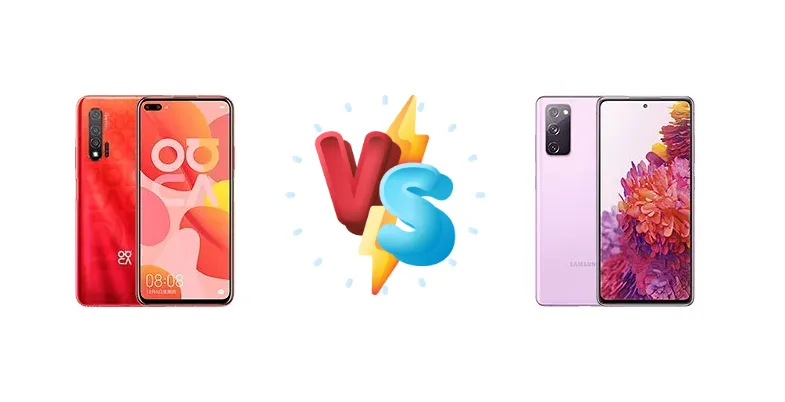
|
🏆 Quick Verdict
For the average user prioritizing raw performance and 5G connectivity, the Samsung Galaxy S20 FE 2022 is the stronger choice. Its Snapdragon 865 offers a noticeable edge in demanding tasks and gaming, while the inclusion of wireless charging and reverse wireless charging adds convenience. However, the nova 6’s faster wired charging is a significant advantage for those who prioritize speed.
| PHONES | ||
|---|---|---|
| Phone Names | Huawei nova 6 | Samsung Galaxy S20 FE 2022 |
| Network | ||
|---|---|---|
| 2G bands | GSM 850 / 900 / 1800 / 1900 | GSM 850 / 900 / 1800 / 1900 |
| 3G bands | HSDPA 800 / 850 / 900 / 1700(AWS) / 1900 / 2100 | HSDPA 850 / 900 / 1700(AWS) / 1900 / 2100 |
| 4G bands | 1, 2, 3, 4, 5, 7, 8, 18, 19, 26, 34, 38, 39, 40, 41 | LTE |
| 5G bands | - | SA/NSA/Sub6 |
| Speed | HSPA, LTE | HSPA 42.2/5.76 Mbps, LTE (5CA) Cat19 1800/200 Mbps, 5G |
| Technology | GSM / HSPA / LTE | GSM / CDMA / HSPA / EVDO / LTE / 5G |
| - | CDMA2000 1xEV-DO | |
| Launch | ||
|---|---|---|
| Announced | 2019, December. Released 2019, December | 2022, April 01 |
| Status | Discontinued | Available. Released 2022, April 01 |
| Body | ||
|---|---|---|
| Build | Glass front, glass back, aluminum frame | Glass front (Gorilla Glass 3), plastic back, aluminum frame |
| Dimensions | 162.6 x 75.7 x 8.6 mm (6.40 x 2.98 x 0.34 in) | 159.8 x 74.5 x 8.4 mm (6.29 x 2.93 x 0.33 in) |
| SIM | Nano-SIM + Nano-SIM | Nano-SIM + Nano-SIM |
| Weight | 197 g (6.95 oz) | 190 g (6.70 oz) |
| - | IP68 dust/water resistant (up to 1.5m for 30 min) | |
| Display | ||
|---|---|---|
| Protection | - | Corning Gorilla Glass 3 |
| Resolution | 1080 x 2400 pixels, 20:9 ratio (~401 ppi density) | 1080 x 2400 pixels, 20:9 ratio (~405 ppi density) |
| Size | 6.57 inches, 104.2 cm2 (~84.7% screen-to-body ratio) | 6.5 inches, 102.0 cm2 (~85.7% screen-to-body ratio) |
| Type | IPS LCD | Super AMOLED, 120Hz, HDR10+ |
| - | Always-on display | |
| Platform | ||
|---|---|---|
| CPU | Octa-core (2x2.86 GHz Cortex-A76 & 2x2.09 GHz Cortex-A76 & 4x1.86 GHz Cortex-A55) | Octa-core (1x2.84 GHz Cortex-A77 & 3x2.42 GHz Cortex-A77 & 4x1.80 GHz Cortex-A55) |
| Chipset | Kirin 990 (7 nm) | Qualcomm SM8250 Snapdragon 865 5G (7 nm+) |
| GPU | Mali-G76 MP16 | Adreno 650 |
| OS | Android 10, EMUI 10, no Google Play Services | Android 12, One UI 4.1 |
| Memory | ||
|---|---|---|
| Card slot | No | microSDXC (uses shared SIM slot) |
| Internal | 128GB 8GB RAM | 128GB 6GB RAM |
| UFS 3.0 | UFS 3.1 | |
| Main Camera | ||
|---|---|---|
| Features | Laser AF, Panorama, HDR, LED flash | LED flash, auto-HDR, panorama |
| Triple | 40 MP, f/1.8, 27mm (wide), 1/1.7", PDAF 8 MP, f/2.4, 80mm (telephoto), 1/4.0", PDAF, OIS, 3x optical zoom 8 MP, f/2.4, 16mm (ultrawide) | 12 MP, f/1.8, 26mm (wide), 1/1.76", 1.8µm, dual pixel PDAF, OIS 8 MP, f/2.4, 76mm (telephoto), 1/4.5", 1.0µm, PDAF, OIS, 3x optical zoom 12 MP, f/2.2, 13mm, 123˚ (ultrawide), 1/3.0", 1.12µm |
| Video | 4K@30/60fps, 1080p@30fps, 720p@960fps, (gyro-EIS) | 4K@30/60fps, 1080p@30/60fps, gyro-EIS |
| Selfie camera | ||
|---|---|---|
| Dual | 32 MP, f/2.0, 26mm (wide), 1/2.8", 0.8µm 8 MP, f/2.2, 17mm (ultrawide) | - |
| Features | HDR | HDR |
| Single | - | 32 MP, f/2.2, 26mm (wide), 1/2.74", 0.8µm |
| Video | 4K@30fps | 4K@30/60fps, 1080p@30/60fps, gyro-EIS |
| Sound | ||
|---|---|---|
| 3.5mm jack | Yes | No |
| 35mm jack | Yes | No |
| Loudspeaker | Yes | Yes, with stereo speakers |
| - | 32-bit/384kHz audio Tuned by AKG | |
| Comms | ||
|---|---|---|
| Bluetooth | 5.1, A2DP, LE | 5.0, A2DP, LE |
| NFC | Yes | Yes |
| Positioning | GPS (L1+L5), GLONASS (L1), BDS (B1), GALILEO (E1+E5a), QZSS (L1+L5) | GPS, GLONASS, BDS, GALILEO |
| Radio | No | No |
| USB | USB Type-C 2.0, OTG | USB Type-C 3.2, OTG |
| WLAN | Wi-Fi 802.11 a/b/g/n/ac, dual-band, Wi-Fi Direct | Wi-Fi 802.11 a/b/g/n/ac/6, dual-band, Wi-Fi Direct |
| Features | ||
|---|---|---|
| Sensors | Fingerprint (side-mounted), accelerometer, gyro, proximity, compass | Fingerprint (under display, optical), accelerometer, gyro, compass |
| - | Virtual proximity sensing Bixby natural language commands and dictation Samsung Pay (Visa, MasterCard certified) | |
| Battery | ||
|---|---|---|
| Charging | 40W wired, 70% in 30 min | 25W wired, PD3.0 15W wireless (Qi) 4.5W reverse wireless |
| Type | Li-Po 4100 mAh, non-removable | Li-Ion 4500 mAh |
| Misc | ||
|---|---|---|
| Colors | Black, Blue, Red, Provence | Cloud White, Cloud Lavender, Cloud Navy |
| Models | WLZ-AL10, WLZ-TL10 | SM-G781NK, SM-G781NK22 |
| Price | - | About 520 EUR |
Huawei nova 6
- Significantly faster 40W wired charging
- Competitive Kirin 990 performance
- Potentially more affordable price point
- Lacks 5G connectivity (depending on region)
- Huawei ecosystem limitations (Google services)
- No wireless charging
Samsung Galaxy S20 FE 2022
- Powerful Snapdragon 865 5G chipset
- Wireless charging and reverse wireless charging
- Established Android ecosystem with Google services
- Slower 25W wired charging
- Potentially higher price
- Can experience thermal throttling under sustained load
Display Comparison
While display specifications aren't provided, both phones likely feature AMOLED panels common in this price bracket. However, the S20 FE 2022, being a flagship-adjacent device, likely boasts a higher peak brightness and potentially a 120Hz refresh rate, offering a smoother visual experience. The nova 6, while still offering a vibrant display, may prioritize color accuracy and power efficiency. Bezels are expected to be minimal on both, reflecting current design trends.
Camera Comparison
Without detailed sensor information, it’s difficult to make definitive claims. However, the S20 FE 2022, given its positioning, likely features a larger primary sensor with optical image stabilization (OIS). The Kirin 990’s ISP is capable, but the Snapdragon 865’s ISP, coupled with Samsung’s image processing algorithms, generally delivers more consistent and dynamic range in challenging lighting conditions. The presence of a telephoto lens on the S20 FE 2022 provides versatility lacking in many mid-range phones, while the nova 6 may focus on AI-powered scene optimization.
Performance
The core difference lies in the chipsets. The Samsung Galaxy S20 FE 2022’s Snapdragon 865 5G (7nm+) benefits from a slightly refined manufacturing process compared to the Huawei nova 6’s Kirin 990 (7nm). The Snapdragon 865 utilizes a Cortex-A77 prime core clocked at 2.84 GHz, while the Kirin 990 employs a Cortex-A76 core at 2.86 GHz. While clock speeds are similar, the architectural improvements in the A77 and the Snapdragon’s Adreno 650 GPU give the S20 FE 2022 a clear advantage in graphics-intensive tasks and sustained performance. Both utilize LPDDR4X RAM, but the Snapdragon’s optimized memory controller further enhances its performance lead.
Battery Life
The Huawei nova 6’s 40W wired charging is a standout feature, capable of reaching 70% charge in just 30 minutes. The Samsung Galaxy S20 FE 2022’s 25W charging, while respectable, is significantly slower. However, the S20 FE 2022 compensates with 15W wireless charging (Qi standard) and 4.5W reverse wireless charging, offering added convenience. Battery capacity isn’t specified, but the S20 FE 2022’s more efficient chipset may offset a potentially smaller battery size, resulting in comparable real-world battery life.
Buying Guide
Buy the Huawei nova 6 if you need exceptionally fast 40W wired charging and are comfortable with the potential limitations of the Huawei ecosystem. Buy the Samsung Galaxy S20 FE 2022 if you prefer a more established Android experience, benefit from the superior processing power of the Snapdragon 865 for gaming and multitasking, and value the convenience of wireless charging and 5G connectivity.