
Huawei nova 6 5G vs Samsung Galaxy S20 5G UW: A Detailed Performance and Feature Comparison
| Phones Images | |||||
|---|---|---|---|---|---|
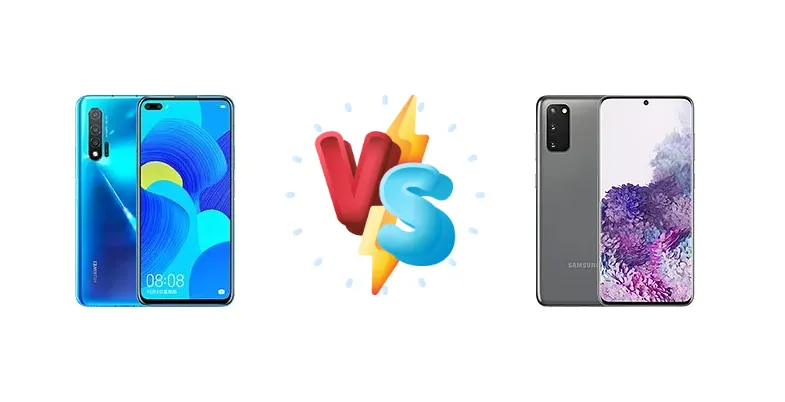
|
🏆 Quick Verdict
For the average user prioritizing raw performance and future-proofing, the Samsung Galaxy S20 5G UW is the better choice, thanks to the Snapdragon 865. However, the Huawei nova 6 5G offers significantly faster 40W charging and a competitive experience at a potentially lower price point, making it ideal for users who value speed of refueling.
| PHONES | ||
|---|---|---|
| Phone Names | Huawei nova 6 5G | Samsung Galaxy S20 5G UW |
| Network | ||
|---|---|---|
| 2G bands | GSM 850 / 900 / 1800 / 1900 | GSM 850 / 900 / 1800 / 1900 |
| 3G bands | HSDPA 800 / 850 / 900 / 1700(AWS) / 1900 / 2100 | HSDPA 850 / 900 / 1700(AWS) / 1900 / 2100 |
| 4G bands | 1, 2, 3, 4, 5, 7, 8, 12, 17, 18, 19, 26, 34, 38, 39, 40, 41 | 2, 3, 4, 5, 7, 8, 13, 18, 19, 20, 26, 28, 48, 66 |
| 5G bands | 1, 3, 41, 77, 78, 79 SA/NSA | 260, 261 mmWave |
| Speed | HSPA, LTE, 5G (2+ Gbps DL) | HSPA 42.2/5.76 Mbps, LTE (7CA) Cat20 2000/200 Mbps, 5G (5+ Gbps DL) |
| Technology | GSM / HSPA / LTE / 5G | GSM / CDMA / HSPA / EVDO / LTE / 5G |
| - | CDMA2000 1xEV-DO | |
| Launch | ||
|---|---|---|
| Announced | 2019, December. Released 2019, December | 2020, May 20 |
| Status | Discontinued | Available. Released 2020, June 04 |
| Body | ||
|---|---|---|
| Build | Glass front, glass back, aluminum frame | Glass front (Gorilla Glass 6), glass back (Gorilla Glass 6), aluminum frame |
| Dimensions | 162.7 x 75.8 x 9 mm (6.41 x 2.98 x 0.35 in) | 151.7 x 69.1 x 8.1 mm (5.97 x 2.72 x 0.32 in) |
| SIM | Nano-SIM + Nano-SIM | Nano-SIM (pre-installed) |
| Weight | 212 g (7.48 oz) | 168.1 g (5.93 oz) |
| - | IP68 dust/water resistant (up to 1.5m for 30 min) | |
| Display | ||
|---|---|---|
| Protection | - | Corning Gorilla Glass 6 |
| Resolution | 1080 x 2400 pixels, 20:9 ratio (~401 ppi density) | 1440 x 3200 pixels, 20:9 ratio (~566 ppi density) |
| Size | 6.57 inches, 104.2 cm2 (~84.5% screen-to-body ratio) | 6.2 inches, 92.8 cm2 (~88.5% screen-to-body ratio) |
| Type | IPS LCD | Dynamic AMOLED 2X, 120Hz, HDR10+, 1200 nits (peak) |
| - | Always-on display 120Hz@FHD/60Hz@QHD refresh rate | |
| Platform | ||
|---|---|---|
| CPU | Octa-core (2x2.86 GHz Cortex-A76 & 2x2.09 GHz Cortex-A76 & 4x1.86 GHz Cortex-A55) | Octa-core (1x2.84 GHz Cortex-A77 & 3x2.42 GHz Cortex-A77 & 4x1.80 GHz Cortex-A55) |
| Chipset | Kirin 990 (7 nm) | Qualcomm SM8250 Snapdragon 865 5G (7 nm+) |
| GPU | Mali-G76 MP16 | Adreno 650 |
| OS | Android 10, EMUI 10 | Android 10, One UI 2.5 |
| Memory | ||
|---|---|---|
| Card slot | No | No |
| Internal | 128GB 8GB RAM, 256GB 8GB RAM | 128GB 8GB RAM |
| UFS 3.0 | UFS 3.0 | |
| Main Camera | ||
|---|---|---|
| Features | Laser AF, Panorama, HDR, LED flash | LED flash, auto-HDR, panorama |
| Triple | 40 MP, f/1.8, 27mm (wide), 1/1.7", PDAF 8 MP, f/2.4, 80mm (telephoto), 1/4.0", PDAF, OIS, 3x optical zoom 8 MP, f/2.4, 16mm (ultrawide) | 12 MP, f/1.8, 26mm (wide), 1/1.76", 1.8µm, dual pixel PDAF, OIS 64 MP, f/2.0, 29mm (telephoto), 1/1.72", 0.8µm, PDAF, OIS, 1.1x optical zoom, 3x hybrid zoom 12 MP, f/2.2, 13mm, 120˚ (ultrawide), 1/2.55" 1.4µm, Super Steady video |
| Video | 4K@30/60fps, 1080p@30fps, 720p@960fps, (gyro-EIS) | 8K@24fps, 4K@30/60fps, 1080p@30/60/240fps, 720p@960fps, HDR10+, stereo sound rec., gyro-EIS & OIS |
| Selfie camera | ||
|---|---|---|
| Dual | 32 MP, f/2.0, 26mm (wide), 1/2.8", 0.8µm, PDAF 8 MP, f/2.2, 17mm (ultrawide) | - |
| Features | HDR | HDR |
| Single | - | 10 MP, f/2.2, 26mm (wide), 1/3.24", 1.22µm, dual pixel PDAF |
| Video | 4K@30fps | 4K@30/60fps, 1080p@30fps |
| Sound | ||
|---|---|---|
| 3.5mm jack | Yes | No |
| 35mm jack | Yes | No |
| Loudspeaker | Yes | Yes, with stereo speakers |
| - | 32-bit/384kHz audio Tuned by AKG | |
| Comms | ||
|---|---|---|
| Bluetooth | 5.1, A2DP, LE | 5.0, A2DP, LE |
| NFC | Yes | Yes |
| Positioning | GPS (L1+L5), GLONASS (L1), BDS (B1), GALILEO (E1+E5a), QZSS (L1+L5) | GPS, GLONASS, BDS, GALILEO |
| Radio | No | FM radio |
| USB | USB Type-C 2.0, OTG | USB Type-C 3.2, OTG |
| WLAN | Wi-Fi 802.11 a/b/g/n/ac, dual-band, Wi-Fi Direct | Wi-Fi 802.11 a/b/g/n/ac/6, dual-band, Wi-Fi Direct |
| Features | ||
|---|---|---|
| Sensors | Fingerprint (side-mounted), accelerometer, gyro, proximity, compass | Fingerprint (under display, ultrasonic), accelerometer, gyro, proximity, compass, barometer |
| - | Samsung DeX, Samsung Wireless DeX (desktop experience support) ANT+ Bixby natural language commands and dictation Samsung Pay (Visa, MasterCard certified) | |
| Battery | ||
|---|---|---|
| Charging | 40W wired, 70% in 30 min | 25W wired, PD3.0 15W wireless (Qi) 4.5W reverse wireless |
| Type | Li-Po 4200 mAh, non-removable | Li-Ion 4000 mAh |
| Misc | ||
|---|---|---|
| Colors | Black, Blue, Red, Provence | Cloud Pink, Cosmic Grey, Cloud White |
| Models | WLZ-AN00, WLZ-TN00 | SM-G981V |
| Price | - | About 880 EUR |
| SAR | - | 0.91 W/kg (head) 1.05 W/kg (body) |
Huawei nova 6 5G
- Significantly faster 40W wired charging
- Potentially more affordable price point
- Competitive performance for the price
- Kirin 990 chipset is outperformed by Snapdragon 865
- Lacks wireless charging and reverse wireless charging
Samsung Galaxy S20 5G UW
- Superior performance with Snapdragon 865
- Wireless charging and reverse wireless charging capabilities
- Access to mmWave 5G (UW) networks
- Slower 25W wired charging
- Higher price point
- Potential for thermal throttling under sustained load
Display Comparison
While specific display specs aren't provided, both devices likely feature OLED panels given their market positioning. The S20 5G UW, being a flagship, likely boasts a higher peak brightness and potentially a higher resolution. However, without knowing the nova 6 5G’s panel characteristics, a definitive comparison is difficult. The S20 5G UW’s display benefits from Samsung’s industry-leading color accuracy and potentially a 120Hz refresh rate (depending on the variant), offering a smoother visual experience.
Camera Comparison
Without detailed camera specs, a direct comparison is limited. However, Samsung flagships typically prioritize image processing and sensor size. The S20 5G UW likely features a larger primary sensor and more sophisticated image stabilization (OIS) than the nova 6 5G. While the nova 6 5G may offer competitive image quality in good lighting, the S20 5G UW’s Snapdragon ISP and advanced algorithms will likely deliver superior low-light performance and dynamic range. The absence of details on the nova 6 5G’s camera array suggests a focus on versatility rather than outright image quality.
Performance
The core difference lies in the chipsets. The Samsung Galaxy S20 5G UW’s Qualcomm Snapdragon 865 (7nm+) demonstrably outperforms the Huawei nova 6 5G’s Kirin 990 (7nm) in CPU and GPU benchmarks. The Snapdragon 865 utilizes newer Cortex-A77 cores in its prime cluster, offering a performance edge. While both chips are 7nm, the ‘+’ designation on the Snapdragon indicates process refinements for improved efficiency and clock speeds. The S20 5G UW also benefits from potentially faster LPDDR5 RAM, further enhancing performance. This translates to smoother multitasking, faster app loading times, and superior gaming performance on the Samsung device.
Battery Life
The Huawei nova 6 5G’s 40W wired charging is a significant advantage over the Samsung Galaxy S20 5G UW’s 25W charging. The 40W charging can deliver a 70% charge in just 30 minutes, drastically reducing downtime. While the S20 5G UW offers 15W wireless charging and 4.5W reverse wireless charging – features absent on the nova 6 5G – the faster wired charging of the Huawei device is more impactful for daily use. The actual battery life will depend on capacity (not provided), but the charging speed difference is a key differentiator.
Buying Guide
Buy the Huawei nova 6 5G if you need exceptionally fast charging and are comfortable with the Huawei ecosystem. It’s a strong contender for users who prioritize quick power-ups and value. Buy the Samsung Galaxy S20 5G UW if you prefer a more polished software experience, the superior processing power of the Snapdragon 865, and access to mmWave 5G networks, even if it means slower charging speeds.