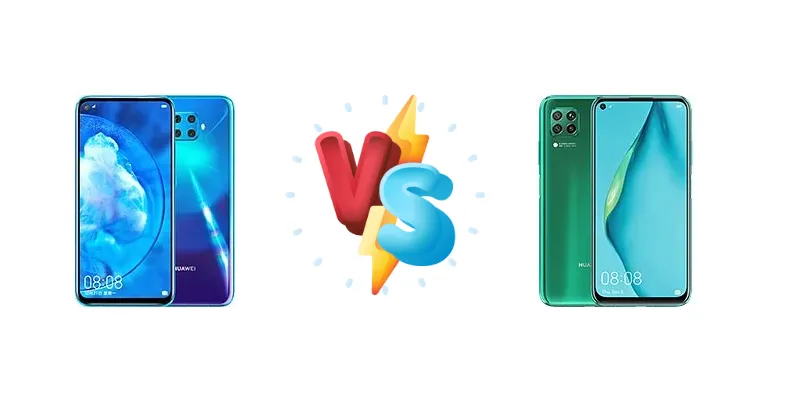
The Huawei nova series consistently delivers compelling mid-range options, but navigating the model numbers can be tricky. We're pitting the Huawei nova 5z against the nova 7i, two devices sharing the same Kirin 810 chipset, but diverging significantly in charging technology. This comparison will reveal whether the newer model's faster charging justifies a potential price premium.
🏆 Quick Verdict
For most users, the Huawei nova 7i is the superior choice. While both phones utilize the Kirin 810, the nova 7i’s 40W fast charging – capable of reaching 70% in just 30 minutes – offers a substantial convenience advantage over the nova 5z’s 20W charging. The core performance remains similar, making the charging speed the key differentiator.
| Network |
|---|
| 2G bands | GSM 850 / 900 / 1800 / 1900 | GSM 850 / 900 / 1800 / 1900 |
| 3G bands | HSDPA 800 / 850 / 900 / 1700(AWS) / 2100 | HSDPA 800 / 850 / 900 / 1700(AWS) / 2100 |
| 4G bands | 1, 3, 4, 5, 8, 19, 34, 38, 39, 40, 41 | 1, 2, 3, 4, 5, 7, 8, 18, 19, 20, 28, 34, 38, 39, 40, 41 - JNY-L21A, JNY-L01A, JNY-L21B |
| Speed | HSPA, LTE | HSPA 42.2/5.76 Mbps, LTE (2CA) Cat13 400/75 Mbps |
| Technology | GSM / CDMA / HSPA / LTE | GSM / CDMA / HSPA / LTE |
| | CDMA 800 & TD-SCDMA | 1, 2, 3, 4, 5, 7, 8, 18, 19, 28, 34, 38, 39, 40, 41 - JNY-L22A, JNY-L02A, JNY-L22B |
| Launch |
|---|
| Announced | 2019, October. Released 2019, November | 2020, January 30. Released 2020, February 14 |
| Status | Discontinued | Discontinued |
| Body |
|---|
| Build | Glass front, plastic back, plastic frame | Glass front, plastic back, plastic frame |
| Dimensions | 156.1 x 73.9 x 8.3 mm (6.15 x 2.91 x 0.33 in) | 159.2 x 76.3 x 8.7 mm (6.27 x 3.00 x 0.34 in) |
| SIM | Nano-SIM + Nano-SIM | · Nano-SIM· Nano-SIM + Nano-SIM |
| Weight | 178 g (6.28 oz) | 183 g (6.46 oz) |
| Display |
|---|
| Resolution | 1080 x 2340 pixels, 19.5:9 ratio (~412 ppi density) | 1080 x 2310 pixels (~398 ppi density) |
| Size | 6.26 inches, 96.2 cm2 (~83.4% screen-to-body ratio) | 6.4 inches, 101.4 cm2 (~83.5% screen-to-body ratio) |
| Type | IPS LCD | IPS LCD |
| Platform |
|---|
| CPU | Octa-core (2x2.27 GHz Cortex-A76 & 6x1.88 GHz Cortex-A55) | Octa-core (2x2.27 GHz Cortex-A76 & 6x1.88 GHz Cortex-A55) |
| Chipset | Kirin 810 (7 nm) | Kirin 810 (7 nm) |
| GPU | Mali-G52 MP6 | Mali-G52 MP6 |
| OS | Android 9.0 (Pie), EMUI 9.1 | Android 10, EMUI 10, no Google Play Services |
| Memory |
|---|
| Card slot | Nano Memory (uses shared SIM slot) | Nano Memory (uses shared SIM slot) |
| Internal | 64GB 6GB RAM, 128GB 6GB RAM | 128GB 8GB RAM |
| | UFS 2.1 | UFS 2.1 |
| Main Camera |
|---|
| Features | LED flash, HDR, panorama | LED flash, HDR, panorama |
| Quad | 48 MP, f/1.8, 26mm (wide), 1/2.0", 0.8µm, PDAF
8 MP, f/2.4, (ultrawide)
2 MP (macro)
Auxiliary lens | 48 MP, f/1.8, 26mm (wide), 1/2.0", 0.8µm, PDAF
8 MP, f/2.4, (ultrawide)
2 MP (macro)
Auxiliary lens |
| Video | 4K@30fps, 1080p@30fps | 1080p@30fps |
| Selfie camera |
|---|
| Features | HDR | HDR |
| Single | 32 MP, f/2.0, 26mm (wide), 1/2.8", 0.8µm | 16 MP, f/2.0, (wide), 1/3.06", 1.0µm |
| Video | 1080p@30fps | 1080p@30fps |
| Sound |
|---|
| 3.5mm jack | Yes | Yes |
| 35mm jack | Yes | Yes |
| Loudspeaker | Yes | Yes |
| Comms |
|---|
| Bluetooth | 5.0, A2DP, LE | 5.1, A2DP, LE |
| NFC | No | No |
| Positioning | GPS, GLONASS, GALILEO, QZSS, BDS | GPS, GLONASS, GALILEO, BDS, QZSS |
| Radio | FM radio | FM radio (market/region dependent) |
| USB | USB Type-C 2.0, OTG | USB Type-C 2.0, OTG |
| WLAN | Wi-Fi 802.11 a/b/g/n/ac, dual-band, Wi-Fi Direct | Wi-Fi 802.11 a/b/g/n/ac, dual-band, Wi-Fi Direct |
| Features |
|---|
| Sensors | Fingerprint (rear-mounted), accelerometer, gyro, proximity, compass | Fingerprint (side-mounted), accelerometer, proximity, compass |
| Battery |
|---|
| Charging | 20W wired | 40W wired, 70% in 30 min |
| Type | Li-Po 4000 mAh, non-removable | Li-Po 4200 mAh |
| Misc |
|---|
| Colors | Black, Aurora, Emerald Green | Midnight Black, Crush Green, Sakura Pink |
| Models | SPN-AL00, SPN-TL00 | JNY-L22B, JNY-L21A, JNY-L01A, JNY-L21B, JNY-L22A, JNY-L02A, JNY-LX2 |
| Price | About 200 EUR | About 240 EUR |
Huawei nova 5z
- Potentially lower price point
- Similar CPU performance to nova 7i
- Reliable Kirin 810 chipset
- Significantly slower 20W charging
- Likely less efficient power management
- May have a less refined software experience
Huawei nova 7i
- 40W fast charging (70% in 30 min)
- More convenient charging experience
- Potentially improved thermal management
- Likely a higher price tag
- Similar CPU performance to nova 5z
- May not offer significant camera improvements
Display Comparison
Both the nova 5z and 7i likely feature similar LCD panels, typical for their price bracket. While specific details like peak brightness and color gamut coverage aren't provided, the focus here isn't on display innovation. The absence of high refresh rates is expected. Bezels are likely comparable, prioritizing affordability over an edge-to-edge design. The user experience will be similar in terms of visual fidelity, with neither device offering a standout display feature.
Camera Comparison
Without detailed sensor information, a direct camera comparison is limited. Both phones likely feature a multi-camera setup, but the quality will depend on the primary sensor and image processing algorithms. The inclusion of a 2MP macro camera on either device is likely a marketing feature with limited real-world utility. Image processing style will be a key differentiator, with Huawei typically favoring vibrant, saturated colors. The absence of Optical Image Stabilization (OIS) is probable in this price range, relying on software stabilization instead.
Performance
The core of both devices is the Kirin 810 (7nm). This chipset features an octa-core configuration with 2x 2.27 GHz Cortex-A76 cores and 6x 1.88 GHz Cortex-A55 cores. This means CPU performance will be virtually identical between the two. The GPU performance will also be nearly indistinguishable. However, sustained performance could differ slightly based on thermal design, which isn't specified. Both phones likely utilize similar RAM configurations, impacting multitasking capabilities. The 7nm process node ensures reasonable power efficiency, but neither device is positioned as a gaming powerhouse.
Battery Life
The battery capacity isn't specified, but the key difference lies in charging speed. The nova 7i’s 40W wired charging is a game-changer, promising a 70% charge in just 30 minutes. This drastically reduces downtime compared to the nova 5z’s 20W charging. While a larger battery capacity on the 5z might offer slightly longer overall runtime, the convenience of the 7i’s faster charging will be more impactful for many users. The 7i’s charging speed effectively mitigates any potential battery capacity disadvantage.
Buying Guide
Buy the Huawei nova 5z if you prioritize finding the lowest possible price for a capable Kirin 810-powered device and aren't heavily reliant on rapid charging. Buy the Huawei nova 7i if you value significantly faster charging speeds, minimizing downtime and maximizing usability, even if it means spending a bit more upfront. The 7i is ideal for users who frequently find themselves needing a quick power boost throughout the day.
Frequently Asked Questions
❓ Is the 40W charging on the nova 7i compatible with all USB-C chargers?
While the nova 7i supports 40W charging, achieving that speed requires a compatible Huawei SuperCharge charger. Using a standard USB-C Power Delivery (PD) charger will still charge the device, but at a slower rate. Huawei often implements proprietary charging protocols for optimal speed.
❓ Will I notice a significant performance difference in gaming between the nova 5z and nova 7i?
Given both phones utilize the same Kirin 810 chipset, the CPU and GPU performance will be nearly identical in gaming. However, the nova 7i *might* sustain higher frame rates for longer periods due to potentially improved thermal management, but this is speculative without detailed thermal testing.
❓ Does the nova 7i support 5G connectivity?
Neither the nova 5z nor the nova 7i support 5G connectivity. Both devices are 4G LTE only, reflecting their mid-range positioning and release timeframe.
❓ How does Huawei's EMUI software affect the user experience on these devices?
Huawei's EMUI software is known for its customization options and feature set. However, it also includes pre-installed apps and a different user interface compared to stock Android. Updates may also be less frequent due to the ongoing geopolitical situation.