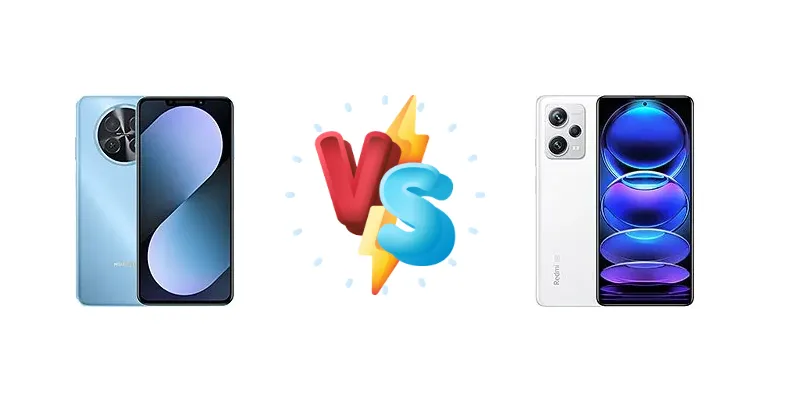
The mid-range smartphone market is fiercely competitive. The Huawei nova 14i offers a solid foundation with a familiar Qualcomm chipset, while the Xiaomi Redmi Note 12 Pro+ aggressively targets the fast-charging and camera-focused user. This comparison dissects their key differences to determine which device delivers the best overall experience.
🏆 Quick Verdict
For the average user prioritizing rapid charging and a more powerful processor, the Xiaomi Redmi Note 12 Pro+ is the clear winner. Its 120W charging and Dimensity 1080 chipset offer a significant advantage, despite a potentially higher price point. However, the nova 14i remains a viable option for budget-conscious buyers.
| Network |
|---|
| 2G bands | GSM 850 / 900 / 1800 / 1900 | GSM 850 / 900 / 1800 / 1900 - SIM 1 & SIM 2 |
| 3G bands | HSDPA 850 / 900 / 1700(AWS) / 1900 / 2100 | HSDPA 800 / 850 / 900 / 1900 / 2100 |
| 4G bands | 1, 2, 3, 4, 5, 7, 8, 13, 20, 26, 28, 38, 40, 41, 66 | 1, 3, 5, 8, 19, 34, 38, 39, 40, 41 - International, China |
| 5G bands | - | 1, 3, 5, 8, 28, 38, 40, 41, 77, 78 SA/NSA - International |
| Speed | HSPA, LTE | HSPA, LTE-A (CA), 5G |
| Technology | GSM / HSPA / LTE | GSM / CDMA / HSPA / EVDO / LTE / 5G |
| | - | 1, 3, 5, 8, 28, 38, 41, 77, 78 SA/NSA - China |
| Launch |
|---|
| Announced | 2025, October 01 | 2022, October 27 |
| Status | Available. Released 2025, October 08 | Available. Released 2022, November 01 |
| Body |
|---|
| Build | - | Glass front (Gorilla Glass 5), glass back |
| Dimensions | 171.6 x 79.9 x 8.9 mm (6.76 x 3.15 x 0.35 in) | 162.9 x 76 x 8.9 mm (6.41 x 2.99 x 0.35 in) |
| SIM | Nano-SIM + Nano-SIM | Dual SIM (Nano-SIM, dual stand-by) |
| Weight | 216 g (7.62 oz) | 208.4 g (7.34 oz) |
| | - | IP53, dust and splash resistant |
| Display |
|---|
| Protection | - | Corning Gorilla Glass 5 |
| Resolution | 1080 x 2376 pixels (~376 ppi density) | 1080 x 2400 pixels, 20:9 ratio (~395 ppi density) |
| Size | 6.95 inches, 117.4 cm2 (~85.6% screen-to-body ratio) | 6.67 inches, 107.4 cm2 (~86.8% screen-to-body ratio) |
| Type | IPS LCD, 90Hz | OLED, 1B colors, 120Hz, Dolby Vision, HDR10+, 500 nits (typ), 900 nits (HBM) |
| Platform |
|---|
| CPU | Octa-core (4x2.4 GHz Cortex-A73 & 4x1.9 GHz Cortex-A53) | Octa-core (2x2.6 GHz Cortex-A78 & 6x2.0 GHz Cortex-A55) |
| Chipset | Qualcomm Snapdragon 680 4G (6 nm) | Mediatek MT6877V Dimensity 1080 (6 nm) |
| GPU | Adreno 610 | Mali-G68 MC4 |
| OS | EMUI 14.2 | Android 12, MIUI 13 |
| Memory |
|---|
| Card slot | No | No |
| Internal | 128GB 8GB RAM, 256GB 8GB RAM | 256GB 8GB RAM, 256GB 12GB RAM |
| | - | UFS 2.2 |
| Main Camera |
|---|
| Dual | 50 MP, f/1.8, 26mm (wide), PDAF
Auxiliary lens | - |
| Features | LED flash, HDR, panorama | Dual-LED dual-tone flash, HDR, panorama |
| Triple | - | 200 MP, f/1.7, 24mm (wide), 1/1.4", 0.56µm, PDAF, OIS
8 MP, f/2.2, 120˚ (ultrawide), 1/4", 1.12µm
2 MP, f/2.4, (macro) |
| Video | 1080p@30fps | 4K@30fps, 1080p@30/60/120fps, 720p@960fps |
| Selfie camera |
|---|
| Features | - | HDR |
| Single | 8 MP, f/2.0, (wide) | 16 MP, f/2.5, (wide), 1/3.06", 1.0µm |
| Video | 1080p@30fps | 1080p@30/60fps |
| Sound |
|---|
| 3.5mm jack | - | Yes |
| 35mm jack | No | - |
| Loudspeaker | Yes, with stereo speakers | Yes, with stereo speakers |
| | - | 24-bit/192kHz audio |
| Comms |
|---|
| Bluetooth | 5.0, A2DP, LE | 5.2, A2DP, LE |
| Infrared port | - | Yes |
| NFC | No | Yes (market/region dependent) |
| Positioning | GPS, GLONASS, GALILEO, BDS, QZSS | GPS (L1), GLONASS (G1), BDS (B1I+B1c), GALILEO (E1), QZSS (L1) |
| Radio | No | No |
| USB | USB Type-C 2.0 | USB Type-C 2.0, OTG |
| WLAN | Wi-Fi 802.11 a/b/g/n/ac, dual-band | Wi-Fi 802.11 a/b/g/n/ac/6, dual-band, Wi-Fi Direct |
| Features |
|---|
| Sensors | Fingerprint (side-mounted), accelerometer, proximity, compass | Fingerprint (side-mounted), accelerometer, proximity, gyro, compass |
| Battery |
|---|
| Charging | 22.5W wired | 120W wired, PD3.0, 100% in 19 min (advertised) |
| Type | Li-Po 7000 mAh | Li-Po 5000 mAh, non-removable |
| Misc |
|---|
| Colors | Black, Blue | Arctic White, Iceberg Blue, Obsidian Black, Trend edition |
| Models | STG-LX2 | 22101316UCP, 22101316UG |
| Price | About 170 EUR | $ 348.00 / £ 439.00 / € 399.00 / ₹ 29,949 |
| Tests |
|---|
| Battery life | - |
Endurance rating 88h
|
| Camera | - |
Photo / Video |
| Display | - |
Contrast ratio: Infinite (nominal) |
| Loudspeaker | - |
-26.7 LUFS (Good)
|
| Performance | - |
AnTuTu: 498710 (v9)
GeekBench: 2208 (v5.1), 2372 (v6)
GFXBench: 22fps (ES 3.1 onscreen) |
Huawei nova 14i
- Potentially more affordable price point
- Reliable Qualcomm Snapdragon 680 chipset
- Familiar software experience (depending on region)
- Significantly slower charging speed (22.5W)
- Less powerful processor compared to the Dimensity 1080
- Likely inferior camera performance
Xiaomi Redmi Note 12 Pro+
- Blazing-fast 120W charging
- More powerful Mediatek Dimensity 1080 chipset
- Potentially superior camera system with high resolution sensor
- Potentially higher price
- Mediatek chipset may have software optimization concerns (region dependent)
- May run warmer under sustained load
Display Comparison
The Redmi Note 12 Pro+ boasts an unspecified, but likely high-resolution display with an 'Infinite' contrast ratio, suggesting a vibrant viewing experience. While the nova 14i’s display specs are missing, it’s reasonable to assume a standard LCD panel. The lack of LTPO or high refresh rate information for either device suggests neither prioritizes advanced display features. The Redmi’s contrast ratio hints at a superior visual experience, particularly with darker content.
Camera Comparison
The Redmi Note 12 Pro+ is expected to feature a high-resolution camera system, potentially including a 200MP main sensor (based on market positioning). While the nova 14i’s camera specs are unavailable, it’s likely to feature a more modest setup. The Redmi’s potential for larger sensor size and advanced image processing algorithms, coupled with OIS (Optical Image Stabilization), will result in superior low-light performance and sharper images. The absence of detailed camera information for the nova 14i makes a direct comparison difficult, but the Redmi is positioned as a camera-centric device.
Performance
The core difference lies in the chipsets. The Redmi Note 12 Pro+ utilizes the Mediatek Dimensity 1080 (6nm), featuring a more modern CPU architecture with 2x2.6 GHz Cortex-A78 cores and 6x2.0 GHz Cortex-A55 cores. This contrasts with the nova 14i’s Qualcomm Snapdragon 680 (6nm) which employs older Cortex-A73 cores clocked at 2.4 GHz alongside Cortex-A53 cores at 1.9 GHz. The Dimensity 1080’s architecture translates to significantly better multi-core performance and improved efficiency, benefiting demanding tasks like gaming and video editing. The Redmi’s likely use of faster LPDDR4X or LPDDR5 RAM further enhances its performance edge.
Battery Life
The Redmi Note 12 Pro+’s 120W wired charging is a game-changer, advertised to reach 100% in just 19 minutes. This drastically reduces downtime compared to the nova 14i’s 22.5W charging. While the Redmi’s battery capacity is unknown, the ultra-fast charging mitigates the impact of a potentially smaller battery. The Redmi Note 12 Pro+ also boasts an endurance rating of 88h, suggesting optimized power management. The nova 14i, with its slower charging, will require significantly longer to fully replenish.
Buying Guide
Buy the Huawei nova 14i if you need a reliable, everyday smartphone with a focus on affordability and a familiar Qualcomm platform. It’s ideal for users who prioritize a stable experience over bleeding-edge performance. Buy the Xiaomi Redmi Note 12 Pro+ if you prefer blazing-fast charging, a more capable processor for gaming and multitasking, and a potentially more versatile camera system. This phone is geared towards power users and those who value convenience.
Frequently Asked Questions
❓ Does the Dimensity 1080 in the Redmi Note 12 Pro+ get noticeably warmer than the Snapdragon 680 during extended gaming sessions?
The Dimensity 1080 is a more powerful chip, and therefore generates more heat under load. While Xiaomi likely implements thermal management solutions, users may experience some degree of warming during prolonged gaming. The Snapdragon 680, being less powerful, will generally run cooler, but at the cost of performance.
❓ Is the 22.5W charging on the nova 14i sufficient for typical daily use, or will I find myself frequently needing to top up the battery?
22.5W charging is relatively slow by today's standards. While sufficient for overnight charging, users who heavily utilize their phone throughout the day may find themselves needing to top up the battery more frequently compared to the Redmi Note 12 Pro+ with its 120W charging.
❓ How does the software experience differ between Huawei's EMUI (or HarmonyOS) and Xiaomi's MIUI on these devices?
Huawei's software (EMUI or HarmonyOS, depending on region) is known for its customization options and focus on security, but may lack full Google Mobile Services in some markets. Xiaomi's MIUI is also highly customizable and feature-rich, but can sometimes be criticized for pre-installed bloatware and aggressive battery management.
❓ Given the lack of detailed camera specs for the nova 14i, is it a reasonable assumption that the Redmi Note 12 Pro+ will offer significantly better image quality in low-light conditions?
Yes, it's a reasonable assumption. The Redmi Note 12 Pro+ is expected to feature a larger sensor and potentially OIS, both of which are crucial for capturing more light and reducing blur in low-light scenarios. Without comparable specs for the nova 14i, it's difficult to make a precise comparison, but the Redmi is positioned as a camera-focused device.