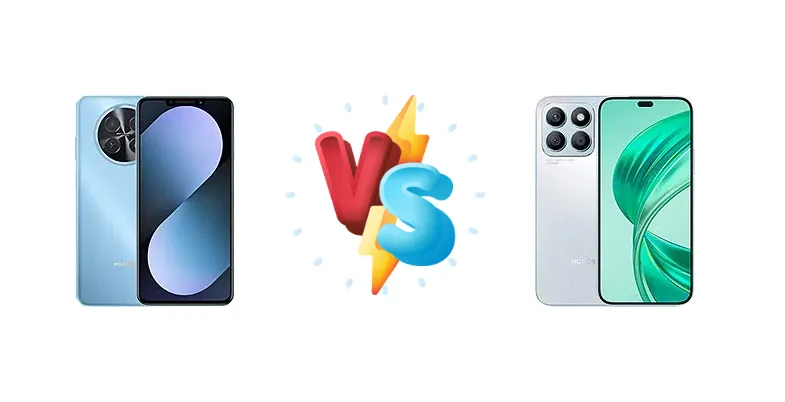
Both the Huawei nova 14i and the Honor X8b target the competitive budget smartphone market, relying on the Qualcomm Snapdragon 680 to deliver a smooth experience. However, despite sharing the same chipset, key differences in charging speed and potential software optimizations create a compelling head-to-head. This comparison dissects these nuances to determine which device offers the best value.
🏆 Quick Verdict
For the average user prioritizing quick top-ups and potentially faster overall usability, the Honor X8b emerges as the winner. Its 35W charging significantly outperforms the nova 14i’s 22.5W, reducing downtime. While both phones share the same core processing power, the X8b’s charging advantage is a practical benefit in daily use.
| Network |
|---|
| 2G bands | GSM 850 / 900 / 1800 / 1900 | GSM 850 / 900 / 1800 / 1900 |
| 3G bands | HSDPA 850 / 900 / 1700(AWS) / 1900 / 2100 | HSDPA 850 / 900 / 1900 / 2100 |
| 4G bands | 1, 2, 3, 4, 5, 7, 8, 13, 20, 26, 28, 38, 40, 41, 66 | LTE |
| Speed | HSPA, LTE | HSPA, LTE |
| Technology | GSM / HSPA / LTE | GSM / HSPA / LTE |
| Launch |
|---|
| Announced | 2025, October 01 | 2023, December 14 |
| Status | Available. Released 2025, October 08 | Available. Released 2023, December 22 |
| Body |
|---|
| Dimensions | 171.6 x 79.9 x 8.9 mm (6.76 x 3.15 x 0.35 in) | 161.1 x 74.6 x 6.8 mm (6.34 x 2.94 x 0.27 in) |
| SIM | Nano-SIM + Nano-SIM | Nano-SIM + Nano-SIM |
| Weight | 216 g (7.62 oz) | 166 g (5.86 oz) |
| Display |
|---|
| Resolution | 1080 x 2376 pixels (~376 ppi density) | 1080 x 2412 pixels, 20:9 ratio (~394 ppi density) |
| Size | 6.95 inches, 117.4 cm2 (~85.6% screen-to-body ratio) | 6.7 inches, 108.0 cm2 (~89.9% screen-to-body ratio) |
| Type | IPS LCD, 90Hz | AMOLED, 90Hz, 1200 nits (HBM), 2000 nits (peak) |
| Platform |
|---|
| CPU | Octa-core (4x2.4 GHz Cortex-A73 & 4x1.9 GHz Cortex-A53) | Octa-core (4x2.4 GHz Kryo 265 Gold & 4x1.9 GHz Kryo 265 Silver) |
| Chipset | Qualcomm Snapdragon 680 4G (6 nm) | Qualcomm SM6225 Snapdragon 680 4G (6 nm) |
| GPU | Adreno 610 | Adreno 610 |
| OS | EMUI 14.2 | Android 13, MagicOS 7.2 |
| Memory |
|---|
| Card slot | No | No |
| Internal | 128GB 8GB RAM, 256GB 8GB RAM | 128GB 8GB RAM, 256GB 6GB RAM, 256GB 8GB RAM, 512GB 8GB RAM |
| Main Camera |
|---|
| Dual | 50 MP, f/1.8, 26mm (wide), PDAF
Auxiliary lens | - |
| Features | LED flash, HDR, panorama | LED flash, HDR, panorama |
| Triple | - | 108 MP, f/1.8, 24mm (wide), 1/1.67", PDAF
5 MP, f/2.2, (ultrawide)
2 MP (macro) |
| Video | 1080p@30fps | 1080p@30fps |
| Selfie camera |
|---|
| Features | - | LED flash |
| Single | 8 MP, f/2.0, (wide) | 50 MP, f/2.1, (wide) |
| Video | 1080p@30fps | 1080p@30fps |
| Sound |
|---|
| 35mm jack | No | No |
| Loudspeaker | Yes, with stereo speakers | Yes |
| Comms |
|---|
| Bluetooth | 5.0, A2DP, LE | 5.0, A2DP, LE |
| NFC | No | No |
| Positioning | GPS, GLONASS, GALILEO, BDS, QZSS | GPS, GLONASS, GALILEO, BDS |
| Radio | No | No |
| USB | USB Type-C 2.0 | USB Type-C 2.0, OTG |
| WLAN | Wi-Fi 802.11 a/b/g/n/ac, dual-band | Wi-Fi 802.11 a/b/g/n/ac, dual-band, Wi-Fi Direct |
| Features |
|---|
| Sensors | Fingerprint (side-mounted), accelerometer, proximity, compass | Fingerprint (side-mounted), accelerometer, compass |
| Battery |
|---|
| Charging | 22.5W wired | 35W wired |
| Type | Li-Po 7000 mAh | Li-Po 4500 mAh |
| Misc |
|---|
| Colors | Black, Blue | Glamorous Green, Titanium Silver, Midnight Black, Blue |
| Models | STG-LX2 | LLY-LX1, LLY-LX2, LLY-LX3 |
| Price | About 170 EUR | $ 369.00 / € 219.99 |
Huawei nova 14i
- Familiar Huawei brand and ecosystem
- Potentially more robust software features (depending on user preference)
- Competitive price point
- Slower 22.5W charging
- Potentially heavier software customization (EMUI)
- Image processing may not appeal to all users
Honor X8b
- Faster 35W charging for quicker top-ups
- Potentially cleaner software experience
- Competitive price point
- Less brand recognition compared to Huawei
- Software updates may be less frequent
- Image processing may be less vibrant than Huawei
Display Comparison
Both devices are expected to feature LCD panels, typical for this price point. While specific details like peak brightness and color gamut coverage are unavailable, the focus here isn't on display quality. The absence of high refresh rates on either device suggests a focus on power efficiency. Bezels are likely comparable, contributing minimally to differentiation.
Camera Comparison
Without detailed camera specifications, a direct comparison is challenging. Both phones likely feature a multi-camera setup with a primary sensor, an ultrawide, and potentially a macro lens. The image processing algorithms will be a key differentiator. Huawei historically emphasizes vibrant, sometimes oversaturated colors, while Honor tends towards a more natural look. Sensor size and aperture are critical factors, but absent that data, we can assume similar performance given the shared chipset's ISP capabilities. The inclusion of a 2MP macro lens on either device is largely a marketing feature with limited practical utility.
Performance
Both the Huawei nova 14i and Honor X8b utilize the Qualcomm Snapdragon 680 4G (6 nm) chipset. The CPU configuration is identical: an octa-core setup with 4x2.4 GHz Cortex-A73 and 4x1.9 GHz Cortex-A53 cores. However, Honor’s software optimizations, potentially lighter than Huawei’s EMUI, could translate to slightly smoother multitasking and app launch times. The Kryo 265 Gold and Silver cores in the X8b are Qualcomm’s branding for the same architecture as the Cortex-A73 and A53, respectively, offering no inherent performance difference. RAM configurations are likely similar, impacting multitasking capabilities equally.
Battery Life
The battery capacity is not specified, but both devices likely house batteries in the 5000mAh range, common for this segment. The critical difference lies in charging speed. The Honor X8b’s 35W wired charging is a significant advantage over the nova 14i’s 22.5W. This translates to a substantially faster 0-100% charge time, reducing downtime and improving usability. While a larger battery capacity is beneficial, the faster charging of the X8b mitigates the impact of a potentially slightly smaller battery.
Buying Guide
Buy the Huawei nova 14i if you prioritize brand familiarity within the Huawei ecosystem and are comfortable with potentially slower charging speeds. Buy the Honor X8b if you value faster charging, a more streamlined user experience (potentially due to less software customization), and are looking for the most efficient daily use experience within this price bracket.
Frequently Asked Questions
❓ Will the Snapdragon 680 in the Honor X8b handle demanding games like PUBG Mobile?
The Snapdragon 680 is capable of running PUBG Mobile, but expect to play at medium settings for a smooth experience. High settings may result in frame drops. Both phones share the same chipset, so gaming performance will be largely identical, but the X8b’s potentially better thermal management due to lighter software could prevent more throttling during extended gaming sessions.
❓ Does the Honor X8b support Google Mobile Services (GMS)?
Yes, the Honor X8b fully supports Google Mobile Services, meaning you'll have access to the Google Play Store, Gmail, YouTube, and other essential Google apps. This is a key advantage over some Huawei devices that may lack full GMS support.
❓ How long will it take to fully charge the Huawei nova 14i with the 22.5W charger?
Based on typical charging rates for 22.5W charging, a full 0-100% charge on the Huawei nova 14i is likely to take around 1 hour and 45 minutes to 2 hours, depending on battery capacity and usage during charging.
❓ Is the difference in charging speed between the two phones really that noticeable?
Yes, the 35W charging on the Honor X8b is significantly faster than the 22.5W charging on the nova 14i. You'll gain a substantial amount of battery life in a shorter period, making it ideal for users who need to quickly top up their phone throughout the day.