
Google Pixel 7a vs. Huawei nova 14i: A Detailed Comparison
| Phones Images | |||||
|---|---|---|---|---|---|
|
🏆 Quick Verdict
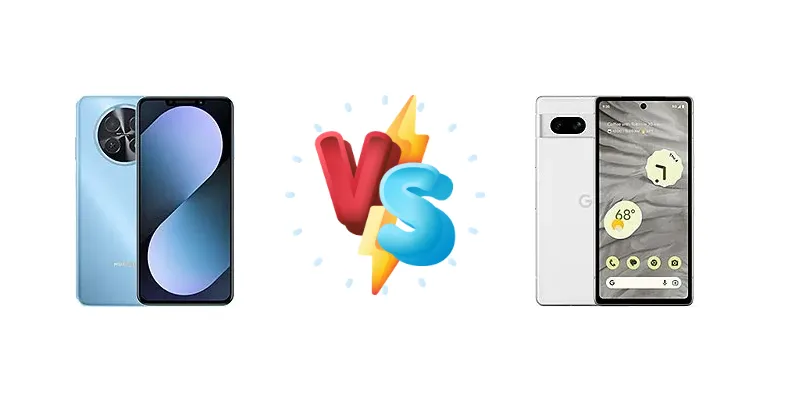
For most users, the Google Pixel 7a is the superior choice. Its Tensor G2 chipset provides significantly faster performance and unlocks advanced features like Magic Eraser, while its camera consistently delivers better image quality. However, the Huawei nova 14i offers compelling value for those prioritizing affordability and don't require 5G connectivity.
| PHONES | ||
|---|---|---|
| Phone Names | Huawei nova 14i | Google Pixel 7a |
| Network | ||
|---|---|---|
| 2G bands | GSM 850 / 900 / 1800 / 1900 | GSM 850 / 900 / 1800 / 1900 |
| 3G bands | HSDPA 850 / 900 / 1700(AWS) / 1900 / 2100 | HSDPA 800 / 850 / 900 / 1700(AWS) / 1900 / 2100 |
| 4G bands | 1, 2, 3, 4, 5, 7, 8, 13, 20, 26, 28, 38, 40, 41, 66 | 1, 2, 3, 4, 5, 7, 8, 12, 13, 14, 17, 20, 25, 26, 28, 29, 30, 38, 40, 41, 48, 66, 71 - GWKK3, G0DZQ |
| 5G bands | - | 1, 2, 3, 5, 7, 8, 12, 14, 20, 25, 28, 30, 38, 41, 48, 66, 71, 77, 78 SA/NSA/Sub6 - GWKK3 |
| Speed | HSPA, LTE | HSPA, LTE, 5G |
| Technology | GSM / HSPA / LTE | GSM / HSPA / LTE / 5G |
| - | 1, 2, 3, 5, 7, 8, 12, 20, 25, 28, 38, 40, 41, 66, 75, 76, 77, 78, 79 SA/NSA/Sub6 - GHL1X, G82U8 | |
| Launch | ||
|---|---|---|
| Announced | 2025, October 01 | 2023, May 10 |
| Status | Available. Released 2025, October 08 | Available. Released 2023, May 10 |
| Body | ||
|---|---|---|
| Build | - | Glass front (Gorilla Glass 3), aluminum frame, plastic back |
| Dimensions | 171.6 x 79.9 x 8.9 mm (6.76 x 3.15 x 0.35 in) | 152 x 72.9 x 9 mm (5.98 x 2.87 x 0.35 in) |
| SIM | Nano-SIM + Nano-SIM | Nano-SIM + eSIM |
| Weight | 216 g (7.62 oz) | 193.5 g (6.84 oz) |
| - | IP67 dust/water resistant (up to 1m for 30 min) | |
| Display | ||
|---|---|---|
| Protection | - | Corning Gorilla Glass 3 |
| Resolution | 1080 x 2376 pixels (~376 ppi density) | 1080 x 2400 pixels, 20:9 ratio (~429 ppi density) |
| Size | 6.95 inches, 117.4 cm2 (~85.6% screen-to-body ratio) | 6.1 inches, 90.7 cm2 (~81.8% screen-to-body ratio) |
| Type | IPS LCD, 90Hz | OLED, HDR, 90Hz |
| - | Always-on display | |
| Platform | ||
|---|---|---|
| CPU | Octa-core (4x2.4 GHz Cortex-A73 & 4x1.9 GHz Cortex-A53) | Octa-core (2x2.85 GHz Cortex-X1 & 2x2.35 GHz Cortex-A78 & 4x1.80 GHz Cortex-A55) |
| Chipset | Qualcomm Snapdragon 680 4G (6 nm) | Google Tensor G2 (5 nm) |
| GPU | Adreno 610 | Mali-G710 MP7 |
| OS | EMUI 14.2 | Android 13, upgradable to Android 15, up to 5 major Android upgrades |
| Memory | ||
|---|---|---|
| Card slot | No | No |
| Internal | 128GB 8GB RAM, 256GB 8GB RAM | 128GB 8GB RAM |
| - | UFS 3.1 | |
| Main Camera | ||
|---|---|---|
| Dual | 50 MP, f/1.8, 26mm (wide), PDAF Auxiliary lens | 64 MP, f/1.9, 26mm (wide), 1/1.73", 0.8µm, dual pixel PDAF, OIS 13 MP, f/2.2, 120˚ (ultrawide), 1.12µm |
| Features | LED flash, HDR, panorama | Dual-LED flash, Pixel Shift, Auto-HDR, panorama |
| Video | 1080p@30fps | 4K@30/60fps, 1080p@30/60/120/240fps, OIS |
| Selfie camera | ||
|---|---|---|
| Features | - | HDR, panorama |
| Single | 8 MP, f/2.0, (wide) | 13 MP, f/2.2, 20mm (ultrawide), 1.12µm |
| Video | 1080p@30fps | 4K@30fps, 1080p@30fps |
| Sound | ||
|---|---|---|
| 3.5mm jack | - | No |
| 35mm jack | No | No |
| Loudspeaker | Yes, with stereo speakers | Yes, with stereo speakers |
| Comms | ||
|---|---|---|
| Bluetooth | 5.0, A2DP, LE | 5.3, A2DP, LE |
| NFC | No | Yes |
| Positioning | GPS, GLONASS, GALILEO, BDS, QZSS | GPS, GLONASS, GALILEO, BDS, QZSS, NavIC |
| Radio | No | No |
| USB | USB Type-C 2.0 | USB Type-C 3.2 |
| WLAN | Wi-Fi 802.11 a/b/g/n/ac, dual-band | Wi-Fi 802.11 a/b/g/n/ac/6e, tri-band |
| Features | ||
|---|---|---|
| Sensors | Fingerprint (side-mounted), accelerometer, proximity, compass | Fingerprint (under display, optical), accelerometer, gyro, proximity, compass, barometer |
| Battery | ||
|---|---|---|
| Charging | 22.5W wired | 18W wired, PD3.0 7.5W wireless |
| Type | Li-Po 7000 mAh | Li-Po 4385 mAh |
| Misc | ||
|---|---|---|
| Colors | Black, Blue | Charcoal, Snow, Sea, Coral |
| Models | STG-LX2 | GWKK3, GHL1X, G0DZQ, G82U8 |
| Price | About 170 EUR | € 179.90 / $ 150.00 / £ 170.00 / ₹ 25,980 |
Huawei nova 14i
- Faster and more efficient processor (Tensor G2)
- Superior camera performance and features
- Guaranteed software updates and security patches
- Slightly slower wired charging (18W)
- Higher price point
Google Pixel 7a
- More affordable price
- Faster wired charging (22.5W)
- Sleek design
- Significantly slower processor (Snapdragon 680)
- Limited 4G connectivity
- Less frequent software updates
Display Comparison
The Pixel 7a boasts a brighter display, reaching a measured peak brightness of 1070 nits, which translates to better visibility outdoors compared to the nova 14i (brightness data unavailable, but likely lower given the price point). While both likely utilize OLED panels, the Pixel 7a’s superior brightness and Google’s color calibration expertise will result in a more vibrant and accurate viewing experience. The absence of high refresh rate information for the nova 14i suggests a standard 60Hz panel, while the Pixel 7a is expected to offer a smoother 90Hz experience, enhancing scrolling and animations.
Camera Comparison
The Pixel 7a’s camera system is a clear standout. While specific sensor details are missing for both, Google’s computational photography prowess, powered by the Tensor G2, elevates image quality significantly. The Pixel 7a excels in low-light conditions and offers features like Magic Eraser and Photo Unblur. The nova 14i likely relies more on hardware and less on software processing, resulting in less dynamic range and detail in challenging lighting scenarios. Ignoring the likely low-resolution macro lens on the nova 14i, the Pixel 7a’s image processing pipeline will deliver consistently superior results.
Performance
The performance gap between these two devices is substantial. The Google Pixel 7a’s Tensor G2, built on a 5nm process, features a tri-cluster configuration with high-performance Cortex-X1 cores, offering a significant advantage over the Huawei nova 14i’s Snapdragon 680 (6nm). The Tensor G2’s architecture is optimized for AI and machine learning tasks, powering features like real-time translation and advanced image processing. The Snapdragon 680, while efficient, is geared towards everyday tasks and will struggle with demanding games or multitasking. The Pixel 7a’s likely LPDDR5 RAM further enhances performance compared to the nova 14i’s unspecified RAM type.
Battery Life
The Pixel 7a has an endurance rating of 76 hours, indicating solid battery life despite its 18W charging. The nova 14i’s 22.5W charging is faster on paper, but the Pixel 7a’s more efficient Tensor G2 chip and optimized software may offset the charging speed difference in real-world usage. The Pixel 7a also supports PD3.0 and 7.5W wireless charging, offering greater convenience, features absent on the nova 14i.
Buying Guide
Buy the Huawei nova 14i if you need a functional smartphone for basic tasks, prioritize a lower upfront cost, and don't rely heavily on 5G data speeds. It's ideal for users in areas with limited 5G coverage or those on tight budgets. Buy the Google Pixel 7a if you value a smooth user experience, exceptional camera capabilities, and access to Google’s latest software features and security updates. It’s the better option for photography enthusiasts, power users, and those who want a phone that will remain supported for years to come.