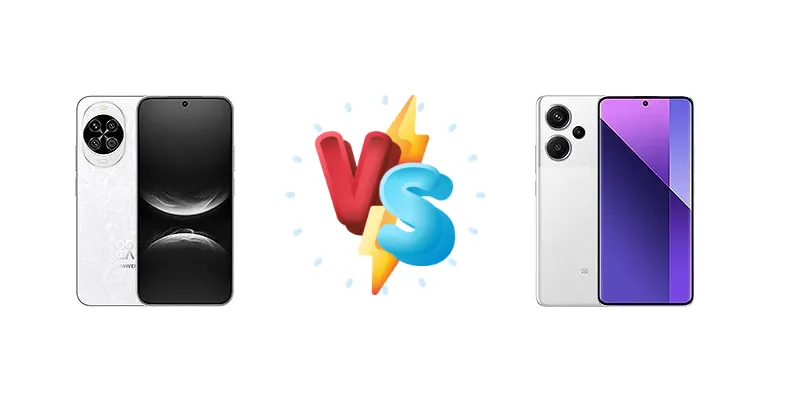
The Huawei nova 14 and Xiaomi Redmi Note 13 Pro+ represent compelling options in the increasingly competitive mid-range smartphone market. The nova 14 aims to deliver a stylish experience with Huawei’s Kirin chipset, while the Redmi Note 13 Pro+ focuses on raw performance and rapid charging with the MediaTek Dimensity 7200 Ultra. This comparison dissects their key differences to determine which device best suits your needs.
🏆 Quick Verdict
For the average user prioritizing battery life and charging speed, the Xiaomi Redmi Note 13 Pro+ is the clear winner. Its Dimensity 7200 Ultra chipset and 120W charging significantly outperform the Huawei nova 14’s Kirin 8000 and 100W charging, despite the nova 14’s potentially more refined software experience.
| Network |
|---|
| 2G bands | GSM 850 / 900 / 1800 / 1900 | GSM 850 / 900 / 1800 / 1900 |
| 3G bands | HSDPA 800 / 850 / 900 / 1700(AWS) / 1900 / 2100 | HSDPA 800 / 850 / 900 / 1700(AWS) / 1900 / 2100 - International |
| 4G bands | LTE | 1, 2, 3, 4, 5, 7, 8, 12, 13, 17, 18, 19, 20, 26, 28, 32, 38, 40, 41, 66 - International |
| 5G bands | SA/NSA | 1, 3, 5, 7, 8, 20, 28, 38, 40, 41, 66, 77, 78 SA/NSA- International |
| Speed | HSPA, LTE, 5G | HSPA, LTE, 5G |
| Technology | GSM / CDMA / HSPA / CDMA2000 / LTE / 5G | GSM / CDMA / HSPA / EVDO / LTE / 5G |
| Launch |
|---|
| Announced | 2025, May 19 | 2023, September 21 |
| Status | Available. Released 2025, May 19 | Available. Released 2023, September 21 |
| Body |
|---|
| Build | - | Glass front (Gorilla Glass Victus), glass back or silicone polymer back (eco leather) |
| Dimensions | 161.7 x 75.5 x 7.2 mm (6.37 x 2.97 x 0.28 in) | 161.4 x 74.2 x 8.9 mm (6.35 x 2.92 x 0.35 in) |
| SIM | Nano-SIM + Nano-SIM | · Nano-SIM + eSIM· Nano-SIM + Nano-SIM |
| Weight | 192 g (6.77 oz) | 199 g or 204.5 g (7.02 oz) |
| Display |
|---|
| Protection | Aluminosilicate glass | Corning Gorilla Glass Victus |
| Resolution | 1084 x 2412 pixels, 20:9 ratio (~395 ppi density) | 1220 x 2712 pixels, 20:9 ratio (~446 ppi density) |
| Size | 6.7 inches, 108.3 cm2 (~88.7% screen-to-body ratio) | 6.67 inches, 107.4 cm2 (~89.7% screen-to-body ratio) |
| Type | OLED, 1B colors, HDR Vivid, 120Hz, 1100 nits (HBM) | AMOLED, 68B colors, 120Hz, 1920Hz PWM, Dolby Vision, HDR10+, 1800 nits (peak) |
| Platform |
|---|
| CPU | Octa-core (1x2.4 GHz & 3x2.2 GHz & 4x1.84 GHz) | Octa-core (2x2.8 GHz Cortex-A715 & 6x2.0 GHz Cortex-A510) |
| Chipset | Kirin 8000 (7 nm) | Mediatek Dimensity 7200 Ultra (4 nm) |
| GPU | Mali-G610 MP4 | Mali-G610 MC4 |
| OS | HarmonyOS 5.0 | Android 13, up to 3 major Android upgrades, HyperOS |
| Memory |
|---|
| Card slot | No | No |
| Internal | 256GB 12GB RAM, 512GB 12GB RAM | 256GB 8GB RAM, 256GB 12GB RAM, 512GB 8GB RAM, 512GB 12GB RAM, 512GB 16GB RAM |
| Main Camera |
|---|
| Features | Color spectrum sensor, LED flash, panorama, HDR | Dual-LED dual-tone flash, HDR, panorama |
| Triple | 50 MP, f/1.9, 23mm (wide), 1/1.56", Dual Pixel PDAF
12 MP, f/2.4, 69mm (telephoto), PDAF, OIS, 3x optical zoom
8 MP, f/2.2, 16mm, 112˚ (ultrawide), AF | 200 MP, f/1.7, 23mm (wide), 1/1.4", 0.56µm, multi-directional PDAF, OIS
8 MP, f/2.2, 16mm, 120˚ (ultrawide), 1/4.0", 1.12µm
2 MP (macro) |
| Video | 4K, 1080p, gyro-EIS | 4K@24/30fps, 1080p@30/60/120fps, gyro-EIS |
| Selfie camera |
|---|
| Features | HDR, panorama | HDR, panorama |
| Single | 50 MP, f/2.4, 1/2.5" | 16 MP, f/2.4, (wide) |
| Video | 4K, 1080p, gyro-EIS | 1080p@30/60fps |
| Sound |
|---|
| 35mm jack | No | No |
| Loudspeaker | Yes, with stereo speakers | Yes, with stereo speakers |
| Comms |
|---|
| Bluetooth | 5.2, A2DP, LE, L2HC (320-960 kbps HD audio) | 5.3, A2DP, LE |
| Infrared port | Yes | Yes |
| NFC | Yes | Yes (market/region dependent) |
| Positioning | GPS, GALILEO, GLONASS, BDS, QZSS | GPS, GLONASS, BDS, GALILEO, QZSS |
| Radio | No | No |
| USB | USB Type-C 2.0, OTG | USB Type-C 2.0, OTG |
| WLAN | Wi-Fi 802.11 a/b/g/n/ac/6, dual-band, Wi-Fi Direct | Wi-Fi 802.11 a/b/g/n/ac/6, dual-band, Wi-Fi Direct |
| Features |
|---|
| Sensors | Fingerprint (side-mounted), accelerometer, gyro, compass | Fingerprint (under display, optical), accelerometer, gyro, proximity, compass |
| Battery |
|---|
| Charging | 100W wired, SCP, UFCS, PD, PPS, QC
5W reverse wired | 120W wired, PD3.0, 100% in 19 min |
| Type | 5500 mAh | Li-Po 5000 mAh |
| Misc |
|---|
| Colors | Black, White, Blue | Midnight Black (Fushion Black), Moonlight White (Fushion White), Aurora Purple, Fushion Purple, Camo Green |
| Models | TLR-AL00 | 23090RA98C, 23090RA98G, 23090RA98I |
| Price | About 330 EUR | $ 299.98 / £ 299.00 / € 208.98 / ₹ 24,999 |
| SAR | - | 1.09 W/kg (head) 0.85 W/kg (body) |
| SAR EU | - | 0.98 W/kg (head) 1.00 W/kg (body) |
Huawei nova 14
- Sleek and stylish design (assumed based on Huawei’s design language)
- 100W fast charging is still very competitive
- Potentially refined software experience (depending on user preference)
- Kirin 8000 chipset may be less efficient than Dimensity 7200 Ultra
- Potential limitations due to lack of full Google Mobile Services
Xiaomi Redmi Note 13 Pro+
- Faster 120W charging for minimal downtime
- More power-efficient Dimensity 7200 Ultra chipset
- Full Google Mobile Services support for wider app compatibility
- Software experience may not be as polished as Huawei’s (subjective)
- No reverse wireless charging
Display Comparison
The Redmi Note 13 Pro+ boasts a significantly brighter display, reaching a measured peak of 1283 nits, compared to an unspecified brightness for the nova 14. This higher peak brightness translates to better outdoor visibility in direct sunlight. While panel technology details for the nova 14 are missing, the Redmi Note 13 Pro+ likely utilizes an AMOLED panel, common in this price range, offering vibrant colors and deep blacks. Bezels are expected to be minimal on both devices, but the Redmi Note 13 Pro+'s brightness advantage is a key differentiator.
Camera Comparison
Without detailed camera specifications for the nova 14, a direct comparison is challenging. However, the Redmi Note 13 Pro+ is expected to feature a high-resolution main sensor (likely 200MP, based on market trends for this series) with optical image stabilization (OIS). The larger sensor size and OIS will contribute to better low-light performance and sharper images. While the nova 14 may offer a competent camera system, the Redmi Note 13 Pro+ is positioned to deliver superior image quality, especially in challenging conditions. We can assume both phones will include ultrawide and macro lenses, but the focus should be on the primary sensor capabilities.
Performance
The Xiaomi Redmi Note 13 Pro+ leverages the 4nm MediaTek Dimensity 7200 Ultra chipset, featuring a dual-core Cortex-A715 configuration clocked at 2.8 GHz, paired with six Cortex-A510 cores at 2.0 GHz. This architecture, built on a smaller node, generally offers improved power efficiency and thermal performance compared to the Huawei nova 14’s 7nm Kirin 8000. The Kirin 8000’s octa-core setup (1x2.4 GHz, 3x2.2 GHz, 4x1.84 GHz) is capable, but the Dimensity 7200 Ultra’s newer architecture and process node provide a performance edge, particularly in sustained workloads. The Redmi Note 13 Pro+ is likely to exhibit less throttling during extended gaming sessions.
Battery Life
The Redmi Note 13 Pro+ shines in battery performance, achieving an active use score of 10 hours and 38 minutes. This, combined with its blazing-fast 120W wired charging (fully charging in 19 minutes), provides a significant advantage over the Huawei nova 14. The nova 14 offers 100W charging, which is still rapid, but the Redmi Note 13 Pro+’s faster charging minimizes downtime. While the nova 14 includes 5W reverse wired charging, a feature absent from the Redmi Note 13 Pro+’s specifications, the overall battery and charging experience favors the Xiaomi device.
Buying Guide
Buy the Huawei nova 14 if you prioritize a sleek design and are comfortable operating within Huawei’s ecosystem, potentially without full Google Mobile Services. Its 100W charging is still very fast, and the Kirin 8000 offers solid performance for everyday tasks. Buy the Xiaomi Redmi Note 13 Pro+ if you demand maximum battery endurance, the fastest possible charging speeds (120W), and a more universally compatible software experience with full Google support. It’s the better choice for power users and gamers.
Frequently Asked Questions
❓ Does the Kirin 8000 chipset in the Huawei nova 14 struggle with demanding games like Genshin Impact?
While the Kirin 8000 is a capable chipset, the MediaTek Dimensity 7200 Ultra in the Redmi Note 13 Pro+ offers a performance advantage, particularly in sustained gaming scenarios. The Dimensity 7200 Ultra’s 4nm process and newer architecture are more efficient, leading to less thermal throttling and potentially higher frame rates in demanding titles like Genshin Impact.
❓ How significant is the difference in charging speed between 100W and 120W, and will I notice it in daily use?
The difference between 100W and 120W charging is substantial. The Redmi Note 13 Pro+ can fully charge in just 19 minutes, while the nova 14 will take longer. In daily use, this translates to significantly less downtime plugged into the wall, especially for users who frequently need to top up their battery throughout the day.
❓ What are the implications of Huawei’s software ecosystem and the potential lack of full Google Mobile Services on the nova 14?
Huawei’s software ecosystem, while improving, still lacks full Google Mobile Services (GMS). This means you may need to rely on Huawei’s AppGallery for apps, and some Google apps may not be directly available or require workarounds. This can be a significant inconvenience for users heavily reliant on Google services like Gmail, Google Maps, and YouTube.