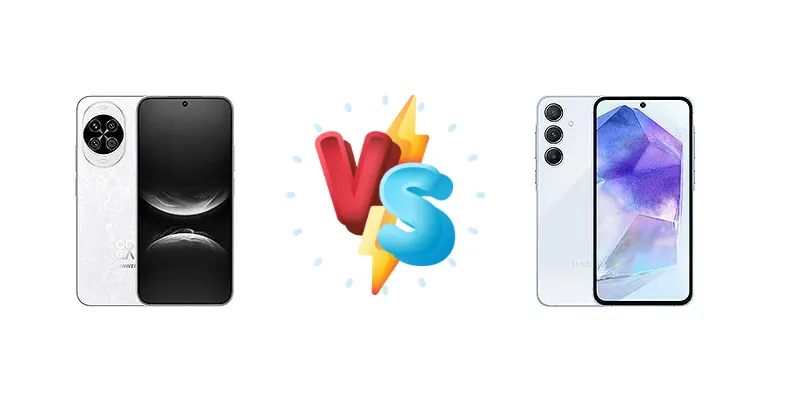
The mid-range smartphone market is fiercely competitive, and the Huawei nova 14 and Samsung Galaxy A55 represent compelling options. The nova 14 aggressively targets charging speed and a modern aesthetic, while the Galaxy A55 prioritizes battery endurance and a proven software experience. This comparison dissects their key differences to help you choose the right device.
🏆 Quick Verdict
For the average user prioritizing all-day battery life and a polished software experience, the Samsung Galaxy A55 is the stronger choice. Its Exynos 1480 offers efficient performance, and the 13:27h active use score demonstrates impressive endurance. However, the Huawei nova 14’s 100W charging is a game-changer for those who value rapid top-ups.
| Network |
|---|
| 2G bands | GSM 850 / 900 / 1800 / 1900 | GSM 850 / 900 / 1800 / 1900 |
| 3G bands | HSDPA 800 / 850 / 900 / 1700(AWS) / 1900 / 2100 | HSDPA 850 / 900 / 1700(AWS) / 1900 / 2100 |
| 4G bands | LTE | 1, 2, 3, 4, 5, 7, 8, 12, 17, 20, 25, 26, 28, 32, 38, 40, 41, 66 |
| 5G bands | SA/NSA | 1, 3, 5, 7, 8, 20, 28, 38, 40, 41, 66, 77, 78 SA/NSA/Sub6 |
| Speed | HSPA, LTE, 5G | HSPA, LTE, 5G |
| Technology | GSM / CDMA / HSPA / CDMA2000 / LTE / 5G | GSM / HSPA / LTE / 5G |
| Launch |
|---|
| Announced | 2025, May 19 | 2024, March 11 |
| Status | Available. Released 2025, May 19 | Available. Released 2024, March 15 |
| Body |
|---|
| Build | - | Glass front (Gorilla Glass Victus+), glass back (Gorilla Glass), aluminum frame |
| Dimensions | 161.7 x 75.5 x 7.2 mm (6.37 x 2.97 x 0.28 in) | 161.1 x 77.4 x 8.2 mm (6.34 x 3.05 x 0.32 in) |
| SIM | Nano-SIM + Nano-SIM | · Nano-SIM· Nano-SIM + eSIM· Nano-SIM + Nano-SIM· Nano-SIM + Nano-SIM + eSIM (max 2 at a time) |
| Weight | 192 g (6.77 oz) | 213 g (7.51 oz) |
| Display |
|---|
| Protection | Aluminosilicate glass | Corning Gorilla Glass Victus+ |
| Resolution | 1084 x 2412 pixels, 20:9 ratio (~395 ppi density) | 1080 x 2340 pixels, 19.5:9 ratio (~390 ppi density) |
| Size | 6.7 inches, 108.3 cm2 (~88.7% screen-to-body ratio) | 6.6 inches, 106.9 cm2 (~85.8% screen-to-body ratio) |
| Type | OLED, 1B colors, HDR Vivid, 120Hz, 1100 nits (HBM) | Super AMOLED, 120Hz, HDR10+, 1000 nits (HBM) |
| Platform |
|---|
| CPU | Octa-core (1x2.4 GHz & 3x2.2 GHz & 4x1.84 GHz) | Octa-core (4x2.75 GHz Cortex-A78 & 4x2.0 GHz Cortex-A55) |
| Chipset | Kirin 8000 (7 nm) | Exynos 1480 (4 nm) |
| GPU | Mali-G610 MP4 | Xclipse 530 |
| OS | HarmonyOS 5.0 | Android 14, up to 4 major Android upgrades, One UI 6.1 |
| Memory |
|---|
| Card slot | No | microSDXC (uses shared SIM slot) |
| Internal | 256GB 12GB RAM, 512GB 12GB RAM | 128GB 6GB RAM, 128GB 8GB RAM, 256GB 6GB RAM, 256GB 8GB RAM, 256GB 12GB RAM |
| Main Camera |
|---|
| Features | Color spectrum sensor, LED flash, panorama, HDR | LED flash, panorama, HDR |
| Triple | 50 MP, f/1.9, 23mm (wide), 1/1.56", Dual Pixel PDAF
12 MP, f/2.4, 69mm (telephoto), PDAF, OIS, 3x optical zoom
8 MP, f/2.2, 16mm, 112˚ (ultrawide), AF | 50 MP, f/1.8, (wide), 1/1.56", 1.0µm, PDAF, OIS
12 MP, f/2.2, 123˚ (ultrawide), 1/3.06", 1.12µm
5 MP (macro) |
| Video | 4K, 1080p, gyro-EIS | 4K@30fps, 1080p@30/60fps, gyro-EIS |
| Selfie camera |
|---|
| Features | HDR, panorama | - |
| Single | 50 MP, f/2.4, 1/2.5" | 32 MP, f/2.2, 26mm (wide), 1/2.74", 0.8µm |
| Video | 4K, 1080p, gyro-EIS | 4K@30fps, 1080p@30/60fps |
| Sound |
|---|
| 35mm jack | No | No |
| Loudspeaker | Yes, with stereo speakers | Yes, with stereo speakers |
| Comms |
|---|
| Bluetooth | 5.2, A2DP, LE, L2HC (320-960 kbps HD audio) | 5.3, A2DP, LE |
| Infrared port | Yes | - |
| NFC | Yes | Yes (market/region dependent) |
| Positioning | GPS, GALILEO, GLONASS, BDS, QZSS | GPS, GALILEO, GLONASS, BDS, QZSS |
| Radio | No | No |
| USB | USB Type-C 2.0, OTG | USB Type-C 2.0, OTG |
| WLAN | Wi-Fi 802.11 a/b/g/n/ac/6, dual-band, Wi-Fi Direct | Wi-Fi 802.11 a/b/g/n/ac/6, dual-band, Wi-Fi Direct |
| Features |
|---|
| Sensors | Fingerprint (side-mounted), accelerometer, gyro, compass | Fingerprint (under display, optical), accelerometer, gyro, compass |
| Battery |
|---|
| Charging | 100W wired, SCP, UFCS, PD, PPS, QC
5W reverse wired | 25W wired |
| Type | 5500 mAh | Li-Ion 5000 mAh |
| Misc |
|---|
| Colors | Black, White, Blue | Iceblue, Lilac, Navy, Lemon |
| Models | TLR-AL00 | SM-A556V, SM-A556B, SM-A556B/DS, SM-A556E, SM-A556E/DS, SM-A5560 |
| Price | About 330 EUR | $ 324.99 / £ 251.50 / € 319.99 / ₹ 23,998 |
| SAR EU | - | 0.68 W/kg (head) 1.04 W/kg (body) |
Huawei nova 14
- Blazing-fast 100W wired charging
- Sleek and modern design (assumed)
- Potentially competitive camera performance (pending details)
- Kirin 8000 chipset may throttle under sustained load
- Limited battery life information
- Software ecosystem concerns (Huawei Mobile Services)
Samsung Galaxy A55
- Excellent 13:27h active use battery life
- Bright and vibrant 1010 nit display
- Efficient Exynos 1480 processor
- Slower 25W wired charging
- May lack the design flair of the nova 14
- Software bloatware (typical of Samsung)
Display Comparison
The Samsung Galaxy A55 boasts a significantly brighter display, reaching a measured 1010 nits. This is crucial for outdoor visibility, a clear advantage over the nova 14 (brightness data unavailable). While the nova 14’s panel technology isn’t specified, Samsung’s likely utilizes a high-quality AMOLED panel with excellent color accuracy. The A55’s brightness allows for a more comfortable viewing experience in direct sunlight, while the nova 14 may struggle in similar conditions. Bezels are assumed to be comparable given the market segment, but the A55’s brightness is a clear differentiator.
Camera Comparison
Camera details for the nova 14 are limited, making a direct comparison challenging. However, the A55’s camera system likely focuses on a well-rounded experience with a primary sensor and OIS (Optical Image Stabilization) for sharper photos and videos. The prevalence of 2MP macro cameras in this segment suggests both phones may include one, but their utility is questionable. Image processing styles will differ – Huawei often leans towards vibrant, saturated colors, while Samsung typically aims for more natural tones. Without specific sensor sizes and aperture details for the nova 14, the A55’s likely superior image stabilization and processing give it an edge.
Performance
The core difference lies in the chipsets: Huawei’s Kirin 8000 (7nm) versus Samsung’s Exynos 1480 (4nm). The Exynos 1480, built on a more efficient 4nm process, should deliver better thermal management and sustained performance. The Kirin 8000’s octa-core configuration (2.4GHz + 2.2GHz + 1.84GHz) is offset by the older 7nm node. The A55’s CPU utilizes Cortex-A78 cores at 2.75GHz, offering a performance edge in demanding tasks. While the Kirin 8000 is capable, the Exynos 1480’s architecture and process node provide a more modern and efficient experience, particularly for gaming and multitasking. RAM specifications are missing for the nova 14, but the A55’s LPDDR5x RAM contributes to faster data access.
Battery Life
The Samsung Galaxy A55 shines in battery life, achieving an impressive 13:27h of active use. While the nova 14’s battery capacity is unknown, its 100W wired charging is a significant advantage. This allows for incredibly fast charging speeds – a full charge from 0-100% will be substantially quicker than the A55’s 25W charging. The A55’s slower charging speed necessitates longer charging times, but its superior battery endurance mitigates this issue. The nova 14’s 5W reverse wired charging is a niche feature, useful for topping up accessories, while the A55 lacks this capability.
Buying Guide
Buy the Huawei nova 14 if you absolutely need the fastest charging available and appreciate a sleek design. It’s ideal for users who frequently find themselves needing to quickly replenish their battery. Buy the Samsung Galaxy A55 if you prioritize long-lasting battery life, a consistently smooth user experience, and a brighter, more visible display in outdoor conditions. It’s the better option for everyday users and media consumers.
Frequently Asked Questions
❓ Does the Exynos 1480 in the Galaxy A55 overheat during prolonged gaming sessions?
The Exynos 1480’s 4nm process and efficient architecture are designed to minimize thermal throttling. While some heat generation is inevitable during intensive gaming, the A55’s thermal management system should prevent significant performance drops, offering a consistently smooth gaming experience.
❓ How long does it *actually* take to fully charge the Huawei nova 14 with the 100W charger?
While Huawei doesn't provide exact figures, 100W charging typically takes around 20-30 minutes to charge a phone from 0-100%. This is a substantial advantage over the Galaxy A55’s 25W charging, which will require over an hour for a full charge.
❓ Is the lack of Google Mobile Services on the Huawei nova 14 a dealbreaker?
The nova 14 utilizes Huawei Mobile Services (HMS) instead of Google Mobile Services (GMS). This means you won’t have direct access to the Google Play Store and core Google apps. While Huawei’s AppGallery offers a growing selection of apps, compatibility issues may arise with certain popular applications. Consider your reliance on Google services before purchasing.
❓ What kind of gaming performance can I expect from the Samsung Galaxy A55?
The Exynos 1480 and its Mali-G68 MP5 GPU are capable of running most popular mobile games at medium to high settings. While it won’t match the performance of flagship chipsets, the A55 provides a smooth and enjoyable gaming experience for casual and moderate gamers.