
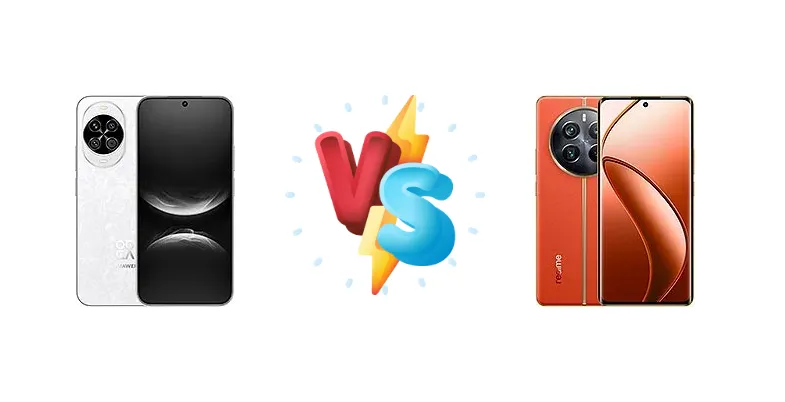
Huawei nova 14 vs Realme 12 Pro+: Which Mid-Range Champion Reigns Supreme?
| Phones Images | |||||
|---|---|---|---|---|---|
|
🏆 Quick Verdict
For users prioritizing raw charging speed and a potentially more unique software experience (despite potential app limitations), the Huawei nova 14 is the winner. However, the Realme 12 Pro+ offers a more consistently reliable experience with a modern chipset and demonstrably longer battery life, making it the better choice for most.
| PHONES | ||
|---|---|---|
| Phone Names | Huawei nova 14 | Realme 12 Pro+ |
| Network | ||
|---|---|---|
| 2G bands | GSM 850 / 900 / 1800 / 1900 | GSM 850 / 900 / 1800 / 1900 |
| 3G bands | HSDPA 800 / 850 / 900 / 1700(AWS) / 1900 / 2100 | HSDPA 850 / 900 / 2100 |
| 4G bands | LTE | 1, 3, 5, 8, 28, 40, 41 |
| 5G bands | SA/NSA | 1, 3, 5, 8, 28, 40, 41, 77, 78 SA/NSA |
| Speed | HSPA, LTE, 5G | HSPA, LTE, 5G |
| Technology | GSM / CDMA / HSPA / CDMA2000 / LTE / 5G | GSM / HSPA / LTE / 5G |
| Launch | ||
|---|---|---|
| Announced | 2025, May 19 | 2024, January 29 |
| Status | Available. Released 2025, May 19 | Available. Released 2024, January 29 |
| Body | ||
|---|---|---|
| Dimensions | 161.7 x 75.5 x 7.2 mm (6.37 x 2.97 x 0.28 in) | 161.5 x 74 x 8.8 mm (6.36 x 2.91 x 0.35 in) |
| SIM | Nano-SIM + Nano-SIM | Nano-SIM + Nano-SIM |
| Weight | 192 g (6.77 oz) | 196 g (6.91 oz) |
| Display | ||
|---|---|---|
| Protection | Aluminosilicate glass | - |
| Resolution | 1084 x 2412 pixels, 20:9 ratio (~395 ppi density) | 1080 x 2412 pixels, 20:9 ratio (~394 ppi density) |
| Size | 6.7 inches, 108.3 cm2 (~88.7% screen-to-body ratio) | 6.7 inches, 108.0 cm2 (~90.4% screen-to-body ratio) |
| Type | OLED, 1B colors, HDR Vivid, 120Hz, 1100 nits (HBM) | AMOLED, 1B colors, 120Hz, 800 nits (HBM), 950 nits (peak) |
| Platform | ||
|---|---|---|
| CPU | Octa-core (1x2.4 GHz & 3x2.2 GHz & 4x1.84 GHz) | Octa-core (4x2.40 GHz Cortex-A78 & 4x1.95 GHz Cortex-A55) |
| Chipset | Kirin 8000 (7 nm) | Qualcomm SM7435-AB Snapdragon 7s Gen 2 (4 nm) |
| GPU | Mali-G610 MP4 | Adreno 710 |
| OS | HarmonyOS 5.0 | Android 14, Realme UI 5.0 |
| Memory | ||
|---|---|---|
| Card slot | No | No |
| Internal | 256GB 12GB RAM, 512GB 12GB RAM | 128GB 8GB RAM, 256GB 8GB RAM, 256GB 12GB RAM, 512GB 12GB RAM |
| Main Camera | ||
|---|---|---|
| Features | Color spectrum sensor, LED flash, panorama, HDR | LED flash, HDR, panorama |
| Triple | 50 MP, f/1.9, 23mm (wide), 1/1.56", Dual Pixel PDAF 12 MP, f/2.4, 69mm (telephoto), PDAF, OIS, 3x optical zoom 8 MP, f/2.2, 16mm, 112˚ (ultrawide), AF | 50 MP, f/1.8, 24mm (wide), 1/1.56", 1.0µm, multi-directional PDAF, OIS 64 MP, f/2.8, 71mm, (periscope telephoto), 1/2.0", 0.7µm, PDAF, OIS, 3x optical zoom 8 MP, f/2.2, 16mm, 112˚ (ultrawide), 1/4.0", 1.12µm |
| Video | 4K, 1080p, gyro-EIS | 4K@30fps, 1080p@30/60/120fps, gyro-EIS |
| Selfie camera | ||
|---|---|---|
| Features | HDR, panorama | - |
| Single | 50 MP, f/2.4, 1/2.5" | 32 MP, f/2.4, 22mm (wide) |
| Video | 4K, 1080p, gyro-EIS | 1080p@30fps |
| Sound | ||
|---|---|---|
| 35mm jack | No | No |
| Loudspeaker | Yes, with stereo speakers | Yes, with stereo speakers |
| Comms | ||
|---|---|---|
| Bluetooth | 5.2, A2DP, LE, L2HC (320-960 kbps HD audio) | 5.2, A2DP, LE |
| Infrared port | Yes | - |
| NFC | Yes | Yes (market/region dependent) |
| Positioning | GPS, GALILEO, GLONASS, BDS, QZSS | GPS, GLONASS, GALILEO, BDS, QZSS |
| Radio | No | No |
| USB | USB Type-C 2.0, OTG | USB Type-C 2.0 |
| WLAN | Wi-Fi 802.11 a/b/g/n/ac/6, dual-band, Wi-Fi Direct | Wi-Fi 802.11 a/b/g/n/ac/6, dual-band |
| Features | ||
|---|---|---|
| Sensors | Fingerprint (side-mounted), accelerometer, gyro, compass | Fingerprint (under display, optical), accelerometer, gyro, proximity, compass |
| Battery | ||
|---|---|---|
| Charging | 100W wired, SCP, UFCS, PD, PPS, QC 5W reverse wired | 67W wired, 50% in 19 min |
| Type | 5500 mAh | 5000 mAh |
| Misc | ||
|---|---|---|
| Colors | Black, White, Blue | Submarine Blue, Navigator Beige, Explorer Red |
| Models | TLR-AL00 | RMX3840, RMX3841 |
| Price | About 330 EUR | $ 465.00 / £ 299.00 / € 344.26 / ₹ 28,400 |
Huawei nova 14
- Ultra-fast 100W charging
- Potentially unique Huawei software features
- Sleek design (assumed based on brand reputation)
- Kirin 8000 chipset may be less efficient
- Potential app compatibility issues due to Huawei restrictions
- Battery life likely shorter than Realme 12 Pro+
Realme 12 Pro+
- Excellent battery life (13:24h active use)
- Efficient Snapdragon 7s Gen 2 chipset
- Bright and clear 802 nit display
- Slower 67W charging compared to Huawei
- Less distinctive software experience
- May lack some of Huawei's unique features
Display Comparison
The Realme 12 Pro+ edges out the nova 14 in display quality, achieving a measured peak brightness of 802 nits. While the nova 14’s display specs are not provided, the Realme’s brightness ensures excellent visibility outdoors. The Realme likely utilizes a standard AMOLED panel, while Huawei’s panel technology remains unspecified. The Realme’s brightness is a tangible benefit for users who frequently consume content in bright environments.
Camera Comparison
Without detailed camera specifications for the nova 14, a direct comparison is limited. However, the Realme 12 Pro+ likely features a more modern image processing pipeline thanks to the Snapdragon’s ISP. The Realme’s focus on a primary sensor (details unspecified in context) and OIS suggests a stronger emphasis on image quality in various lighting conditions. The absence of sensor details for the nova 14 makes it difficult to assess its photographic capabilities, but the Realme’s chipset provides a solid foundation for computational photography.
Performance
The Realme 12 Pro+’s Snapdragon 7s Gen 2 (4nm) offers a clear architectural advantage over the Huawei nova 14’s Kirin 8000 (7nm). The smaller 4nm process node translates to improved power efficiency and thermal management, potentially leading to less throttling during sustained workloads. While both CPUs feature octa-core designs with similar peak clock speeds (2.4GHz), the Snapdragon’s Cortex-A78 cores are generally more performant than the Kirin’s core configuration. This benefits gamers and users running demanding applications. The Kirin 8000’s performance is respectable, but the Snapdragon 7s Gen 2 provides a more future-proof platform.
Battery Life
The Realme 12 Pro+ demonstrably wins in battery endurance, achieving an active use score of 13 hours and 24 minutes. While the nova 14’s battery capacity is unknown, its 100W charging is its key advantage. The Realme’s 67W charging still delivers a 50% charge in 19 minutes, but the nova 14’s 100W system is significantly faster. However, faster charging is less valuable without a battery that can sustain a full day of use, which the Realme 12 Pro+ clearly achieves.
Buying Guide
Buy the Huawei nova 14 if you absolutely need the fastest charging available and are comfortable navigating a potentially restricted app ecosystem. Its 100W charging is a significant advantage for power users. Buy the Realme 12 Pro+ if you prioritize long-lasting battery life, a stable Android experience with guaranteed updates, and a well-rounded feature set without compromise. It’s the safer, more practical choice for everyday use.