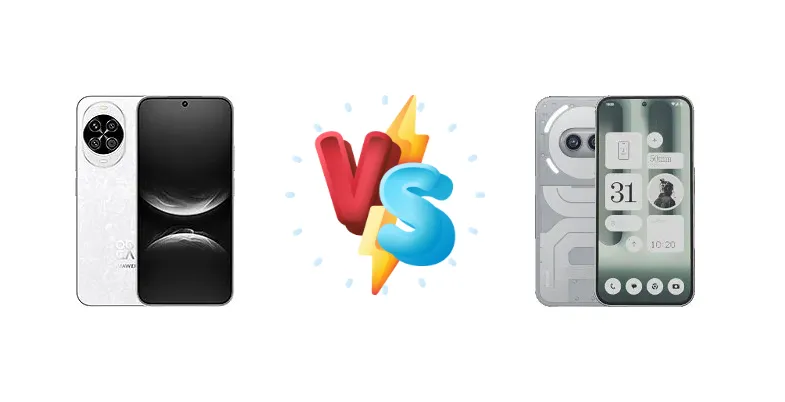
The mid-range smartphone market is fiercely competitive, and the Huawei nova 14 and Nothing Phone (2a) Plus represent compelling options. The nova 14 boasts Huawei’s in-house Kirin 8000 chipset and blazing-fast 100W charging, while the Nothing Phone (2a) Plus counters with a modern Mediatek Dimensity 7350 Pro and a focus on software experience. This comparison dissects their strengths and weaknesses to help you choose.
🏆 Quick Verdict
For users prioritizing raw charging speed and a potentially more refined camera experience (based on Huawei’s image processing history), the Huawei nova 14 is the better choice. However, the Nothing Phone (2a) Plus delivers superior battery life and a more efficient processor, making it ideal for everyday users and those valuing longevity.
| Network |
|---|
| 2G bands | GSM 850 / 900 / 1800 / 1900 | GSM 850 / 900 / 1800 / 1900 |
| 3G bands | HSDPA 800 / 850 / 900 / 1700(AWS) / 1900 / 2100 | HSDPA 800 / 850 / 900 / 1700(AWS) / 1900 / 2100 |
| 4G bands | LTE | 1, 3, 4, 5, 7, 8, 18, 19, 20, 26, 28, 38, 39, 40, 41, 42, 66 |
| 5G bands | SA/NSA | 1, 3, 5, 7, 8, 20, 28, 38, 40, 41, 66, 77, 78 SA/NSA |
| Speed | HSPA, LTE, 5G | HSPA, LTE, 5G |
| Technology | GSM / CDMA / HSPA / CDMA2000 / LTE / 5G | GSM / HSPA / LTE / 5G |
| Launch |
|---|
| Announced | 2025, May 19 | 2024, July 31 |
| Status | Available. Released 2025, May 19 | Available. Released 2024, August 03 |
| Body |
|---|
| Build | - | Glass front (Gorilla Glass 5), plastic frame, plastic back |
| Dimensions | 161.7 x 75.5 x 7.2 mm (6.37 x 2.97 x 0.28 in) | 161.7 x 76.3 x 8.5 mm (6.37 x 3.00 x 0.33 in) |
| SIM | Nano-SIM + Nano-SIM | Nano-SIM + Nano-SIM |
| Weight | 192 g (6.77 oz) | 190 g (6.70 oz) |
| Display |
|---|
| Protection | Aluminosilicate glass | Corning Gorilla Glass 5 |
| Resolution | 1084 x 2412 pixels, 20:9 ratio (~395 ppi density) | 1080 x 2412 pixels, 20:9 ratio (~395 ppi density) |
| Size | 6.7 inches, 108.3 cm2 (~88.7% screen-to-body ratio) | 6.7 inches, 107.5 cm2 (~87.1% screen-to-body ratio) |
| Type | OLED, 1B colors, HDR Vivid, 120Hz, 1100 nits (HBM) | AMOLED, 1B colors, 120Hz, 2160Hz PWM, HDR10+, 700 nits (typ), 1100 nits (HBM), 1300 nits (peak) |
| Platform |
|---|
| CPU | Octa-core (1x2.4 GHz & 3x2.2 GHz & 4x1.84 GHz) | Octa-core (2x3.0 GHz Cortex-A715 & 6x 2.0 GHz Cortex-A510) |
| Chipset | Kirin 8000 (7 nm) | Mediatek Dimensity 7350 Pro (4 nm) |
| GPU | Mali-G610 MP4 | Mali-G610 MC4 |
| OS | HarmonyOS 5.0 | Android 14, up to 3 major Android upgrades, Nothing OS 3.0 |
| Memory |
|---|
| Card slot | No | No |
| Internal | 256GB 12GB RAM, 512GB 12GB RAM | 256GB 8GB RAM, 256GB 12GB RAM |
| Main Camera |
|---|
| Dual | - | 50 MP, f/1.9, 24mm (wide), 1/1.57", 1.0µm, PDAF, OIS
50 MP, f/2.2, 114˚ (ultrawide), 1/2.76", 0.64µm |
| Features | Color spectrum sensor, LED flash, panorama, HDR | LED flash, panorama, HDR |
| Triple | 50 MP, f/1.9, 23mm (wide), 1/1.56", Dual Pixel PDAF
12 MP, f/2.4, 69mm (telephoto), PDAF, OIS, 3x optical zoom
8 MP, f/2.2, 16mm, 112˚ (ultrawide), AF | - |
| Video | 4K, 1080p, gyro-EIS | 4K@30fps, 1080p@60/120fps, gyro-EIS |
| Selfie camera |
|---|
| Features | HDR, panorama | HDR |
| Single | 50 MP, f/2.4, 1/2.5" | 50 MP, f/2.2, (wide), 1/2.76" |
| Video | 4K, 1080p, gyro-EIS | 4K@30fps |
| Sound |
|---|
| 35mm jack | No | No |
| Loudspeaker | Yes, with stereo speakers | Yes, with stereo speakers |
| Comms |
|---|
| Bluetooth | 5.2, A2DP, LE, L2HC (320-960 kbps HD audio) | 5.3, A2DP, LE |
| Infrared port | Yes | - |
| NFC | Yes | Yes, 360˚ |
| Positioning | GPS, GALILEO, GLONASS, BDS, QZSS | GPS, GALILEO, GLONASS, BDS, QZSS |
| Radio | No | No |
| USB | USB Type-C 2.0, OTG | USB Type-C 2.0, OTG |
| WLAN | Wi-Fi 802.11 a/b/g/n/ac/6, dual-band, Wi-Fi Direct | Wi-Fi 802.11 a/b/g/n/ac/6, dual-band, Wi-Fi Direct |
| Features |
|---|
| Sensors | Fingerprint (side-mounted), accelerometer, gyro, compass | Fingerprint (under display, optical), accelerometer, gyro, proximity, compass |
| Battery |
|---|
| Charging | 100W wired, SCP, UFCS, PD, PPS, QC
5W reverse wired | 50W wired, 50% in 21 min, 100% in 56 min |
| Type | 5500 mAh | 5000 mAh |
| Misc |
|---|
| Colors | Black, White, Blue | Black, Grey |
| Models | TLR-AL00 | A142P |
| Price | About 330 EUR | € 269.90 / ₹ 22,599 |
Huawei nova 14
- Ultra-fast 100W charging
- Potentially superior image processing (Huawei)
- Huawei’s established software features
- Older 7nm chipset
- Battery life potentially lower than Nothing Phone (2a) Plus
- Software ecosystem concerns for some users
Nothing Phone (2a) Plus
- More efficient 4nm Dimensity 7350 Pro chipset
- Excellent battery life (16:34h active use)
- Cleaner software experience
- Slower 50W charging
- Peak brightness is good, but not exceptional
- Camera image processing may not appeal to all
Display Comparison
The Nothing Phone (2a) Plus takes an early lead with its measured peak brightness of 1097 nits, offering superior visibility in direct sunlight compared to the nova 14 (brightness data unavailable). While the nova 14’s panel specifics are unknown, the Nothing Phone (2a) Plus’s brightness suggests a more advanced display technology. The absence of LTPO on either device means neither offers adaptive refresh rates for optimal power saving, but the Nothing Phone (2a) Plus’s higher brightness is a significant advantage for outdoor use.
Camera Comparison
Without detailed camera specs for the nova 14, analysis relies on Huawei’s established reputation for strong image processing. However, the Nothing Phone (2a) Plus’s camera system, while lacking detailed specs in the provided data, benefits from the Dimensity 7350 Pro’s advanced ISP. Huawei typically prioritizes vibrant, sometimes oversaturated, images, while Nothing aims for a more natural look. The absence of OIS information for either device is a concern, potentially impacting low-light performance. The focus should be on the main sensor quality, as auxiliary lenses (like 2MP macros) rarely deliver significant value.
Performance
The Mediatek Dimensity 7350 Pro in the Nothing Phone (2a) Plus, fabricated on a 4nm process, offers a clear architectural advantage over the Huawei nova 14’s 7nm Kirin 8000. The Dimensity 7350 Pro’s Cortex-A715 cores, clocked at 3.0 GHz, provide a substantial performance boost over the Kirin 8000’s configuration. This translates to snappier app launches and smoother multitasking. The 4nm node also contributes to better thermal efficiency, potentially reducing throttling during sustained workloads. While the Kirin 8000 is no slouch, the Dimensity 7350 Pro is the more modern and efficient chipset.
Battery Life
The Nothing Phone (2a) Plus demonstrates a clear advantage in battery endurance, achieving an active use score of 16:34 hours. While the nova 14’s battery capacity is unknown, its 100W charging capability is a standout feature. The Nothing Phone (2a) Plus charges to 50% in 21 minutes and 100% in 56 minutes with its 50W charging. The nova 14’s 100W charging promises significantly faster top-ups, but the Nothing Phone (2a) Plus’s longer runtime reduces the need for frequent charging. The trade-off is speed versus longevity.
Buying Guide
Buy the Huawei nova 14 if you need the absolute fastest charging available and are comfortable with the Huawei ecosystem. Its 100W charging is a game-changer for power users. Buy the Nothing Phone (2a) Plus if you prefer a cleaner software experience, longer battery life, and a more modern, power-efficient chipset. It’s the better all-rounder for typical smartphone tasks.
Frequently Asked Questions
❓ Does the Kirin 8000 chipset in the Huawei nova 14 struggle with demanding games like Genshin Impact?
While the Kirin 8000 is capable, the Dimensity 7350 Pro in the Nothing Phone (2a) Plus offers a more modern architecture and better thermal efficiency, leading to potentially smoother and more sustained performance in graphically intensive games. Expect to potentially need lower graphics settings on the nova 14 for optimal frame rates.
❓ How does Huawei’s software experience compare to Nothing OS on the Phone (2a) Plus, and are there Google app compatibility issues with the nova 14?
Nothing OS is known for its clean, near-stock Android experience with unique visual customizations. Huawei’s EMUI, while feature-rich, is more heavily customized and can be polarizing. Due to ongoing restrictions, the Huawei nova 14 lacks full Google Mobile Services (GMS) support, meaning users may need to rely on workarounds to access apps like Gmail and YouTube.
❓ Is the 100W charging on the Huawei nova 14 likely to degrade the battery health faster than the 50W charging on the Nothing Phone (2a) Plus?
While faster charging is convenient, it can theoretically contribute to slightly faster battery degradation over the long term. However, modern smartphones employ sophisticated charging management systems to mitigate this effect. The difference in degradation is likely to be minimal for typical usage patterns, and the convenience of 100W charging may outweigh this concern for many users.