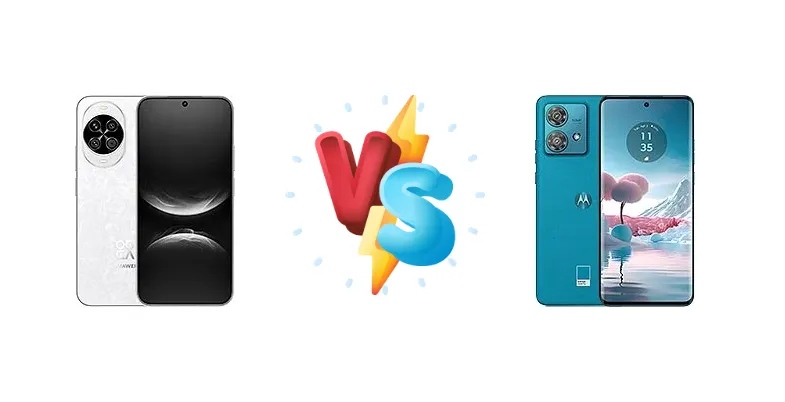
The mid-range smartphone market is fiercely competitive, and the Huawei nova 14 and Motorola Edge 40 Neo represent compelling options. The nova 14 boasts Huawei’s in-house Kirin 8000 chipset and blazing-fast 100W charging, while the Edge 40 Neo counters with a MediaTek Dimensity 7030 and a focus on all-day battery life. This comparison dissects their strengths and weaknesses to determine which device delivers the best overall experience.
🏆 Quick Verdict
For users prioritizing raw charging speed and a potentially more powerful processor, the Huawei nova 14 is the winner. However, the Motorola Edge 40 Neo offers a more balanced package with excellent battery endurance and a competitive price, making it ideal for everyday users.
| Network |
|---|
| 2G bands | GSM 850 / 900 / 1800 / 1900 | GSM 850 / 900 / 1800 / 1900 |
| 3G bands | HSDPA 800 / 850 / 900 / 1700(AWS) / 1900 / 2100 | HSDPA 800 / 850 / 900 / 1700(AWS) / 1900 / 2100 |
| 4G bands | LTE | 1, 2, 3, 4, 5, 7, 8, 12, 13, 17, 18, 19, 20, 25, 26, 28, 32, 38, 38, 39, 40, 41, 42, 43, 48, 66 |
| 5G bands | SA/NSA | 1, 2, 3, 5, 7, 8, 20, 28, 38, 40, 41, 66, 77, 78 SA/NSA |
| Speed | HSPA, LTE, 5G | HSPA, LTE, 5G |
| Technology | GSM / CDMA / HSPA / CDMA2000 / LTE / 5G | GSM / HSPA / LTE / 5G |
| Launch |
|---|
| Announced | 2025, May 19 | 2023, September 14 |
| Status | Available. Released 2025, May 19 | Available. Released 2023, September 14 |
| Body |
|---|
| Build | - | Glass front (Gorilla Glass 3), plastic frame, plastic back |
| Dimensions | 161.7 x 75.5 x 7.2 mm (6.37 x 2.97 x 0.28 in) | 159.6 x 72 x 7.9 mm (6.28 x 2.83 x 0.31 in) |
| SIM | Nano-SIM + Nano-SIM | · Nano-SIM + eSIM· Nano-SIM + Nano-SIM |
| Weight | 192 g (6.77 oz) | 170 g or 172 g (6.00 oz) |
| Display |
|---|
| Protection | Aluminosilicate glass | Corning Gorilla Glass 3 |
| Resolution | 1084 x 2412 pixels, 20:9 ratio (~395 ppi density) | 1080 x 2400 pixels, 20:9 ratio (~402 ppi density) |
| Size | 6.7 inches, 108.3 cm2 (~88.7% screen-to-body ratio) | 6.55 inches, 103.6 cm2 (~90.1% screen-to-body ratio) |
| Type | OLED, 1B colors, HDR Vivid, 120Hz, 1100 nits (HBM) | P-OLED, 1B colors, 144Hz, HDR10+, 1300 nits (peak) |
| Platform |
|---|
| CPU | Octa-core (1x2.4 GHz & 3x2.2 GHz & 4x1.84 GHz) | Octa-core (2x2.5 GHz Cortex-A78 & 6x2.0 GHz Cortex-A55) |
| Chipset | Kirin 8000 (7 nm) | MediaTek Dimensity 7030 (6 nm) |
| GPU | Mali-G610 MP4 | Mali-G610 MC3 |
| OS | HarmonyOS 5.0 | Android 13, up to 2 major Android upgrades |
| Memory |
|---|
| Card slot | No | No |
| Internal | 256GB 12GB RAM, 512GB 12GB RAM | 128GB 8GB RAM, 256GB 8GB RAM, 256GB 12GB RAM |
| Main Camera |
|---|
| Dual | - | 50 MP, f/1.8, (wide), 1/1.55", 1.0µm, multi-directional PDAF, OIS
13 MP, f/2.2, 120˚ (ultrawide), 1/3.0", 1.12µm, PDAF |
| Features | Color spectrum sensor, LED flash, panorama, HDR | LED flash, HDR, panorama |
| Triple | 50 MP, f/1.9, 23mm (wide), 1/1.56", Dual Pixel PDAF
12 MP, f/2.4, 69mm (telephoto), PDAF, OIS, 3x optical zoom
8 MP, f/2.2, 16mm, 112˚ (ultrawide), AF | - |
| Video | 4K, 1080p, gyro-EIS | 4K@30fps, 1080p@30/60/120/240fps, gyro-EIS |
| Selfie camera |
|---|
| Features | HDR, panorama | HDR |
| Single | 50 MP, f/2.4, 1/2.5" | 32 MP, f/2.4, (wide), 1/3.0", 0.7µm |
| Video | 4K, 1080p, gyro-EIS | 4K@30fps, 1080p@30fps |
| Sound |
|---|
| 35mm jack | No | No |
| Loudspeaker | Yes, with stereo speakers | Yes, with stereo speakers |
| Comms |
|---|
| Bluetooth | 5.2, A2DP, LE, L2HC (320-960 kbps HD audio) | 5.4, A2DP, LE |
| Infrared port | Yes | - |
| NFC | Yes | Yes |
| Positioning | GPS, GALILEO, GLONASS, BDS, QZSS | GPS, GLONASS, GALILEO |
| Radio | No | No |
| USB | USB Type-C 2.0, OTG | USB Type-C 2.0, OTG |
| WLAN | Wi-Fi 802.11 a/b/g/n/ac/6, dual-band, Wi-Fi Direct | Wi-Fi 802.11 a/b/g/n/ac/6e, tri-band, Wi-Fi Direct |
| Features |
|---|
| Sensors | Fingerprint (side-mounted), accelerometer, gyro, compass | Fingerprint (under display, optical), accelerometer, gyro, proximity, compass |
| Battery |
|---|
| Charging | 100W wired, SCP, UFCS, PD, PPS, QC
5W reverse wired | 68W wired, 50% in 15 min |
| Type | 5500 mAh | Li-Po 5000 mAh |
| Misc |
|---|
| Colors | Black, White, Blue | Black, Soothing Sea, Caneel Bay, Peach Fuzz |
| Models | TLR-AL00 | XT2307-1 |
| Price | About 330 EUR | $ 299.00 / € 168.73 / ₹ 19,900 |
Huawei nova 14
- Ultra-fast 100W charging
- Potentially powerful Kirin 8000 chipset
- Huawei’s software optimizations (for those within the ecosystem)
- Limited information on battery capacity
- Potential software restrictions due to Huawei’s situation
- Uncertain display quality compared to competitors
Motorola Edge 40 Neo
- Excellent battery life (10:28h active use)
- Bright and modern display (1073 nits)
- Clean Android experience
- Slower charging speed (68W)
- Dimensity 7030 may not match Kirin 8000 in peak performance
- Lacks reverse wireless charging
Display Comparison
The Motorola Edge 40 Neo takes an early lead in display quality, achieving a measured peak brightness of 1073 nits. While the nova 14’s display specs are not provided, this brightness level suggests superior outdoor visibility on the Motorola. The Edge 40 Neo’s panel likely benefits from its modern construction, potentially offering better color accuracy and viewing angles. Without knowing the nova 14’s panel type (OLED vs LCD) or refresh rate, it’s difficult to assess its overall display experience, but the Edge 40 Neo sets a high bar.
Camera Comparison
Detailed camera specs are limited, but we can infer some differences. Both phones likely feature multi-camera systems, but the focus should be on the main sensors. Without knowing the megapixel count or sensor size of the nova 14’s primary camera, it’s hard to directly compare. The Edge 40 Neo’s camera is described as capable for both photo and video, suggesting a balanced approach. The absence of details regarding OIS (Optical Image Stabilization) on either device is a concern, as it significantly impacts low-light photography and video stability. Ignoring the likely inclusion of low-resolution macro/depth sensors on both, the main sensor performance will be the deciding factor.
Performance
The chipset battle pits Huawei’s 7nm Kirin 8000 against MediaTek’s 6nm Dimensity 7030. The Dimensity 7030, with its Cortex-A78 cores clocked at 2.5 GHz, offers a strong performance profile, particularly in multi-threaded tasks. The Kirin 8000’s octa-core configuration, while featuring a higher peak clock speed (2.4 GHz), is built on an older 7nm process. This suggests the Dimensity 7030 may have an edge in power efficiency and sustained performance. The Edge 40 Neo’s likely use of LPDDR5X RAM further enhances its memory bandwidth, potentially improving application loading times and multitasking.
Battery Life
The Motorola Edge 40 Neo shines in battery endurance, boasting an active use score of 10:28h and an endurance rating of 80 hours. This indicates a well-optimized system and efficient chipset. The Huawei nova 14, while featuring incredibly fast 100W wired charging (capable of a full charge very quickly), lacks specific battery capacity information. The Edge 40 Neo’s 68W charging, while slower, still offers a respectable 50% charge in 15 minutes. The nova 14’s 5W reverse wired charging is a niche feature, while the Edge 40 Neo lacks this capability. The Edge 40 Neo’s superior battery life is a significant advantage for users who prioritize all-day usage.
Buying Guide
Buy the Huawei nova 14 if you need the absolute fastest charging available and value the potential performance gains from the Kirin 8000, even with the limitations of the Huawei ecosystem. Buy the Motorola Edge 40 Neo if you prioritize long-lasting battery life, a clean Android experience, and a more universally compatible software ecosystem.
Frequently Asked Questions
❓ Does the Kirin 8000 chipset in the Huawei nova 14 suffer from significant thermal throttling during extended gaming sessions?
While the Kirin 8000 is a capable processor, its 7nm manufacturing process may lead to more heat generation compared to the Dimensity 7030’s 6nm process. This could potentially result in thermal throttling during prolonged, demanding gaming sessions, impacting sustained performance. However, without specific thermal testing data, it’s difficult to definitively assess the extent of this issue.
❓ How does Huawei’s software ecosystem (HarmonyOS or EMUI) impact app availability and Google service compatibility on the nova 14?
Huawei’s software ecosystem has faced challenges regarding Google Mobile Services (GMS) compatibility. The nova 14 likely runs on HarmonyOS or EMUI, which may require users to rely on Huawei’s AppGallery for app downloads and potentially use workarounds for accessing Google services like Gmail and Google Maps. This can be a significant inconvenience for users heavily invested in the Google ecosystem.
❓ Is the 68W charging on the Motorola Edge 40 Neo fast enough for most users, or is the 100W charging of the nova 14 a necessity?
While 100W charging is undeniably faster, 68W charging on the Edge 40 Neo is still quite rapid, achieving 50% charge in 15 minutes. For most users, this charging speed is more than adequate for overnight or quick top-ups. The 100W charging on the nova 14 is primarily beneficial for those who absolutely require the fastest possible charging times.