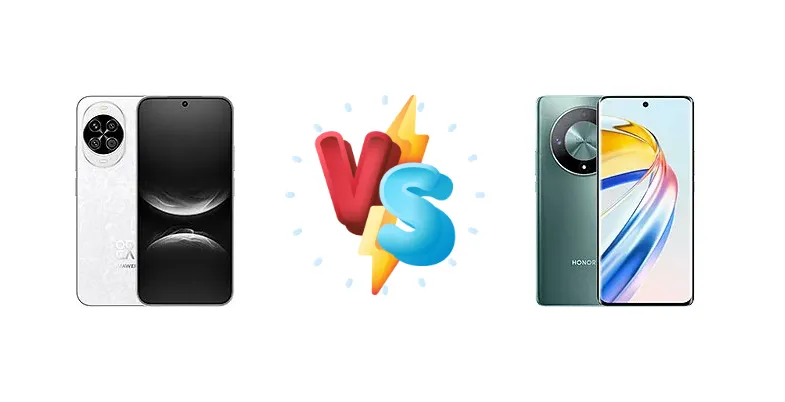
The Huawei nova 14 and Honor X9b represent compelling options in the increasingly competitive mid-range smartphone market. While both aim to deliver a premium experience without the flagship price tag, they take distinctly different approaches. The nova 14 leverages Huawei’s in-house Kirin 8000 chipset and blazing-fast 100W charging, while the X9b opts for Qualcomm’s Snapdragon 6 Gen 1 and a more conservative 35W charging solution. This comparison will dissect these key differences to determine which device best suits your needs.
🏆 Quick Verdict
For users prioritizing charging speed and potentially benefiting from Huawei’s software optimizations, the Huawei nova 14 is the stronger choice. However, the Honor X9b’s more efficient Snapdragon 6 Gen 1 chipset offers a compelling alternative for those seeking balanced performance and battery life, particularly at a potentially lower price point.
| Network |
|---|
| 2G bands | GSM 850 / 900 / 1800 / 1900 | GSM 850 / 900 / 1800 / 1900 |
| 3G bands | HSDPA 800 / 850 / 900 / 1700(AWS) / 1900 / 2100 | HSDPA 850 / 900 / 1900 / 2100 |
| 4G bands | LTE | 1, 2, 3, 4, 5, 7, 8, 20, 28, 32, 38, 40, 41 |
| 5G bands | SA/NSA | 1, 3, 7, 8, 20, 28, 38, 40, 41, 77, 78 SA/NSA |
| Speed | HSPA, LTE, 5G | HSPA, LTE, 5G |
| Technology | GSM / CDMA / HSPA / CDMA2000 / LTE / 5G | GSM / HSPA / LTE / 5G |
| Launch |
|---|
| Announced | 2025, May 19 | 2023, October 18 |
| Status | Available. Released 2025, May 19 | Available. Released 2023, October |
| Body |
|---|
| Dimensions | 161.7 x 75.5 x 7.2 mm (6.37 x 2.97 x 0.28 in) | 163.6 x 75.5 x 8 mm (6.44 x 2.97 x 0.31 in) |
| SIM | Nano-SIM + Nano-SIM | Nano-SIM + Nano-SIM |
| Weight | 192 g (6.77 oz) | 185 g (6.53 oz) |
| Display |
|---|
| Protection | Aluminosilicate glass | - |
| Resolution | 1084 x 2412 pixels, 20:9 ratio (~395 ppi density) | 1220 x 2652 pixels, 19.5:9 ratio (~431 ppi density) |
| Size | 6.7 inches, 108.3 cm2 (~88.7% screen-to-body ratio) | 6.78 inches, 112.6 cm2 (~91.2% screen-to-body ratio) |
| Type | OLED, 1B colors, HDR Vivid, 120Hz, 1100 nits (HBM) | AMOLED, 1B colors, 120Hz, 1200 nits (peak) |
| Platform |
|---|
| CPU | Octa-core (1x2.4 GHz & 3x2.2 GHz & 4x1.84 GHz) | Octa-core (4x2.2 GHz Cortex-A78 & 4x1.8 GHz Cortex-A55) |
| Chipset | Kirin 8000 (7 nm) | Qualcomm SM6450 Snapdragon 6 Gen 1 (4 nm) |
| GPU | Mali-G610 MP4 | Adreno 710 |
| OS | HarmonyOS 5.0 | Android 13, Magic OS 7.2 |
| Memory |
|---|
| Card slot | No | No |
| Internal | 256GB 12GB RAM, 512GB 12GB RAM | 256GB 8GB RAM, 256GB 12GB RAM, 512GB 8GB RAM, 512GB 12GB RAM |
| Main Camera |
|---|
| Features | Color spectrum sensor, LED flash, panorama, HDR | LED flash, panorama, HDR |
| Triple | 50 MP, f/1.9, 23mm (wide), 1/1.56", Dual Pixel PDAF
12 MP, f/2.4, 69mm (telephoto), PDAF, OIS, 3x optical zoom
8 MP, f/2.2, 16mm, 112˚ (ultrawide), AF | 108 MP, f/1.8, (wide), 1/1.67", PDAF
5 MP, f/2.2, (ultrawide)
2 MP (macro) |
| Video | 4K, 1080p, gyro-EIS | 4K@30fps, 1080p@30fps |
| Selfie camera |
|---|
| Features | HDR, panorama | - |
| Single | 50 MP, f/2.4, 1/2.5" | 16 MP, f/2.5, (wide) |
| Video | 4K, 1080p, gyro-EIS | 1080p@30fps |
| Sound |
|---|
| 35mm jack | No | No |
| Loudspeaker | Yes, with stereo speakers | Yes |
| Comms |
|---|
| Bluetooth | 5.2, A2DP, LE, L2HC (320-960 kbps HD audio) | 5.1, A2DP, LE |
| Infrared port | Yes | Yes |
| NFC | Yes | Yes (market/region dependent) |
| Positioning | GPS, GALILEO, GLONASS, BDS, QZSS | GPS, GLONASS, GALILEO, BDS |
| Radio | No | No |
| USB | USB Type-C 2.0, OTG | USB Type-C 2.0, OTG |
| WLAN | Wi-Fi 802.11 a/b/g/n/ac/6, dual-band, Wi-Fi Direct | Wi-Fi 802.11 a/b/g/n/ac, dual-band, Wi-Fi Direct |
| Features |
|---|
| Sensors | Fingerprint (side-mounted), accelerometer, gyro, compass | Fingerprint (under display, optical), accelerometer, gyro, proximity, compass |
| Battery |
|---|
| Charging | 100W wired, SCP, UFCS, PD, PPS, QC
5W reverse wired | 35W wired
Reverse wired |
| Type | 5500 mAh | Li-Po 5800 mAh |
| Misc |
|---|
| Colors | Black, White, Blue | Sunrise Orange, Midnight Black, Emerald Green |
| Models | TLR-AL00 | ALI-NX1 |
| Price | About 330 EUR | About 970 EUR |
Huawei nova 14
- Ultra-fast 100W charging
- Potentially more powerful CPU (Kirin 8000)
- Huawei’s image processing expertise
- Less power-efficient chipset (7nm)
- Potential software limitations due to geopolitical factors
- Thermal throttling potential under sustained load
Honor X9b
- More power-efficient chipset (4nm)
- Clean Android experience
- Balanced performance and battery life
- Slower 35W charging
- Potentially less powerful CPU
- Camera system may not be as advanced
Display Comparison
Detailed display specifications are missing, but considering the market segment, both likely feature OLED panels. The key differentiator will be peak brightness and refresh rate. The nova 14, historically, has focused on visually appealing displays, potentially offering higher nits. However, without concrete data, it's difficult to assess. The X9b’s display quality will likely be solid, but may not reach the same peak brightness as the nova 14. Bezels are expected to be minimal on both devices, aligning with current design trends.
Camera Comparison
Without detailed camera specs, a direct comparison is challenging. However, Huawei historically emphasizes camera capabilities. The nova 14 likely features a more sophisticated image processing pipeline and potentially a larger main sensor. The X9b will likely offer a competent camera system, but may prioritize overall value over cutting-edge camera technology. The absence of information regarding OIS is a significant omission; its presence on either device would be a major advantage for low-light photography and video recording. We can assume both will include standard wide and ultrawide lenses, but details regarding sensor size and aperture are crucial for a definitive assessment.
Performance
The core of the performance difference lies in the chipsets. The Huawei nova 14’s Kirin 8000, built on a 7nm process, boasts a more complex CPU configuration with a higher peak clock speed (2.4 GHz) than the Honor X9b’s Snapdragon 6 Gen 1 (2.2 GHz). However, the Snapdragon 6 Gen 1 is fabricated on a more advanced 4nm node, resulting in significantly improved power efficiency. This translates to better thermal management and potentially longer sustained performance under load. While the Kirin 8000 may win in burst performance, the Snapdragon 6 Gen 1 is likely to offer a smoother, more consistent experience during extended gaming sessions or multitasking. The X9b's Cortex-A78 cores also provide a performance uplift over the Kirin's CPU configuration.
Battery Life
The charging speed is the most significant difference here. The nova 14’s 100W wired charging is a game-changer, promising a full charge in under 30 minutes. The X9b’s 35W charging is considerably slower, requiring significantly more time to reach 100%. While battery capacity is unknown for both, the Snapdragon 6 Gen 1’s efficiency could offset a potentially smaller battery in the X9b, providing comparable real-world battery life. The nova 14’s faster charging is ideal for users who frequently need to top up their battery quickly, while the X9b prioritizes efficiency and potentially longer overall battery longevity.
Buying Guide
Buy the Huawei nova 14 if you need the absolute fastest charging available, frequently use your phone throughout the day, and are comfortable with Huawei’s ecosystem. Buy the Honor X9b if you prioritize a more power-efficient processor for sustained performance, value a clean Android experience, and are less reliant on ultra-fast charging.
Frequently Asked Questions
❓ Will the Kirin 8000 in the nova 14 overheat during prolonged gaming sessions?
The Kirin 8000, being built on a 7nm process, is more prone to thermal throttling than the Snapdragon 6 Gen 1’s 4nm process. While it offers higher peak performance, expect potential frame drops or reduced clock speeds during extended gaming. The X9b’s Snapdragon 6 Gen 1 is likely to maintain more consistent performance over longer periods.
❓ Does the Honor X9b support Google Mobile Services (GMS)?
Yes, the Honor X9b, being a separate entity from Huawei, fully supports Google Mobile Services. This means you’ll have access to the Google Play Store, Google apps, and a wider range of third-party applications without any restrictions. The Huawei nova 14 may have limitations regarding GMS depending on the region and software version.
❓ How long does it realistically take to fully charge the Huawei nova 14 with the 100W charger?
Huawei claims the nova 14 can charge from 0-100% in approximately 30 minutes with the 100W charger. However, real-world charging times may vary slightly depending on battery temperature and usage during charging. It's still significantly faster than the X9b's 35W charging.