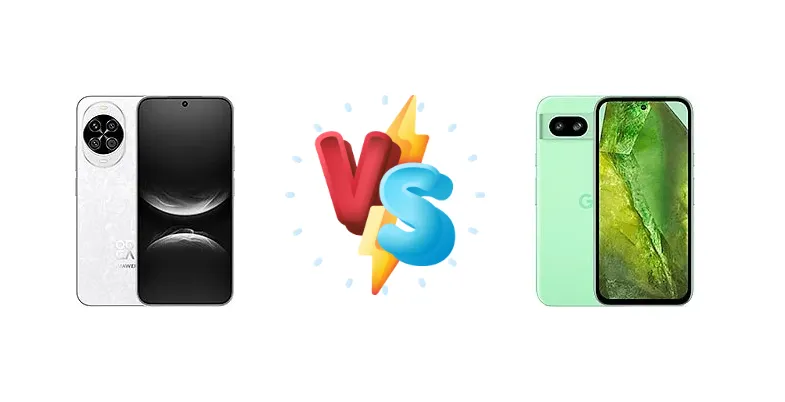
The Huawei nova 14 and Google Pixel 8a represent compelling options in the increasingly competitive mid-range smartphone market. The nova 14 aggressively targets fast charging and a stylish design, while the Pixel 8a leverages Google’s Tensor G3 chip and renowned computational photography. This comparison dissects their key differences to determine which device best suits your needs.
🏆 Quick Verdict
For the average user prioritizing camera quality and long-term software support, the Google Pixel 8a is the stronger choice. Its Tensor G3 chip, combined with Google’s image processing, delivers consistently excellent photos and a smooth user experience. However, the Huawei nova 14’s 100W charging is a significant advantage for those who value speed.
| Network |
|---|
| 2G bands | GSM 850 / 900 / 1800 / 1900 | GSM 850 / 900 / 1800 / 1900 |
| 3G bands | HSDPA 800 / 850 / 900 / 1700(AWS) / 1900 / 2100 | HSDPA 800 / 850 / 900 / 1700(AWS) / 1900 / 2100 |
| 4G bands | LTE | 1, 2, 3, 4, 5, 7, 8, 12, 17, 18, 19, 20, 26, 28, 32, 38, 40, 41, 42, 66 - G6GPR (International) |
| 5G bands | SA/NSA | 1, 2, 3, 5, 7, 8, 12, 20, 26, 28, 38, 40, 41, 66, 75, 76, 77, 78 SA/NSA/Sub6 - G6GPR (International) |
| Speed | HSPA, LTE, 5G | HSPA, LTE, 5G |
| Technology | GSM / CDMA / HSPA / CDMA2000 / LTE / 5G | GSM / HSPA / LTE / 5G |
| Launch |
|---|
| Announced | 2025, May 19 | 2024, May 07 |
| Status | Available. Released 2025, May 19 | Available. Released 2024, May 14 |
| Body |
|---|
| Build | - | Glass front (Gorilla Glass 3), aluminum frame, plastic back |
| Dimensions | 161.7 x 75.5 x 7.2 mm (6.37 x 2.97 x 0.28 in) | 152.1 x 72.7 x 8.9 mm (5.99 x 2.86 x 0.35 in) |
| SIM | Nano-SIM + Nano-SIM | Nano-SIM + eSIM |
| Weight | 192 g (6.77 oz) | 188 g (6.63 oz) |
| Display |
|---|
| Protection | Aluminosilicate glass | Corning Gorilla Glass 3, Mohs level 5 |
| Resolution | 1084 x 2412 pixels, 20:9 ratio (~395 ppi density) | 1080 x 2400 pixels, 20:9 ratio (~430 ppi density) |
| Size | 6.7 inches, 108.3 cm2 (~88.7% screen-to-body ratio) | 6.1 inches, 90.3 cm2 (~81.6% screen-to-body ratio) |
| Type | OLED, 1B colors, HDR Vivid, 120Hz, 1100 nits (HBM) | OLED, HDR, 120Hz, 2000 nits (peak) |
| Platform |
|---|
| CPU | Octa-core (1x2.4 GHz & 3x2.2 GHz & 4x1.84 GHz) | Nona-core (1x3.0 GHz Cortex-X3 & 4x2.45 GHz Cortex-A715 & 4x2.15 GHz Cortex-A510) |
| Chipset | Kirin 8000 (7 nm) | Google Tensor G3 (4 nm) |
| GPU | Mali-G610 MP4 | Immortalis-G715s MC10 |
| OS | HarmonyOS 5.0 | Android 14, upgradable to Android 16, up to 7 major Android upgrades |
| Memory |
|---|
| Card slot | No | No |
| Internal | 256GB 12GB RAM, 512GB 12GB RAM | 128GB 8GB RAM, 256GB 8GB RAM |
| Main Camera |
|---|
| Dual | - | 64 MP (16 MP eff.), f/1.9, 26mm (wide), 1/1.73", 0.8µm, dual pixel PDAF, OIS
13 MP, f/2.2, 120˚ (ultrawide), 1.12µm |
| Features | Color spectrum sensor, LED flash, panorama, HDR | Dual-LED flash, Pixel Shift, Ultra HDR, panorama, Best Take |
| Triple | 50 MP, f/1.9, 23mm (wide), 1/1.56", Dual Pixel PDAF
12 MP, f/2.4, 69mm (telephoto), PDAF, OIS, 3x optical zoom
8 MP, f/2.2, 16mm, 112˚ (ultrawide), AF | - |
| Video | 4K, 1080p, gyro-EIS | 4K@30/60fps, 1080p@30/60/120/240fps, OIS |
| Selfie camera |
|---|
| Features | HDR, panorama | HDR, panorama |
| Single | 50 MP, f/2.4, 1/2.5" | 13 MP, f/2.2, 20mm (ultrawide), 1.12µm |
| Video | 4K, 1080p, gyro-EIS | 4K@30fps, 1080p@30/60fps |
| Sound |
|---|
| 35mm jack | No | No |
| Loudspeaker | Yes, with stereo speakers | Yes, with stereo speakers |
| Comms |
|---|
| Bluetooth | 5.2, A2DP, LE, L2HC (320-960 kbps HD audio) | 5.3, A2DP, LE |
| Infrared port | Yes | - |
| NFC | Yes | Yes |
| Positioning | GPS, GALILEO, GLONASS, BDS, QZSS | GPS, GLONASS, GALILEO, BDS, QZSS, NavIC |
| Radio | No | No |
| USB | USB Type-C 2.0, OTG | USB Type-C 3.2 |
| WLAN | Wi-Fi 802.11 a/b/g/n/ac/6, dual-band, Wi-Fi Direct | Wi-Fi 802.11 a/b/g/n/ac/6e, dual/tri-band (market/region dependent) |
| Features |
|---|
| Sensors | Fingerprint (side-mounted), accelerometer, gyro, compass | Fingerprint (under display, optical), accelerometer, gyro, proximity, compass, barometer |
| Battery |
|---|
| Charging | 100W wired, SCP, UFCS, PD, PPS, QC
5W reverse wired | 18W wired, PD3.0
7.5W wireless
Bypass charging |
| Type | 5500 mAh | Li-Po 4492 mAh |
| Misc |
|---|
| Colors | Black, White, Blue | Obsidian, Porcelain, Bay, Aloe |
| Models | TLR-AL00 | GKV4X, G6GPR, G8HHN, G576D |
| Price | About 330 EUR | $ 229.98 / C$ 417.99 / £ 279.00 / € 299.99 / ₹ 33,300 |
| EU LABEL |
|---|
| Battery | - | 40:06h endurance, 1000 cycles |
| Energy | - | Class B |
| Free fall | - | Class A (270 falls) |
| Repairability | - | Class B |
Huawei nova 14
- Blazing-fast 100W wired charging
- Sleek and modern design (assumed based on Huawei’s design language)
- Potentially competitive price point
- Kirin 8000 chipset may lag behind Tensor G3 in efficiency
- Software ecosystem and update support are uncertain
- Camera performance likely relies heavily on software optimization
Google Pixel 8a
- Excellent camera quality powered by Google’s computational photography
- Guaranteed software updates and long-term support
- Efficient Tensor G3 chipset and long battery life
- Slow 18W wired charging
- No expandable storage
- May lack some of the aesthetic flair of the nova 14
Display Comparison
The Pixel 8a boasts a measured peak brightness of 1508 nits, significantly outshining any expected brightness from the nova 14 (Huawei doesn't publish this spec). This translates to superior visibility in direct sunlight. While the nova 14 likely utilizes an OLED panel, the Pixel 8a’s display benefits from Google’s color calibration expertise. The absence of LTPO technology in either phone suggests both will rely on adaptive refresh rates to conserve battery, but the Pixel 8a’s higher peak brightness is a clear advantage for outdoor use.
Camera Comparison
The Pixel 8a’s camera prowess stems from Google’s computational photography, even without detailed sensor specifications. While the nova 14’s camera specs are currently unknown, the Pixel 8a’s image processing algorithms excel in dynamic range, low-light performance, and portrait mode. The Pixel 8a’s focus on software optimization will likely yield more consistently pleasing results than relying solely on hardware specifications. The absence of a dedicated telephoto lens on either phone means digital zoom will be the primary method for long-distance shots.
Performance
The Google Pixel 8a’s Tensor G3, built on a 4nm process, offers a more efficient architecture than the Huawei nova 14’s 7nm Kirin 8000. The Tensor G3’s nona-core configuration, featuring a Cortex-X3 prime core, provides a performance edge in demanding tasks and AI-driven features. While the Kirin 8000’s octa-core setup is capable, the Tensor G3’s superior process node and core design will likely result in better sustained performance and thermal management during extended gaming sessions. The Pixel 8a’s RAM configuration (assumed LPDDR5x based on market segment) will also contribute to smoother multitasking.
Battery Life
The Pixel 8a’s endurance rating of 40:06h and active use score of 11:25h demonstrate exceptional battery life, supported by 1000 charge cycles, indicating long-term battery health. In contrast, the nova 14’s 100W wired charging is its standout feature, allowing for incredibly fast top-ups. While the Pixel 8a’s 18W charging is comparatively slow, its superior battery endurance and bypass charging (allowing charging while in use) mitigate this disadvantage. The nova 14’s 5W reverse wired charging is a niche feature, while the Pixel 8a offers 7.5W wireless charging.
Buying Guide
Buy the Huawei nova 14 if you prioritize incredibly fast charging and a sleek aesthetic, and are comfortable with the Huawei ecosystem. This phone is ideal for users who frequently top up their battery and appreciate a visually striking device. Buy the Google Pixel 8a if you value a superior camera experience, guaranteed software updates, and a clean Android interface. This is the phone for photography enthusiasts and those seeking a hassle-free, long-lasting smartphone.
Frequently Asked Questions
❓ Does the Kirin 8000 chipset in the Huawei nova 14 overheat during prolonged gaming sessions?
Given the 7nm process node and the Tensor G3’s more efficient 4nm architecture, the Kirin 8000 is more likely to experience thermal throttling during extended gaming. While the nova 14 can likely handle moderate gaming, demanding titles may lead to reduced performance over time.
❓ How does the 18W charging on the Pixel 8a compare to the 100W charging on the nova 14 in real-world usage?
The nova 14’s 100W charging can fully charge the battery in under 30 minutes, while the Pixel 8a will take considerably longer (over an hour). However, the Pixel 8a’s exceptional battery life means you may not need to charge it as frequently, mitigating the slower charging speed.
❓ What is 'bypass charging' on the Pixel 8a and how does it benefit users?
Bypass charging allows the Pixel 8a to be charged directly, bypassing the battery and powering the device simultaneously. This is useful for users who want to use the phone while it's plugged in, as it reduces heat buildup and potential battery degradation.
❓ Does the Huawei nova 14 support Google Mobile Services (GMS)?
The Huawei nova 14 does *not* natively support Google Mobile Services (GMS) due to ongoing restrictions. It relies on Huawei Mobile Services (HMS) and the AppGallery, which may require workarounds to access popular Google apps.